If you are shopping for the best espresso machine under 1000, the one that gets you a real cafe pull without locking you into one brand's capsule system is the Capri Espresso Station: a 19 bar pump, a manual steam wand, and a PID that holds a steady 197°F through the whole shot. The machine is only half the story. Dial in the grind and the milk, and a modest sub-$1000 setup will out-pour plenty of thousand-dollar countertops.
What "Under 1000" Actually Buys You in a Home Espresso Machine
Home espresso used to be an all-or-nothing purchase. The lever piston that Achille Gaggia built in the late 1940s, the mechanism that first gave us crema, lived only in machines the size of a jukebox. Getting that same pressure into a kitchen took another fifty years, and it happened because manufacturers swapped the massive boiler and rotary pump for a thermoblock and a small vibration pump. That miniaturization is the entire reason a machine under 1000 can now hold a PID-stable temperature and push a real 19 bars of pressure, features that once justified a five-figure price tag.
What the budget still will not buy you, at any price point, is a good grind for free. Spend too much of it on the machine's touchscreen and colored lights, and you have nothing left for the one part that decides most of the flavor. The split that actually works: a machine that holds pressure and temperature, and a grinder that holds a setting.
The Espresso Ratio Table
Every style below starts from the same 18 to 20 grams of ground coffee. What changes is how much water you let through, and how long you let it run.
| Style | Dose | Yield | Time | Ratio |
|---|---|---|---|---|
| Ristretto | 18 to 20g | 20ml | 20 to 25 sec | 1:1 |
| Normale | 18 to 20g | 36 to 40ml | 25 to 30 sec | 1:2 |
| Lungo | 18 to 20g | 60ml | 30 to 35 sec | 1:3 |
| Double shot | 20 to 22g | 40 to 44ml | 28 to 32 sec | 1:2 |
Why the Grinder Decides More Than the Machine Does
Shopping under 1000 puts a specific kind of machine in front of you: the all-in-one, grinder and boiler in a single shell, sold on convenience. The trouble is where that grinder sits. It is almost always mounted right next to the boiler, and as the machine climbs to brewing temperature, that heat radiates straight into the bean hopper. Warm beans lose their aromatics before they are even ground, which is a big part of why an all-in-one can taste flat by mid-morning even with fresh beans.
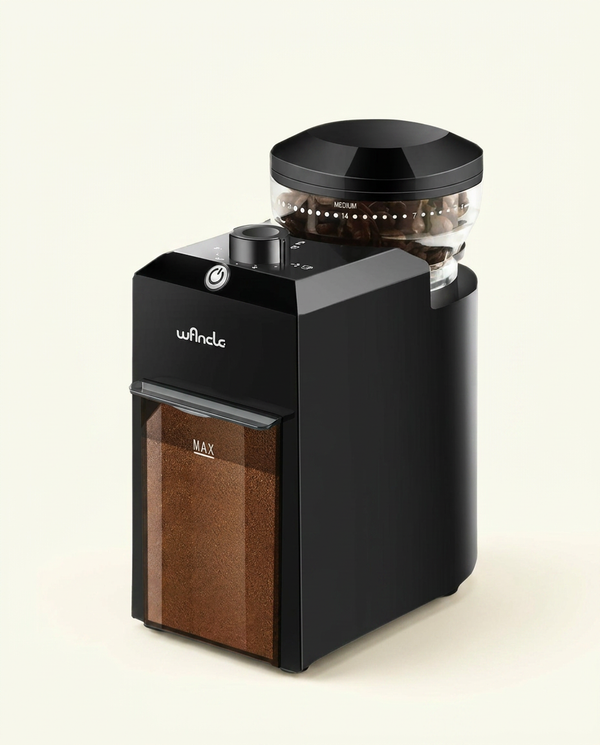
Grind consistency matters just as much as grind freshness. An uneven grind mixes fine dust with coarse chunks, and water finds the path of least resistance through that mess, a phenomenon called channeling. It over-extracts the loose parts of the puck into something bitter and under-extracts the packed parts into something sour, often in the same shot. A grinder built to hold one setting, like the Pro Burr Grinder, solves both problems at once: it sits apart from any boiler, so the beans stay cool, and its touch-screen timer keeps the grind time, and therefore the dose, repeatable from one shot to the next.
Pulling a Shot: The Four Steps That Actually Matter
Step 1, the grind. Set a burr grinder like the Pro Burr Grinder to a fine setting, close to table salt, and grind 18 grams right before you brew. Beans ground even ten minutes early start losing the volatile oils that carry most of the flavor.
Step 2, the puck. Level the grounds in the portafilter with a distribution tool or a finger before you tamp. An uneven bed sends water sideways instead of straight down. Tamp firm and level, and skip the extra spin. Polishing the puck does nothing but disturb what you just leveled.
Step 3, the extraction. Lock the portafilter in and start the pump right away. Watch for a mouse tail, two thin streams that meet into one, running from dark brown through a reddish hazelnut to pale blonde. A machine with a real 19 bar pump and a PID, the Capri Espresso Station among them, holds that curve steady instead of dropping pressure mid-shot the way cheaper thermoblocks do. Stop around 36ml out for 18 grams in and you are in normale territory.
Step 4, the milk. A manual steam wand, like the one on the Capri, takes a few pitchers to learn, but it is also the only way to build real microfoam, the wet-paint texture latte art needs. Submerge the tip just under the surface to stretch the milk, then bury it deeper to spin a vortex until the pitcher reads warm to the hand. If you would rather skip the learning curve entirely, the Le Maestro Milk Frother does the stretching and the timing for you at the touch of one button. Our complete milk frother guide walks through both approaches in more depth.
When the Shot Goes Wrong
| Problem | Cause | Fix |
|---|---|---|
| Sour taste | Under-extraction, water moved too fast | Grind finer to add resistance and time |
| Bitter or burnt | Over-extraction, water moved too slow | Grind coarser, or lower the brew temperature |
| Flow too fast | Stale beans or a grind that is too coarse | Use beans roasted within 30 days, tighten the grind |
| No crema | Old beans or a weak pump | Buy fresher beans, confirm the pump is reaching full pressure |
Keeping a Sub-$1000 Machine Running Like a Cafe One
A machine at this price is still a sensitive instrument, and scale is its biggest enemy. After every session, run a blank shot through the empty portafilter and purge the steam wand for a few seconds, wiping the tip immediately since dried milk sets like cement. Once a week, pull the basket, drop in a blind filter with a pinch of espresso machine cleaner, and run the brew cycle a few times to backflush the group head. Once a month, run a descaling solution or a one to one mix of water and white vinegar through the machine, more often if your tap water is hard.
The grinder needs its own routine. Coffee oils go rancid, and a weekly brush-out of the burr chamber keeps the grind uniform and stops that stale edge from creeping into fresh beans. A machine and a grinder you maintain separately also means one part failing never takes the whole setup down with it.
What We Put on the Counter for Under 1000
Capri Espresso Station
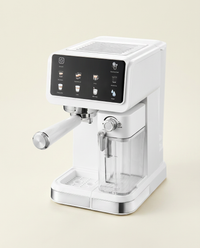
The machine this whole guide is built around, and the closest a sub-1000 budget gets you to the espresso machines that used to cost a lot more. Discover the Capri Espresso Station and its full spec sheet here.
- Real 19 bar pump: the pressure that separates espresso from strong coffee, with automatic and manual extraction modes.
- PID temperature control: a constant 197°F through the shot, not a swing that starts hot and drifts cold.
- Professional steam wand: a 360° swivel wand with its own dial, the tool that actually builds microfoam and latte art.
- 37 oz removable tank: fewer trips to the sink on a morning that already runs on a schedule.
- Ground coffee, ESE pods or capsules: the flexibility to brew fresh grounds today and a pod on a rushed morning.
Pro Burr Grinder
The other half of the setup. A touch-screen conical burr grinder with 25 fixed-point settings from espresso-fine to French press coarse, timed grinding set in seconds, and a see-through catch bin that lifts out under the spout. See the Pro Burr Grinder for the full details.
Le Maestro Milk Frother
Not a replacement for the steam wand so much as a shortcut for the mornings you do not want to practice. Four functions in one stainless steel body: hot foam, cold foam, steamed milk with no foam, and hot chocolate, chosen with a single touch.
Breville Barista Express (around $700)
A genuinely popular all-in-one, with a built-in conical burr grinder and a 15 bar pump, and a fair choice if you want one box and one plug. The trade-off is structural: grinder and machine share one body, so the day you want a better grinder, or the grinder needs service, the whole machine is involved. A separate grinder and machine cost more counter space and give you two parts you can upgrade one at a time.
DeLonghi La Specialista (around $900)
Another built-in grinder machine, priced close to the top of the sub-1000 range. It pulls a competent shot out of the box, but you inherit the same fixed grinder. The grinder and the boiler share one body, so you cannot change the grind side of the setup without changing the machine.
Where a Sub-1000 Budget Quietly Goes
- An all-in-one grinder bolted to the boiler: convenient on day one, warming your beans in the hopper every time the machine heats up.
- A machine with no PID at all: you are buying a pressure gauge and hoping the temperature behaves.
- Pre-ground "espresso roast" bags: stale before you open the bag, no matter how good the machine underneath them is.
- An auto-frother instead of a wand: hot milk, yes, but never the wet-paint texture that holds a latte art pattern.
A Mouse Tail Runs Blonde, and the Heart Holds Its Shape
Ten in the morning, no plans until noon, and a new bag open on the counter for the third day running. You dial the grinder half a step finer than yesterday, tamp level, and lock the portafilter in without checking the clock. The pump comes on with that low, even hum, and the mouse tail runs dark to blonde in under thirty seconds, no guessing this time. While the shot rests, the wand hisses into the pitcher, milk spinning into a tight, glossy vortex instead of the loud bubbles from your first attempts. You pour slow from height, then drop the pitcher close and pull the tip through the crema, and for once the heart holds its shape all the way to the rim. Nobody is watching. You take the photo anyway.
If you take one thing from this article: under 1000, the machine that respects both your pressure and your temperature will always beat the one that only respects your counter space.
Frequently Asked Questions About Buying an Espresso Machine Under 1000
Is an espresso machine under 1000 worth it?
Yes, as long as you look past the price tag on the box. A machine in this range can hold real pressure and a stable temperature, both features that used to require a much bigger budget. Pair it with a good grinder and the gap between your kitchen and a cafe closes fast.
Do I need a dual boiler for home espresso?
Not necessarily. A dual boiler lets you steam milk and pull a shot at the same time, which matters if you are serving a line of people. For one or two cups at home, a single thermoblock with a PID, like the one in the Capri Espresso Station, keeps temperature just as steady, you simply brew and steam one after the other.
Why is my espresso shot sour?
Sourness almost always means under-extraction: the water moved through the puck too quickly and grabbed the acids without the sugars behind them. Grind a step finer, or check that your machine is actually reaching its target temperature before you pull the shot.
Can I use pods or capsules in a machine like this?
On a machine built for both, yes. The Capri Espresso Station accepts ground coffee, ESE pods, and standard NS and DG style capsules, so a rushed weekday does not force you to skip espresso entirely.
How much caffeine is in a double shot of espresso?
A standard double shot lands around 60 to 100mg of caffeine, depending mostly on the bean. Robusta runs noticeably higher in caffeine than arabica, so a blend with robusta in it will hit harder than a single-origin arabica at the same dose.
Can I use regular coffee beans for espresso?
Yes. "Espresso roast" on a bag is a marketing label, not a different bean. Any fresh bean can be pulled as espresso, though a medium to dark roast tends to be more forgiving while you are still dialing in your grind and dose.
Related Guides
- The Ultimate Aeropress Espresso Ratio Guide
- 6 Cup Moka Pot: The Ultimate Guide to Stovetop Espresso
- 4 Cup Moka Pot: The Ultimate Guide to Stovetop Espresso
- Breville or DeLonghi: Which Espresso Machine Reigns Supreme?
- Best Beginner Espresso Setup: Master the Art of Home Brewing
- Best Coffee Grinder for French Press