A 4 cup moka pot brews about 180 ml of strong stovetop coffee, roughly 6 fl oz: four Italian demitasses, or one full mug once you add hot water or milk. Its basket holds only 18 to 20 g, so the grind decides the cup more than the pot does. We grind for it with The Precision Manual Grinder, a hand burr grinder in brushed stainless steel. Even grounds, low heat, and this small pot stops tasting burnt.
How Much Coffee Does a 4 Cup Moka Pot Make?
Less than the name suggests. In the United States, a cup means an 8 to 12 oz mug. On an Italian stove it means a demitasse of about 45 ml, under 2 fl oz. Four of those are the whole output: about 180 ml of dense coffee. Enough for one Americano-style mug, two doubles, or one large latte.
Is a 4 Cup Moka Pot the Right Size for You?
A moka pot cannot be half filled, so choose the size by how you drink every day.
- 3 cup: 130 to 150 ml, one short mug. We cover it in our guide to the Moka Express 3 cup.
- 4 cup: about 180 ml. One generous mug, or two short cups. Smaller still is the 1 cup moka.
- 6 cup: around 300 ml in the boiler, two milky mugs. Our 6 cup moka pot guide has the detail.
Every size up to twelve: moka pot sizes.
Where Did the 4 Cup Moka Pot Come From?
From Italy, in 1933. Alfonso Bialetti is said to have borrowed the idea from a laundry boiler that pushed hot soapy water up a central pipe. He put coffee in its path, and the eight-sided Moka Express has barely changed since.
The 4 cup is a less common size. Bialetti makes it, in aluminum and in stainless, but many makers jump from 3 cups to 6. We are one of them: our own Bottega Wood-Handle Moka is sold in 150 ml (about 3 cups) and 300 ml (about 6 cups), the sizes on either side. So this guide is for the 4 cup pot you already own, or will buy elsewhere. What we can improve is everything around it.
Why Does Moka Pot Coffee Taste Burnt?
Charcoal, burnt rubber, a metallic edge. Most owners blame the pot. The real causes are pressure, temperature and grind, and a small pot magnifies all three. The long version lives in our complete moka pot guide.
How Much Pressure Does a Moka Pot Use?
About 1 to 2 bars. A pump espresso machine works at 9. Heat builds pressure in the closed base until it lifts the water up the funnel and through the coffee. Enough for a strong concentrate, not for real crema. The name stovetop espresso is affectionate, not technical.
What Water Temperature Is Best for a Moka Pot?
Coffee extracts best between 195°F and 205°F. Nothing regulates a moka pot: the water reaching the coffee starts warm and ends close to boiling, with steam on its heels. A 4 cup pot holds so little that a strong burner empties it in under a minute, all at that hot end. Two fixes: start with water that has already boiled, so dry grounds do not bake while a cold base warms up, and use your smallest burner, turned low.
How Does Grind Size Affect Moka Pot Pressure?
The coffee bed is the only thing in the way of the water. Grind too fine, as supermarket espresso is, and the bed chokes: pressure climbs, the water overheats, and the cup tastes scorched. Grind unevenly, as a blade grinder does, and the dust turns bitter while the big pieces stay sour. In 18 g of coffee there is no margin to average that out.
You want an even medium-fine, between drip and espresso. That takes a burr. The conical burr in The Precision Manual Grinder crushes beans to an even size, and the dial at its base moves from fine to coarse. For the target texture, see our moka pot grind size guide.
How to Brew the Perfect Moka Pot Coffee in a 4 Cup Pot
Most leaflets say cold water and medium heat: the recipe for the taste above. This method takes the same five minutes.
Preparing Your Water and Grounds
- Boil fresh water in a kettle. Of all eleven steps, this one removes the most bitterness.
- Grind 18 to 20 g of beans, medium-fine. Just before you brew. Between two fingers, the grounds should feel like table salt, not flour.
- Pour the hot water into the base and stop under the safety valve. The valve releases pressure if the funnel clogs, and it cannot do that under water.
Assembling the Moka Pot Correctly
- Fill the basket level. Tap the side to settle the grounds.
- Do not tamp. A packed basket makes the pot build more heat and pressure than it should.
- Clean the rim, then screw the top on tight. Stray grounds break the seal. The base is hot by now: use an oven mitt.
What Happens During Extraction
- Smallest burner, low heat. On gas, keep the flame under the base. A flame that wraps the sides is what melts handles.
- Leave the lid up and watch. After a minute or two the coffee appears, slow and glossy, like syrup off a spoon. A spurting column means too much heat.
- Stop at the first gurgle. Once the flow goes blond and starts to spit, steam has reached the coffee. Pull the pot off the burner.
- Cool the base. A few seconds under cold running water stop the flow.
- Stir, then pour. The bottom of the top chamber is stronger than the surface. One stir evens it out.
How to Fix Common Moka Pot Problems
What to Buy for a 4 Cup Moka Pot, Grinder First
There is no 4 cup moka pot in our range. If yours is sound, keep it. A new pot brews the same coffee as the old one. A better grind does not.
The Precision Manual Grinder, our first pick for a 4 cup basket
Before anything else, we would put The Precision Manual Grinder next to a 4 cup moka pot.
- A conical burr, not a blade: it crushes beans to an even size instead of chopping them.
- One dial, at the base: fine to coarse, set by feel. For moka, start near the fine end and back off until the grounds feel like table salt.
- Small, like the dose: 5.2 in tall and 1.9 in wide, with a window where you watch the basketful collect. Eighteen grams is a short job, roughly a minute at the crank.
- Brushed 304 stainless steel: a body that does not rust and does not keep the smell of last week's beans.
- Nothing to plug in: no cord, no batteries, no motor, no whine. It works wherever the stove does, and the handle folds flat and lifts off for the drawer.
It comes in Brushed Silver or Brushed Black. If your pot has been tasting harsh, start here: take a closer look at the Precision Manual Grinder.
Bottega Wood-Handle Moka, if you are still choosing a pot
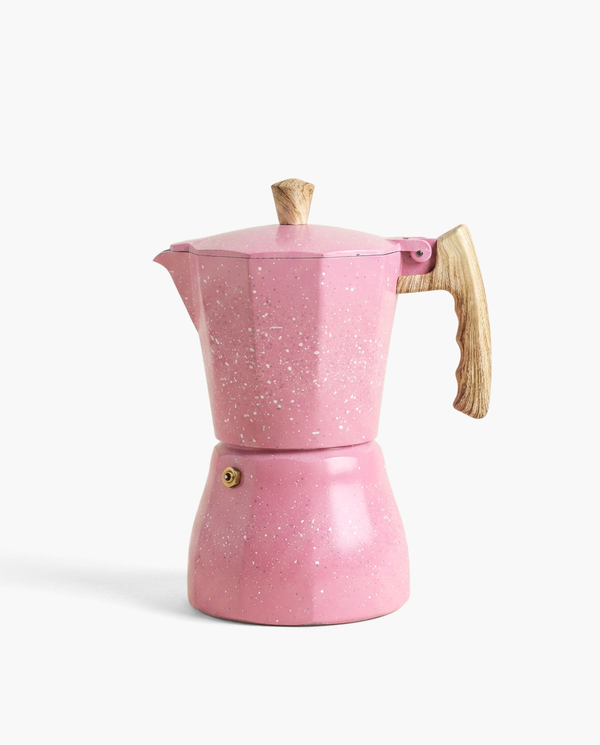
Flexible on size? Our Bottega Wood-Handle Moka is the classic eight-sided shape in painted aluminum, in five finishes, with a cool-touch handle and lid knob in a wood-grain finish. Two sizes, 150 ml (about 3 cups) and 300 ml (about 6 cups), about five minutes on gas, electric or ceramic, and no induction. If you need exactly four cups, this is not your pot. Better to read that here than on the product page.
The Barista Milk Frother, for the flat white
Moka coffee stands up to milk but brings no foam of its own. The Barista Milk Frother is a cordless handheld wand with a 304 stainless steel whisk and a three-speed motor. Warm the milk, give it about twenty seconds, and pour. The whisk head pulls off to rinse, and it recharges over USB-C.
Bialetti Moka Express 4 cup, the pot most people mean (about $40)
The original, and probably the pot you pictured: eight-sided aluminum, a black handle, spare gaskets in almost any kitchen shop. It brews good moka coffee. For induction, Bialetti sells the stainless Venus 4 cup (about $50), which we set against it in Venus vs Moka Express. The pot sets the size of the cup. The grinder sets the taste.
Everything else we make: the full collection.
What a 4 Cup Basket Will Not Forgive
Three shortcuts, each one louder in a small pot:
- Supermarket espresso grind: cut for 9 bars, not for 2. It chokes the bed, the water overheats, and the pot comes out scorched.
- A blade grinder: dust and gravel in the same 18 g. Half the basket turns bitter while the other half stays sour.
- A bargain pot with no name on it: thin metal, a handle set low over the burner, and no spare gasket once the first one hardens.
How Does a 4 Cup Moka Pot Compare to Other Brewers?
Still deciding? Here it is next to the two brewers it most often replaces.
The moka pot wins on intensity without a pump on the counter. More in French press vs moka pot and moka pot vs espresso.
How to Care for Your Moka Pot
A sound aluminum pot lasts for decades on three habits. The full routine: cleaning a moka pot, step by step.
Should You Wash a Moka Pot With Soap?
The old Italian rule says never. It is half right. Harsh detergent and the dishwasher strip the oxide layer that protects bare aluminum: the pot turns dull gray and tastes of metal. But old oils go rancid, so rinse every part in hot water after each use and rub off the residue. Every few months, a short soak in diluted white vinegar lifts the scale.
When Should You Replace the Gasket?
The rubber seal between the two halves is the weak point. Heat hardens it, then cracks it, and steam leaks from the join. Expect a new one about once a year, for a few dollars. Our gasket replacement guide shows the swap.
How to Dry Your Moka Pot Properly
Take it apart, every time. A pot screwed together wet traps moisture against the aluminum, and white powdery spots appear in the boiler. Let the parts air dry first.
The power went out at six, and the coffee did not notice
A January storm, and at six the whole street goes dark. The gas burner still lights with a match, so you heat water in a saucepan and grind by a flashlight propped against the sugar jar: the crank turning smooth and steady under your palm, the grounds gathering behind the little window. The grinder has no cord and no batteries, and nothing in this coffee needs the grid. The pot goes on the smallest burner, the first coffee rises with a low murmur, and the room smells of warm bread and dark chocolate while the wind works at the windows. You stop it at the first gurgle and pour one full mug. When the lights come back an hour later, you are almost sorry.
If you take one thing from this article: a 4 cup moka pot holds 18 to 20 g of coffee and forgives nothing in the grind, so before you change the pot, change what goes into it, with The Precision Manual Grinder.
Frequently Asked Questions
Does a 4 cup moka pot work on induction stoves?
Not the classic ones. Most moka pots are aluminum, which an induction cooktop cannot heat. Look for a stainless steel pot with a magnetic bottom, or put an adapter plate under the aluminum one: if a magnet sticks to the base, it will work. Both routes are in our moka pot on induction guide.
Can I use regular pre-ground coffee in a 4 cup moka pot?
You can, but it rarely tastes right. Espresso grind is too fine and chokes the basket, drip grind is too coarse and brews thin. Better to grind fresh with a burr grinder. For a basket this size, ours is The Precision Manual Grinder, a hand grinder with a conical burr, set to an even medium-fine.
How much caffeine is in a 4 cup moka pot?
Roughly 160 to 220 mg for the whole pot when you brew 18 to 20 g of arabica, so 40 to 55 mg per demitasse. That is close to a strong 12 oz mug of drip coffee. It feels stronger because it arrives in 6 oz.
Can you half fill a 4 cup moka pot?
It will brew, but badly. With half the water, the boiler runs dry sooner and hotter, and a basket that is not full leaves gaps the water takes instead of the coffee. If a full pot is too much, buy a 3 cup.
Is an aluminum moka pot safe to drink from?
Used as intended, yes. Aluminum forms a thin oxide layer on contact with air, and that layer keeps the metal and the coffee apart. Do not scour it off with steel wool, and never put the pot in a dishwasher.