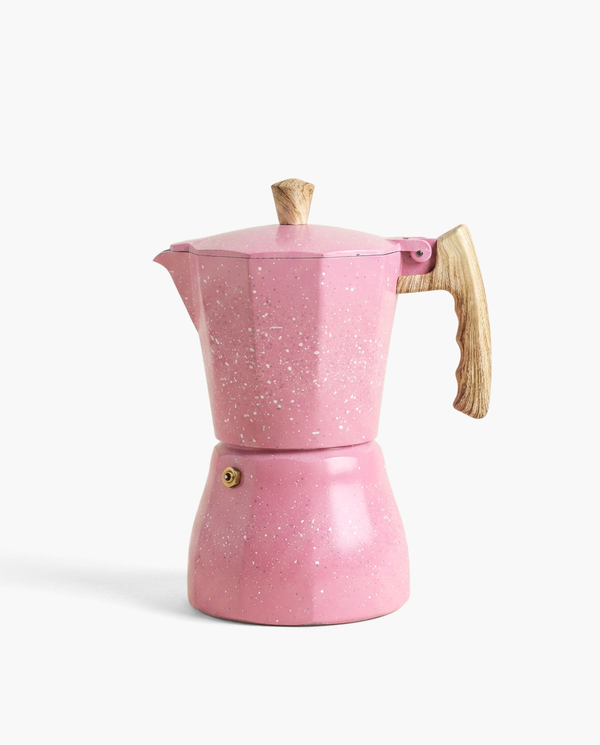
A 6 cup moka pot is a brewer for two: about 300 ml of water goes in, six demitasse shots or two milky mugs come out, after a few minutes on the stove. Ours in that size is the Capri Speckled Moka, an eight-sided aluminum pot under a speckled pink enamel. The six counts Italian demitasses of 50 ml, and the bitterness people blame on the pot is almost always heat.
Why Is It Called a 6 Cup Moka Pot?
Because a moka "cup" is an Italian demitasse of about 50 ml (1.7 fl oz), not an American mug. Six of them add up to roughly 300 ml, or 10 fl oz. Pour a whole pot into a standard mug and it stops short of the rim.
The sizing dates from 1933, when Alfonso Bialetti moved café coffee onto the home stove with the aluminum Moka Express. Six cups is the size you buy when coffee is poured for whoever is at the table. One full pot gives you:
- Six short servings, drunk straight, the traditional way.
- Two Americanos, each topped up with hot water.
- Two lattes or cappuccinos, once you add steamed or frothed milk.
Brewing for one most days? Our 4 cup moka pot guide covers the smaller size. For the exact dose by roast, see how much coffee a 6 cup moka pot needs, and browse every size among our moka pots.
Why Does Moka Pot Coffee Taste Bitter?
Burnt, harsh, faintly metallic: the pot is rarely to blame. Three things decide the cup: pressure, heat and grind.
How Much Pressure Does a Moka Pot Use?
Roughly 1 to 2 bars, against 9 bars for a pump espresso machine. As the sealed boiler heats, trapped air and vapor expand and push the water up the funnel, through the grounds and out of the chimney. So "stovetop espresso" is a nickname: dense and concentrated, but without true crema.
An espresso machine holds its water near 93°C (200°F). A moka pot has no thermostat: the water reaching the coffee gets hotter as the brew goes on, and the last of it arrives near boiling with steam right behind. Start from cold water and the dry grounds also sit in a metal basket over the burner for minutes. They bake before they brew.
What Causes the Moka Pot 'Volcano' Effect?
Too much heat. The water surges through the path of least resistance, a fault baristas call channeling, and coffee shoots out of the chimney instead of rising. Part of the bed tastes sour, the rest bitter. A healthy brew climbs slowly, like warm honey.
Why Does Grind Consistency Matter for Moka Pots?
Water moves through pebbles and through sand at different speeds. If your grounds contain both, it races past the large pieces and stalls in the dust. A blade grinder produces exactly that mix. A burr grinder does not. We grind for moka with The Precision Manual Grinder: a conical burr, and a base dial that runs from fine to coarse. Moka sits between espresso and pour-over. For electric options, see our guide to choosing a burr grinder.
How to Brew Stovetop Espresso With a 6-Cup Moka Pot
Every step has one purpose: keep excess heat away from the grounds. Step one needs a kettle. If you are choosing one, see our gooseneck kettle picks.
What You Need
Your 6 cup moka pot (ours is the speckled Capri), fresh whole beans (medium to medium-dark roast), a burr grinder, a kettle, and a cold damp towel.
Phase 1: Heat the Water First
- Boil the water in a kettle. Fill the bottom chamber to just below the safety valve. Starting cold is the biggest mistake: the grounds cook while the water catches up.
- Grind about 30 g of coffee. Aim for table salt: a little coarser than espresso, finer than drip.
- Fill the basket and do not tamp. Tap the funnel to level the bed. A pressed bed resists more than 1 to 2 bars can push. Wipe the rim so the gasket seals.
Phase 2: Assemble and Heat the Pot
- Screw the halves together firmly. The base is hot now, so hold it with a towel.
- Use gentle heat. On gas, medium-low, the flame staying under the base. On electric or ceramic, low to medium.
- Leave the lid open and watch. Within two or three minutes a dark, thick stream oozes out of the chimney.
- Lift it off at the first pale sputter. Once the honey-dark flow fades to straw yellow and begins to spit, only the bitter tail is left. Off the heat at once, then wrap the damp towel around the base, or hold it under the cold tap for five seconds, to stop the flow.
Phase 3: Stir and Serve
- Stir the upper chamber. The first coffee out is the strongest, the last the weakest. A stir evens out the six servings.
- Serve it your way. Straight in small cups, lengthened with hot water, or under frothed milk.
Warning: never let the finished coffee boil in the upper chamber.
6 Cup Moka Pot Troubleshooting
For every size, from one cup to twelve, read our complete moka pot guide.

Which 6 Cup Moka Pot to Buy: Our Shortlist
Every pot below brews the same style of coffee by the same mechanism. What separates them is the object you live with: the finish, the handle, how it washes.
Capri Speckled Moka, our first pick in the six cup size
The Capri Speckled Moka is the six cup we reach for first.
- The size this guide is about: six cups, about 10 oz, enough for two.
- Enamel over aluminum: an aluminum body under a speckled enamel finish, pink with white flecks.
- A handle made for heat: handle and knob are a wood-look, heat-resistant composite.
- The classic mechanics, untouched: eight-sided shape, single-tube extraction, built-in pressure-release valve.
- Tested to a standard: SGS, TUV and LFGB certifications, stated, not implied.
- It washes like a normal object: warm water, a soft sponge, mild dish soap. No abrasive scrubbers on the speckle.
Its limits are those of aluminum: gas, electric and ceramic stoves, not induction, and hand wash only. If that matches your kitchen, see the Capri in its speckled pink finish.
Bottega Wood-Handle Moka, the same six cups in five finishes
If pink is not your kitchen, the Bottega Wood-Handle Moka is the quieter sibling: eight-sided painted aluminum, a wood-grain cool-touch handle with matching lid knob, five finishes from white to Black Premium. It comes in 150 ml (about 3 cups) and 300 ml (about 6 cups), and brews in about five minutes. Not induction either.
The Precision Manual Grinder, if you already own a pot
A new pot will not fix uneven grounds. If yours is sound, spend on the Precision Manual Grinder instead: a brushed 304 stainless steel hand grinder with a conical burr, a base dial from fine to coarse, a viewing window and a crank that folds flat. No motor, no whine.
Bialetti Moka Express 6 cup, the 1933 benchmark (about $40)
Bialetti's original design, still in production and still good: eight-sided aluminum, a patented safety valve, spare parts stocked almost anywhere. It brews the same coffee. The trade-offs are daily ones: a bare aluminum finish, water-only washing as Bialetti asks, and a plain black plastic handle. We compare the two famous Bialettis in Venus vs Moka Express.
Bialetti Venus 6 cup, for induction hobs (about $60)
Stainless steel with a magnetic base, the fair choice on induction. Heavier, slower to build pressure, brighter in the cup than aluminum. On gas or a radiant ring, that base is just extra steel to heat. See our guide to the moka pot on an induction stove.
6 Cup Moka Pots That Disappoint, and Why
We would talk a friend out of each of these:
- The no-name bargain pot: no stated valve, no listed certification, a handle bolted a finger above the burner. The handle is usually the first thing to go.
- The wrong size "to be safe": a 9 or 12 cup pot cannot brew a good half batch, and a 3 cup leaves two people negotiating.
- Aluminum on an induction cooktop: it will sit there cold. Buy magnetic stainless, or accept an adapter plate and a slower brew.
- A blade grinder beside a good pot: dust and pebbles in one basket undo everything the pot does right.
Moka Pot vs. French Press vs. Espresso Machine
Still deciding whether a 6 cup moka pot is your brewer at all? Here it is beside its two usual rivals.
If the middle column sounds more like your mornings, our checklist for buying a French press is the place to begin.
How Do You Clean and Maintain a Moka Pot?
A 6 cup moka pot can serve for decades, if three habits hold.
Can You Put a Moka Pot in the Dishwasher?
Not an aluminum one. Detergent oxidizes the metal, turns it a dull pitted gray and can leave a metallic taste. Wash by hand, every time.
Should You Use Soap to Clean a Moka Pot?
Tradition says never. We half agree, because old coffee oils turn rancid. Follow the care sheet of your pot: on painted aluminum such as the Bottega, warm water and a soft cloth, no soap. On an enameled finish like the Capri, mild dish soap is fine. Either way, dry every piece: trapped moisture corrodes aluminum.
When Should You Replace the Moka Pot Gasket?
Check the rubber ring under the filter plate every three months, and expect to change it about once a year. Once it feels hard or cracked, steam escapes at the waist.
The first morning in a rented house, and the one thing in the kitchen that is yours
Just after eight, a gas ring that needs three clicks to catch, and a drawer full of someone else's mismatched spoons. The pink pot came out of the suitcase wrapped in a sweater, and on the small burner it looks like the only object here that knows you. Kettle water in, lid up, and you wait with the window open on salt air and gulls. Then a dark thread climbs the chimney, the smell of toasted hazelnut pushes the sea out of the room, and at the first pale sputter you lift it off. Two unfamiliar cups, one stir, and you carry them out to the step where someone is already sitting in the sun. Six small cups between two people last about as long as a first morning should.
If you take one thing from this article: a 6 cup moka pot is a pot for two, its bitterness comes from heat and never from the size, and the Capri Speckled Moka is the six cup we would choose.
Frequently Asked Questions
How much caffeine is in a 6 cup moka pot?
A full pot brewed with about 30 g of arabica holds roughly 250 to 350 mg of caffeine, so 40 to 60 mg per demitasse, in the range of a single espresso shot. Robusta blends carry close to twice as much.
How long does a 6 cup moka pot take to brew?
From cold water, 6 to 8 minutes on medium-low heat. With water boiled in a kettle first, the coffee rises after two or three minutes and the brew is done within five. Much faster than that means the heat is too high.
How much coffee does a 6 cup moka pot make?
About 240 ml, a little over 8 fl oz, from 300 ml of water, because the grounds hold some back: six Italian servings, or two cups once you add water or milk. It is the size of the Capri Speckled Moka: six cups, about 10 oz.
Can I make less than a full pot in a 6 cup moka pot?
You can, but the cup suffers. The pot is built around a full boiler and a full basket: less water means a shorter, hotter brew, and a half-filled basket lets water slip around the coffee. If you often want less, buy a smaller pot.
Can I use a 6 cup moka pot on an induction stove?
Not a classic aluminum one: aluminum is not magnetic, so induction has nothing to act on. You need a stainless pot with a magnetic base, or an adapter plate. Glass ceramic cooktops are a different case, covered in our guide to using a moka pot on a glass top stove.