The Baratza Encore built its name as the first electric burr grinder most home cooks could actually afford, and for a decade it was the default answer to every grinder question. Ten years on, the touch screen and timed dosing on the Pro Burr Grinder answer a different set of complaints: the motor heat, the static on the counter, the guessing at a setting from a chart taped to the cupboard. Here is what made the classic entry grinder work, where the design shows its age, and what we put on the counter instead.
What Made the Encore Coffee Grinder the Default Starter
Why a Blade Grinder Never Really Worked
Before the Encore, most home brewers reached for a spinning blade, a tool that chops rather than crushes. A blade cuts wherever it happens to catch a bean, so one pass leaves you with a mix of fine dust and half-cracked chunks in the same scoop. The dust over-extracts and turns bitter, the chunks under-extract and taste sour, and the two flavors sit in the same cup arguing with each other.
A burr fixes that by crushing beans between two surfaces set a fixed distance apart, so the particle size stays close to uniform no matter how long you run the motor. That single change is why an entry-level burr grinder will usually out-brew a blade grinder twice its price.
How Conical Burrs Changed the Math
Inside a conical burr grinder, a stationary outer ring surrounds a spinning inner cone. Turning the collar moves the cone closer to or further from the ring: closer for a fine espresso powder, further for the coarse grounds a French press needs. The Encore made this mechanism affordable for the first time, and it stayed the entry point for burr grinding for a full decade, as our complete grinder guide covers in more detail. For the full range of methods and settings, see our coffee grinders collection.
Where the Encore Coffee Grinder's Design Starts to Show Its Age
Motor Heat and the Beans It Bakes
A high-speed motor generates friction, and friction generates heat at the exact spot where your beans are being crushed. A few seconds rarely matters, but a slower motor still runs cooler through a full dose, which is one reason grinders built for daily use lean toward lower speeds rather than raw power. Beans that stay cool through the grind hold onto more of the aromatic oils that make the first minute after grinding smell so different from the bag itself.
Static, and Why It Still Happens
Grinding builds up an electrical charge as beans shatter inside the chute, and that charge pulls fine chaff onto the bin, the counter and your hands. It gets worse in dry winter months, when there is less moisture in the air to carry the charge away. The quick fix baristas use is the Ross Droplet Technique: mist your whole beans with a single drop of water before they go into the hopper, and the moisture neutralizes the charge enough that grounds fall straight down instead of clinging to the walls. A grinder with a see-through, removable catch bin at least lets you see the mess forming before it spreads.
Dialing In an Encore-Style Burr Grinder
Whatever grinder sits on your counter, dialing in follows the same four steps. Weigh your dose on a kitchen scale rather than trusting a scoop, since a light roast and a dark roast of the same volume can differ by several grams.
- Start in the middle of the range: begin your first brew at the setting your method usually calls for, not the coarsest or finest number on the dial.
- Taste for sourness: a sharp, thin cup usually means the grind ran too coarse for that brew time, move a couple of clicks finer.
- Taste for bitterness: a harsh, dry finish usually means too much extraction, move a couple of clicks coarser instead.
- Write the number down: once the cup tastes balanced, record the setting for that specific bag, roast level changes the right number more than most people expect.
Keeping an Encore Coffee Grinder, or Any Burr Grinder, Worth Keeping
Coffee oil goes rancid inside a burr chamber whether the grinder cost fifty dollars or three hundred, and old dust hiding in the corners will flatten the taste of even a great bag. On the Pro Burr Grinder, that means lifting the bean hopper and upper burr once a week and sweeping the chamber with the brush that stores on the back of the bean bin cover, a habit that is easy to keep because the tool is never more than an arm's reach away.
Never run water through an electric grinder. Even a trace of moisture will rust steel burrs and dull the edge for good. Every few weeks, run a handful of food-safe grinder cleaning tablets through the machine on a medium setting, then purge with a small batch of cheap beans to clear any tablet dust before your next real dose. Skip the trick of grinding raw rice instead, supermarket rice is harder than roasted coffee and can chip a burr or strain the plastic gears inside a cheaper machine.
The Grinder We Reach for Instead
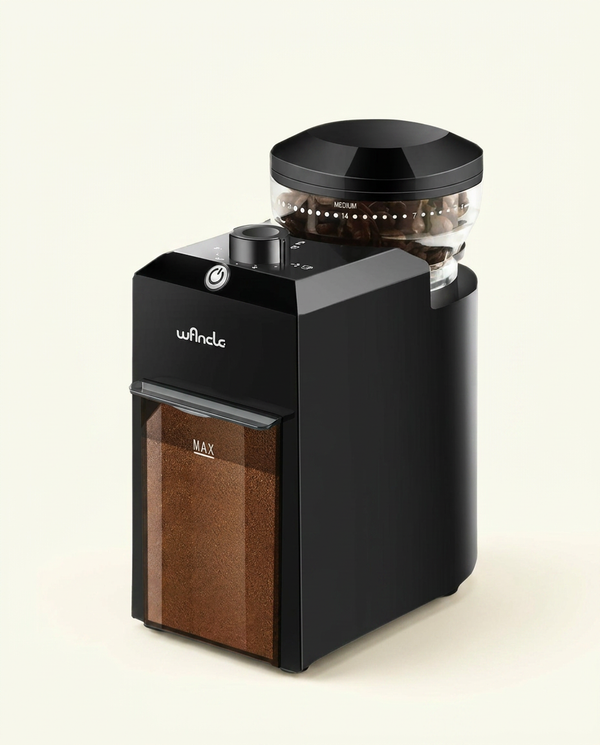
Pro Burr Grinder
The Pro Burr Grinder is built around the two things a classic entry grinder never solved: what the motor does to the beans, and what the grounds do to your counter.
- Grind time set on a touch screen: tap in a number of seconds instead of counting under your breath or guessing when to let go of a button.
- One dial, 25 fixed points from espresso to French press: you do not swap burrs or hunt for a second collar to reach the coarse end this article is about.
- About 250 grams of beans in the hopper: enough for several mornings between refills, inside a base narrow enough to sit beside the machine it feeds.
- A catch bin you can actually see through: it lifts out under the spout, so you can check the dose without opening a lid or tapping the chute.
- The cleaning brush lives on the machine: it stores on the back of the bean bin cover, so the weekly wipe-down actually happens instead of getting skipped.
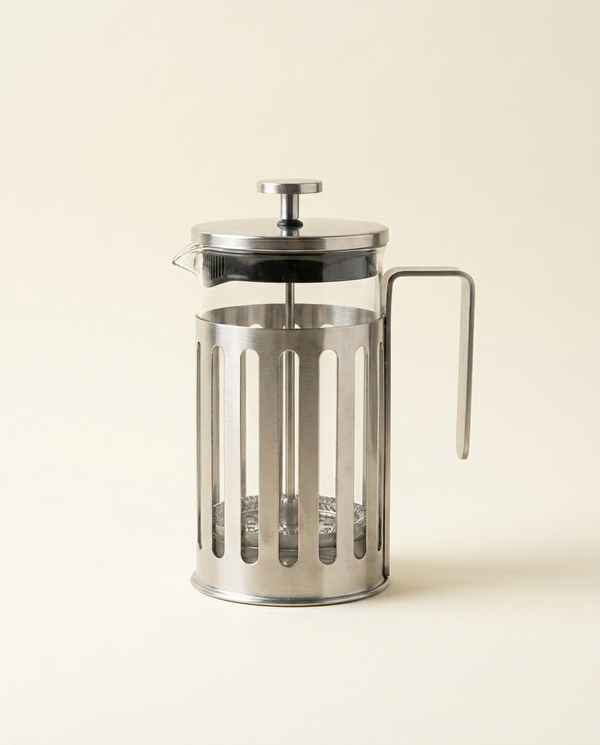
Choose the Pro Burr Grinder in matte black or milky white, with a US, EU or UK plug. Paired with The Signature Stainless Steel French Press, the coarse setting you dial in stays consistent from bag to cup. Browse the rest of our coffee makers, or read our full breakdown of the best grinder settings for French press for more.
Precision Manual Grinder
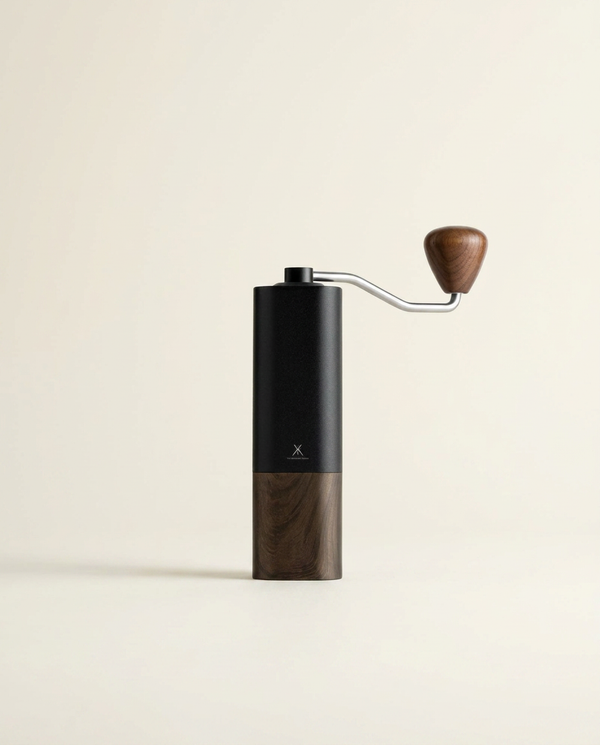
If you would rather leave the cord in the drawer, The Precision Manual Grinder is a brushed 304 stainless steel hand burr grinder with a dial at the base that runs the same fine-to-coarse range. No motor means no friction heat and no whine, and the crank handle folds flat and lifts off, so it fits in a bag for travel as easily as it sits in a drawer at home.
Where the Encore Still Sits
The Encore itself, around $170, is an electric grinder with conical steel burrs and a 40-step collar. The OXO Brew Conical Burr Grinder, around $130, trims the range to fewer settings. The Breville Smart Grinder Pro, around $250, adds a digital dial and a built-in timer across sixty settings. None of the three sets the dose on a touch screen, which is the gap the Pro Burr Grinder was built to close.
Upgrades That Don't Pay Off
- Replacing a blade grinder with another blade grinder: a chopping motor with a nicer housing still chops, no dial or setting fixes uneven particles at the source.
- Choosing a hopper by shelf space instead of daily dose: an oversized hopper just means beans sitting stale for longer before they get used.
- Skipping the weekly brush-out to save two minutes: stale fines trapped in the chamber flavor the next batch before the fresh beans get a chance.
- Rinsing steel burrs to speed up cleaning: a splash of water rusts the metal and dulls the cutting edge, a dry brush and cleaning tablets are the only safe routine.
- Buying on settings count alone: sixty numbered clicks mean little if the motor still runs hot and the bin still leaves chaff on the counter.
Saturday, half past eight, and the grinder finally stops shouting
The kitchen gets its first real light through the window over the sink, and nobody is in a hurry to be anywhere else this morning. You used to time the grind by counting seconds under your breath, one hand on the hopper and the other ready to catch a puff of chaff before it reached the sugar bowl. Now you tap a number into the screen, tip the beans in, and the grounds drop straight into the clear bin while you fill the kettle behind you. No grit on the counter to wipe up, no burnt smell from a motor that has been working too hard for too long. By the time the water is close to boiling, the dose is already measured and sitting there, waiting on you instead of the other way around.
If you take one thing from this article: a grinder earns its place on the counter by what it stops you from cleaning up, not by how many settings are printed on the box.
Encore Coffee Grinder: Frequently Asked Questions
Is the Baratza Encore coffee grinder good for espresso?
It is built primarily for filter methods like drip, pour-over and French press, and its settings run coarser than what espresso really needs. Pushed to its finest setting, shots tend to run fast and taste sour rather than balanced. If espresso is a regular part of your routine, a grinder built with finer, closer-set steps at that end of the range will get you there more reliably.
How long do steel conical burrs actually last?
Steel burrs are durable and typically hold their edge for several hundred pounds of coffee, which works out to years of daily use for most households. Grinding a stone or a piece of debris hidden in the beans is the main way a burr chips early, so a quick glance at your whole beans before they hit the hopper is worth the two seconds it takes.
Why does an entry-level grinder make so much static?
Static builds from the friction of beans shattering inside a plastic chute, and it gets noticeably worse in dry winter air. A single drop of water misted onto your whole beans before grinding, the Ross Droplet Technique, neutralizes the charge and cuts down the mess. A see-through catch bin will not stop the static itself, but it at least lets you see the chaff before it spreads to the counter.
Can I wash grinder burrs with soap and water?
No. Steel burrs should never touch water or liquid soap, even briefly, because moisture rusts the metal and ruins the cutting edge for good. Rely on a stiff dry brush after every use and food-safe cleaning tablets every few weeks, followed by a purge of cheap beans to clear any tablet dust.
Is a manual grinder better than an entry-level electric one?
For one or two cups a day, often yes. A quality hand grinder puts its cost into the burr set rather than a motor, runs silently enough for a 6 a.m. grind, and never builds the friction heat an electric motor does. The trade-off is time and effort at the crank, which stops making sense once daily volume climbs past a few cups.