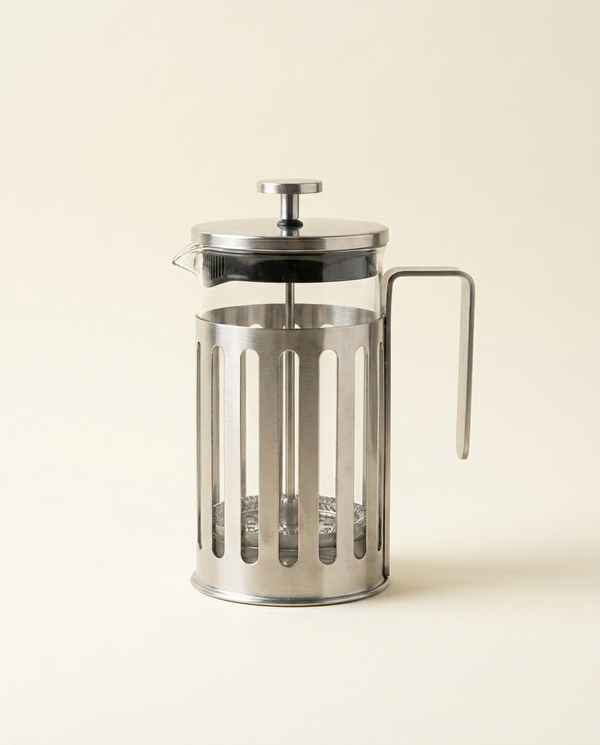
Microplastics in coffee cannot be measured at home, and nobody can sell you a certified microplastic free cup. What a shop can do is show you where plastic meets hot water in an ordinary morning, then name the swap for each place. For the brewer itself, ours is The Signature Stainless Steel French Press: double-wall 304 stainless steel, a stainless mesh plunger, no plastic in contact with your coffee.

Our pick: steel from lid to plunger
The Signature Stainless Steel French Press
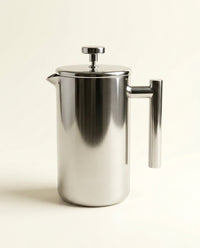
Double-wall 304 stainless steel body, knobbed steel lid, stainless mesh plunger on a perforated press plate. No plastic in contact with your coffee, and nothing hidden to inspect.
See the Signature Steel PressWhere Plastic Meets Heat in a Coffee Routine
Seven stations, from the water to the lid you carry out the door: the part that is usually plastic, the swap, and the guide that goes deep. Tea bags sit outside our subject.
Kettle Microplastics: The Station Before the Coffee
Water is the first ingredient and the hottest object in the routine. An electric kettle takes it to a rolling boil several times a day, for years, and on nearly every model sold here some of the parts around that boil are plastic: the powered base, the underside of the lid, the strip that shows the level, often the frame holding the mesh. Plastic outside the water and plastic in it are two different questions.
As a shopping question, kettle microplastics come down to four lines. Is the interior one piece of steel or glass. Is the lid steel underneath, where steam condenses and drips back. Is there a window set into the wall. What holds the filter mesh. A stovetop kettle answers all four by having none of them. Our guide to the plastic free electric kettle runs that inspection on electric models, ours included.
Microplastics Coffee Maker Worries: What Sits Inside an Automatic Machine
The reservoir gets the attention because it is the part you can lift out and look at. It holds cold water, and cold water is the least of the problem. The stretch that deserves your questions starts at the heating element, where water near boiling is carried to the grounds through a tube, a showerhead and a basket.
Do coffee makers release microplastics?
Nobody can give you a figure for the machine on your counter, and a shop that offers one has made it up. What is knowable is the layout, and it barely changes across the category. On most automatic brewers the heated water crosses molded parts before it reaches the coffee, then the coffee rests in a molded basket for the length of the brew, and heat, abrasion and age are generally understood to increase what a plastic sheds. Whether that trade is acceptable is yours to decide. Our guide to the plastic free drip coffee maker names those parts one at a time, tank to carafe lid.
The Brewer You Fill Yourself: Press, Cone and Stovetop Pot
Take the machine away and the path gets short enough to hold up to the window. A manual brewer is a vessel, a filter and a lid, with no housing to hide anything. That is the argument for one here: not that steel has a special property, but that you can check it yourself.
Manual does not mean free of plastic, and the shortcuts are easy to buy by accident. A glass press often pairs its beaker with a molded lid liner and a collar around the mesh. The best known cone dripper is sold in polypropylene for around ten dollars, and it is a brew basket with no machine around it. Read the lid line and the filter line before the body line. Our guide to coffee makers without plastic takes the methods one by one, and says where we stock nothing.
The Filter, and the Thing That Holds It
Every drop you drink passes through the filter, which gives the smallest part the largest share of contact.
Do paper coffee filters contain plastic?
Most paper coffee filters are paper, and that is the honest general answer. Bleached or unbleached describes color, not material. The confusion usually comes from neighbors on the shelf: some tea bags are closed with a synthetic mesh, and some pods use a plastic film or a plastic cup. Makers differ and change suppliers, so if this matters in your kitchen, ask the name on the box what the paper is and how the seam is closed. Permanent filters are the other place to look: a fine mesh is often set in a molded frame.
Does a French press have microplastics?
It depends on the press, which is the real answer and not an evasion. The carafe is rarely where the plastic is. When a press has some, it sits in the liner under the lid, in the cross plate that carries the mesh and in the strainer at the spout, all three in hot coffee for four minutes at a stretch. Turn the lid over and unscrew the plunger before you judge a press by its walls. Our guide to the best plastic free French press takes three of them apart, point by point.
The Grinder: No Hot Water, but Speed and Friction
Grinding is the one station with no hot water in it, which puts it lower on the list rather than off it. What it has instead is abrasion. An electric blade grinder throws beans against a molded lid for as long as your finger holds the button, and the chamber warms while the motor runs. Behind a brushed steel shell, the hopper, the chute and the bin are usually molded too.
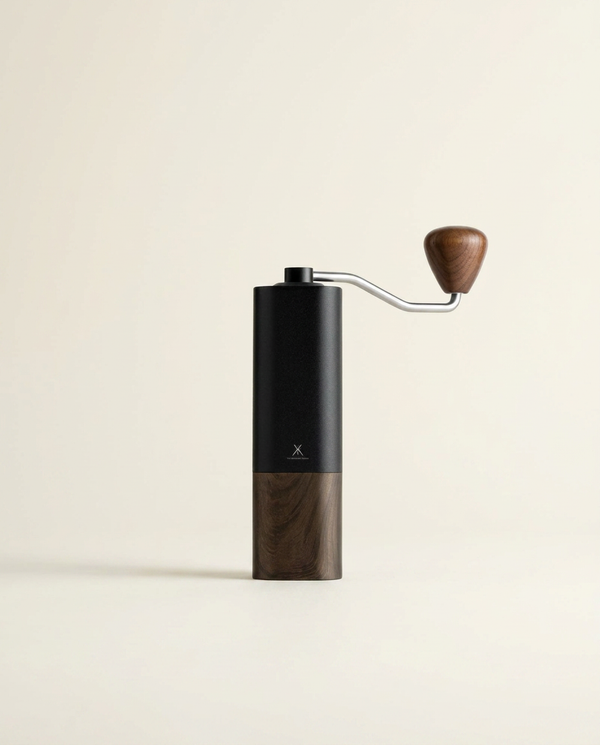
A hand grinder removes the motor and, with it, the warm chamber and most of the plastic. Ours is open about what is left: the Precision has two plastic parts, a small viewing window and the cap of the adjustment dial. Neither meets hot water. Our guide to choosing a non toxic coffee grinder names the plastic on each model it covers, ours included.
Do K Cups Have Microplastics? Pods, Capsules and Pressure
A pod machine adds one step the others do not have: hot water is pushed through the container itself. On K-Cup style pods that container is a molded plastic cup with a filter inside and a foil lid, and the water arrives hot and under pressure. Of the stations on this page, it is the one where heat, pressure and plastic meet most directly.
So, do K cups have microplastics. Nobody can hand you a number for the pod in your machine, and we will not invent one for the sake of a sale. What can be said without guessing is the arrangement: a plastic cup, hot water forced through it, and a material that heat, abrasion and age are generally understood to change. A refillable steel basket keeps the machine and removes the pod. A stovetop pot or a press removes both. Our guide to the plastic free espresso machine reads a pump machine stop by stop, tank to portafilter.
The Takeaway Lid, and the Word Printed on It
The last plastic of the morning is usually the one you carry out the door. A takeaway lid is a molded part with hot coffee against it and a valve you drink through, a paper cup is lined so it can hold liquid at all, and most reusable mugs pair a steel body with a plastic lid and gasket. The body is what people compare in the shop. The closure is what the coffee touches.
A lid is also where shoppers meet the label that explains least. BPA free almost always means plastic is present, and it never tells you where. On a lid the label is at least consistent with the object. The swap costs nothing: drink the first cup at home in ceramic or steel, or fill something with a wide metal mouth that you already own. Our guide to the BPA free coffee maker takes that phrase apart and compares the five materials a brewer can be built from.
Our Picks: Three Tools That Keep Hot Water Off Plastic
One brewer, one kettle, one grinder, covering the three hottest stations in the table. Each is described by what its maker lists, and where there is plastic we name it. More sizes sit in our French press collection.
1. The Signature Stainless Steel French Press: Steel for the Four Minutes That Count

Our first pick is The Signature Stainless Steel French Press, chosen here because the path is short enough that nothing is left to audit. Water in, coffee out, steel in between. The body is double-wall 304 stainless steel, the lid is knobbed steel, and the plunger is two steel parts, a fine mesh screen on a perforated press plate.
- Steel at all four points: body, lid, plunger and mesh. The maker's sheet reads no plastic in contact with your coffee.
- The wall does the heat: insulation holds the brew hot while the outer surface stays cool, so no warming plate sits under the pot.
- Three sizes: 12 oz serves one or two, 27 oz serves two to four, 34 oz serves four to six.
- Nothing to buy again: the plunger is the filter, so no paper and no capsules enter the routine.
- Two safety nets: 30-day returns and a 1-year guarantee.
What it is not: immersion brewing gives a fuller cup with a trace of sediment, and steel is opaque, so you wash it on a schedule.
2. Toscana Cast Iron Kettle: The Boil, With No Base and No Window

If the kettle is the station you would rather settle first, the Toscana Cast Iron Kettle takes those four questions off the table. It is a 34 fl oz stovetop kettle in solid cast iron, with an interior the spec sheet lists as enamel-coated, a stainless steel strainer at the spout and a folding overhead bail handle. No plastic part is listed anywhere on it.
It is listed for gas, induction, electric ceramic, open flame and charcoal, weighs about 3.2 lb empty and is hand wash only, and the enamel chips if you drop it. No whistle appears on the sheet, so it is a kettle you stay near. Filled, it pours one 34 oz press.
3. The Precision Manual Grinder: Steel and Ceramic, Two Plastic Parts Disclosed

The Precision Manual Grinder is our best seller and the one to describe carefully: a brushed 304 stainless steel body with conical ceramic burrs. The only plastic parts are the small viewing window and the cap of the adjustment dial. The window meets ground coffee, dry and at room temperature, for the minute between grinding and brewing. You decide whether that is acceptable.
There is no motor, so nothing warms as it runs. The dial at the base moves from espresso-fine to French-press-coarse, and the crank folds flat for travel. If two plastic parts are two too many, the stricter choice in our range is a machined aluminum hand grinder with no plastic part listed by its maker.
How to Avoid Microplastics in Coffee, in the Order That Matters
Hottest first, longest contact second, everything else after. It is cheapest first as well, since the first two steps can cost nothing.
- Move the boil: a stovetop kettle, or an electric one with a steel interior, a steel-lined lid and no water window.
- Brew where you can see the surfaces: a press, a metal pot or a cone in glass, instead of a heated path running inside a housing. The Signature press is our answer at that station.
- Read the lid and the filter, not the body: a frame around a mesh and a liner under a lid sit in the coffee for the whole brew.
- Retire the pod: it is the one format where hot water is pushed through a plastic container by design.
- Grind by hand when the grinder comes up: no motor, no warm chamber, and a parts list you can read in a line.
- Carry it in steel, ceramic or glass: the travel lid is the last plastic of the morning and the easiest to change.
- Replace what has aged: scratched, clouded or brittle plastic is the one condition on this page you can judge with your own eyes.
None of that empties a kitchen of plastic. It moves the hot water away from what remains, which is the part a person can act on.
What We Cannot Tell You
This is a coffee shop, and that sets a limit on the page, better said out loud than written around. We cannot tell you how much plastic, if any, ends up in a particular cup. We have tested nothing and own no laboratory, and a number offered for your kitchen has been invented for you. Researchers have reported finding microplastics in many foods and drinks, and the science on what that means for health is still developing. That is the state of it, and not ours to advance.
We also cannot tell you whether any of it is harmful to you or to anyone in your house. Those questions belong to your doctor and to the public health agencies that answer them for a living.
What is left is the part a shop is qualified for: reading a spec sheet, naming a material, saying which part of a machine the hot water crosses. That is what these guides do, our own shelves included.
A Monday, and the pod machine goes in the box
Monday, early, and the carton by the door is already half full of things for the donation shelf. The pod machine comes off the counter last, a used capsule still in the holder, and underneath it there is a pale rectangle nobody has seen in three years. You wipe it down, set the kettle on the burner and grind while the water climbs. Four minutes is longer than a pod takes, and you notice that once, then stop noticing. The plunger goes down with a low, flat sound, and the pot that reaches the table holds more than one person needs.
If you take one thing from this article: no lab report comes with a coffee maker, but you can choose where your hot water goes, and the Signature keeps the four minutes that matter inside stainless steel, with 30-day returns and a 1-year guarantee behind it.
Microplastics in Coffee: FAQ
Are there microplastics in coffee?
Researchers have reported finding microplastics in many foods and drinks, and coffee has not been treated as an exception. What nobody can tell you is how much is in your cup, since that depends on your kettle, your brewer, your filter and the age of each. The useful question is which parts of your routine hold hot water against plastic.
How do I avoid microplastics in coffee?
Work in the order of heat. Boil away from plastic, brew in steel, glass or metal, check the filter frame and the lid rather than the walls, leave pods behind, grind by hand when the grinder comes up for renewal, and carry the coffee in metal or ceramic. That keeps the hottest water away from the plastic that is left.
Does a plastic electric kettle add microplastics to the water?
We have no measurement to offer, and we would distrust one that came from a shop. What is plain is the arrangement: a plastic tank, a plastic lid underside and a plastic window hold water at a rolling boil several times a day for years, and heat, abrasion and age are generally understood to increase what a plastic sheds. A stovetop kettle removes the arrangement rather than arguing about it.
Are aluminum capsules better than plastic pods?
On the container, the material differs: an aluminum capsule is metal with a foil lid, where a K-Cup style pod is a molded plastic cup. Which you prefer is your call to make. On the machine, nothing changes, since the hot water still crosses internal lines and a brew unit before it reaches the capsule. If pods are the station you want settled, the reliable move is to leave the format.
Is a stainless steel French press free of plastic?
Not automatically. Steel walls say nothing about the liner under the lid, the cross plate behind the mesh or the strainer at the spout, and all three sit in hot coffee for the length of the steep. The press we stock for this question answers all four in steel, and its maker states no plastic in contact with your coffee.
Do paper coffee filters have plastic in them?
Most paper coffee filters are paper, bleached or unbleached, and neither word describes a plastic. The confusion comes from neighbors on the shelf: some tea bags are closed with a synthetic mesh, and some pods use a plastic film or cup. If it matters to you, ask the name on your box what the paper is and how the seam is sealed.
Can I test my coffee for microplastics at home?
No, and that is worth knowing before anyone sells you a kit. Counting particles that small takes laboratory instruments and trained hands, not a strip on a kitchen counter. It is why this guide is built on materials rather than measurements: what you can verify at your own sink is what each part is made of, and whether hot water crosses it.