A pump espresso machine is a tank, a pump, tubing, a boiler and seals, and on home models several of those parts are plastic. That is why a truly plastic free espresso machine barely exists. The low-plastic way to a short, strong cup is a stovetop pot, and ours is the Bottega Wood-Handle Moka: painted aluminum in two sizes and five finishes, no tank and no pump. It brews espresso-style coffee, not true 9-bar espresso, and this guide is straight about that difference too.

Our pick: espresso-style, on the stove
A classic eight-sided Italian moka pot in aluminum with a wood-grain handle. Metal chambers and funnel, no pump, no tank, no tubing. Two sizes, about five minutes on the stove.
See the Bottega MokaQuick Picks: An Espresso Machine With No Plastic, Five Ways Compared
Five ways to a short, strong cup. We link what we stock and say so where we stock nothing.
Why a Plastic Free Espresso Machine Barely Exists
Espresso is coffee made under pressure: about 9 bar through a fine, packed bed of coffee, in 25 to 30 seconds. Building that pressure on a countertop takes machinery, and the machinery is where the plastic comes in.
A home pump machine needs a reservoir, a pump, lines, a boiler or thermoblock and seals to keep 9 bar from escaping. Metal can do some of those jobs, not all: a flexible line or a seal is silicone, rubber or a heat-resistant plastic, and the tank is plastic on almost every home model.
So among pump machines, a truly plastic free espresso machine is close to nonexistent. What exists is a range: machines with more metal on the hot side, lever machines that drop the pump, and the stovetop pot that drops nearly everything.
What our own espresso machines list
Their spec sheets are plain about it. The Capri Espresso Station lists stainless steel plus ABS plastic. Le Maestro Auto Espresso lists a metal housing with plastic trim. The portable Nomad Espresso Press lists 304 stainless steel plus an ABS housing. They earn their place in our espresso machines collection for other reasons, the 19-bar pump and PID temperature control of the Capri Espresso Station among them. None is a pick here.
Our guide to coffee makers without plastic works the same way, method by method: the parts list first, the opinion second.
Espresso Machine, No Plastic: Six Stops From Tank to Cup
Most listings describe the shell, and the water never touches the shell. Here is the path on a typical home pump machine. Models differ: a maker's parts diagram beats any generalization.
- The tank. Usually a removable plastic reservoir. The largest plastic part on most machines, and the coolest.
- The intake line and the pump. A flexible tube, commonly silicone, feeds a small vibration pump. Still cold.
- The boiler or thermoblock. Where the water gets hot. Aluminum, brass or stainless steel, depending on the price.
- The hot line to the group. Often a heat-resistant plastic or silicone tube on entry-level machines, more often copper or steel pipe on heavier ones.
- The group and its gasket. Metal on most machines, with a steel screen and a rubber or silicone ring that seals against the portafilter.
- The portafilter. A steel basket. On many entry-level machines, also a plastic insert behind it, or plastic spouts.
Stops 1 and 2 are cold. Stops 3 to 6 are hot and under pressure, and that is where to look hardest, because heat increases migration from plastics in general.
Fully automatic and capsule machines
Bean-to-cup machines brew inside a removable brew unit, on most models a molded plastic assembly. Capsule machines send hot water through internal lines, then through a capsule in aluminum or plastic. Neither is the place to look for less plastic. Our own Verona Touch Espresso is fully automatic, and its listing does not detail internal materials, so we make no claim for it.
Stainless steel espresso machine, no plastic: four lines to find on the spec sheet
On a listing, "stainless steel" most often names the housing, the one part the water never meets. The lines worth finding are narrower: stainless steel boiler, brass group, copper or steel pipework, an all-steel portafilter. Machines that can say all four are usually the heavy prosumer kind, often $1,500 and up. Unless plumbed into the water supply they still draw from a plastic tank through a flexible line, and they still seal with gaskets.
Non Toxic Espresso Machine: What You Can Actually Check
Nobody tests an espresso machine and stamps it non toxic. The phrase belongs to shoppers, not to a standard. In practice, a non toxic espresso machine comes down to three checks:
- Known metals on the hot side. Stainless steel, brass, copper or aluminum. Which you prefer is your call. What matters is that the listing names it.
- Plastic kept to the cold side or the outside. Heat is the reason to look at the hot side first.
- "BPA free" read correctly. The badge describes plastic parts, so it almost always means plastic is there, and it never says at which stop.
We will not rank machines by health: we are not doctors, and nothing here is medical advice. We can tell you what the spec sheets say, ours first.
How to Shop for an Espresso Machine Without Plastic Parts
An espresso machine without plastic parts on the hot side is a demanding target, but espresso has one advantage over other appliances: many makers publish a parts diagram or an exploded view, for repairs. Find these five parts on it:
- The boiler or thermoblock. Its metal, and whether the inside is coated.
- The line from the heater to the group. Rigid pipe or flexible tube, and in what material.
- The portafilter. Any insert behind the basket, and the spouts.
- The group gasket and the other seals. Their material is usually in the spare-parts list.
- The tank and its intake line. And whether the machine can be plumbed in.
When a maker publishes no diagram, a spare-parts shop often does. For dose, grind and timing, see our complete espresso guide.
By hand: lever machines such as the Flair and the La Pavoni
A lever machine makes espresso pressure with your arm. That removes the pump, most of the tubing and, on some, the tank.
- Flair, roughly $100 to $600 across the range. A countertop lever press: you heat water in a kettle, fill a metal brew cylinder and pull the shot by hand. Every model relies on piston seals, and materials differ from one model to the next.
- La Pavoni Europiccola, about $1,000. The classic electric lever machine: a metal boiler you fill directly, a lever, no pump. Built for decades in many versions, with gaskets, piston seals, and knobs and handles in plastic or wood depending on the version. We have not taken one apart and will not vouch for its internal parts.
Both make true espresso, which a moka pot does not, and both ask for practice and a capable grinder. We stock neither. If what you want is a short, strong cup with the fewest parts between water and coffee, the stovetop wins, at a fraction of the price.
Moka Pot vs Espresso Machine: Espresso-Style, Not 9-Bar Espresso
A moka pot is often sold as a stovetop espresso maker, and the name is half true. Alfonso Bialetti's 1933 design does use pressure: steam in the sealed base pushes hot water up through the coffee and into the top chamber. But the pressure is modest, roughly 1 to 2 bar against about 9 in a machine.
In the cup, that means a short, dense coffee, roughly two to three times the strength of drip, with little or no crema, brewed from a grind a step coarser than espresso. It will not pass for a ristretto. Better to know that before you buy.
If strength matters less to you than simplicity, our guide to the best plastic free French press covers a brewer with fewer parts still.
Looking for a Plastic Free Espresso Maker? The Two Stovetop Pots We Stock
Both are aluminum. On both, water and coffee travel through metal chambers and a metal funnel, sealed by the one gasket every moka pot has, and neither maker states the gasket material. The handle and knob sit outside the brewing path. Both come with 30-day returns and a 1-year guarantee, and both live in our moka pot collection.
1. Bottega Wood-Handle Moka: Two Chambers, a Funnel, One Gasket

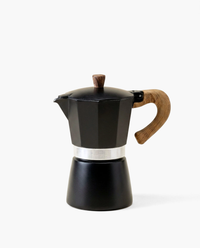
The Bottega Wood-Handle Moka is a classic eight-sided Italian moka pot in painted aluminum, with a wood-grain handle and a matching lid knob. Like any moka pot, it comes apart into a base, a funnel and a top chamber, with a filter plate and a gasket between them. That is the whole machine, and the reason it is our first pick.
- The classic shape, in five finishes. Eight sides, painted aluminum, in Black, Black Premium, Blue, Red or White.
- Two sizes. 150 ml (about three cups, 15.5 cm tall) or 300 ml (about six cups, 19.6 cm). Moka cups are demitasse cups: the small pot suits one or two people.
- Metal where the coffee goes. Aluminum chambers and funnel, single-tube extraction. Like every moka pot it seals with a gasket, and the maker does not state its material.
- A wood-grain handle and knob. Cool-touch, and outside the brewing path. The maker does not state the material under the finish.
- A built-in pressure-release valve, and about five minutes on gas, electric or ceramic stoves, with nothing to plug in.
- If it disappoints. 30-day returns and a 1-year guarantee.
Where it falls short: it is aluminum, not stainless steel. It does not work on induction. It wants hand care: warm water and a soft cloth, no soap, no dishwasher, every piece dried after each brew, a new gasket about once a year. And it makes moka coffee, not espresso.
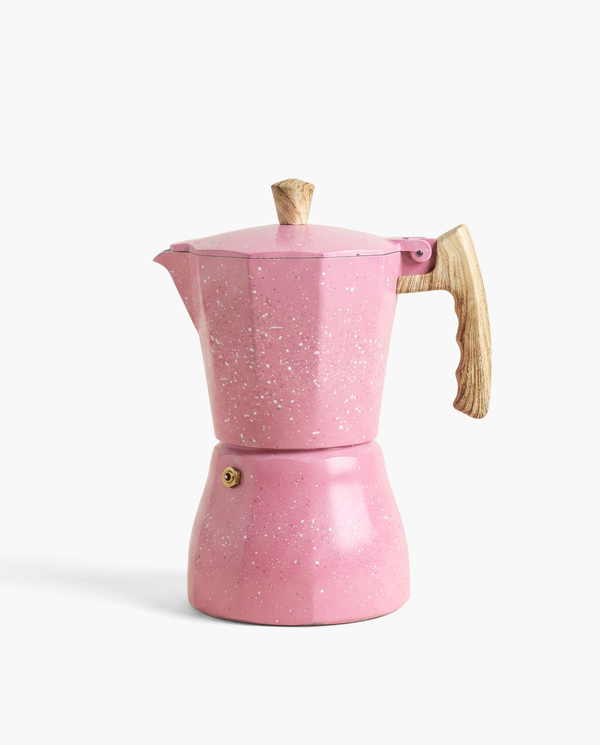
2. Capri Speckled Moka: The Same Brew in Speckled Pink

The Capri Speckled Moka is the same eight-sided shape in another mood: aluminum under a speckled pink enamel finish with white flecks and a built-in pressure-release valve, in the 300 ml size, about six small cups. Gas, electric or ceramic stoves, not induction.
Read the handle line first: a composite handle. The handle and knob are listed as a wood-look, heat-resistant composite. A composite of this kind is usually resin based, so a strict reader should count it as a plastic part. It stays outside the brewing path. Care differs a little: a soft sponge and mild dish soap, never an abrasive, because the enamel scratches.
The Pot Everyone Knows: Bialetti Moka Express, About $40
The original, and the reason every other octagonal pot exists: aluminum chambers, a gasket, a safety valve, a black handle and knob, and sizes from one cup to twelve. The brewing principle is the same. Our pick stands on what its spec sheet lists: the eight-sided shape in five finishes, two sizes, a built-in pressure-release valve, a cool-touch handle, and our 30-day returns and 1-year guarantee.
Stainless Steel Stovetop Espresso Maker: What We Stock, and What to Look For
Many readers arrive wanting a stainless steel stovetop espresso maker, because they cook on induction or would rather not brew in aluminum. Our position: we stock no stainless steel moka pot today. Both of ours are aluminum.
Aluminum or stainless steel: a fair comparison
Stainless usually costs more. We make no health claim for either metal: which one you want against your coffee is a personal choice we respect.
What to look for in a stainless steel moka pot
- A named steel grade. 18/10 or 304, stated for the chambers and the funnel, not just the word "stainless".
- The handle. Steel handles exist. Many stainless pots still carry a plastic one.
- The gasket material, in writing, and replacements on sale.
- A safety valve and a flat magnetic base if you cook on induction.
- The real capacity in ounces. "Cups" means demitasse cups.
The name you will meet first is the Bialetti Venus, about $50: a stainless steel pot made for induction too, with a black handle whose material is worth checking on the maker's page. Run the list on it, as on any other. If neither induction nor the metal is your concern, our aluminum Bottega brews the same style of coffee.
Espresso Listings That Should Slow You Down
- "BPA free water tank" as the headline. One compound, one part, the cold one. The hot side goes unmentioned.
- Portable espresso makers sold as the clean option. Usually housed in plastic. Ours is no exception: the Nomad Espresso Press lists an ABS housing. Buy one for the trail, not for this criterion.
- Stovetop pots that promise "9 bar", or "stainless" with no grade. No moka pot makes 9 bar, and a listing that cannot name its steel has not earned a place on your burner.
How to Brew Espresso-Style Coffee on the Stove
- Start with hot water. Fill the base from a kettle to just below the valve. Less time on the burner, less bitterness. Hold the hot base with a towel.
- Grind fine, not espresso-fine. Think fine sand. Powder chokes the filter.
- Fill the funnel level and do not tamp. Brush the rim clean so the gasket can seal.
- Screw it tight, medium-low heat. On gas, keep the flame under the base, away from the handle.
- Listen. The stream runs dark, turns pale, then gurgles. Lift the pot off at the first gurgle, cool the base under the tap for a few seconds and pour.
In the 150 ml Bottega, a full funnel makes about three short cups. Two things upstream decide the rest. The water: our guide to the plastic free electric kettle does for kettles what this page does for machines. And fresh grinding: our guide to choosing a non toxic coffee grinder goes through hand grinders part by part.
Bitter cup: lower the heat and lift the pot off sooner. Hissing seam: clean the rim, tighten, or replace the gasket. Afterward, take the pot apart, rinse it in warm water and dry every piece, gasket included, because trapped moisture corrodes aluminum.
Half past three, the hour that drags
Half past three, and the afternoon has stalled. You fill the small pot, set it on the smallest burner and go back to the page you were reading. Then the kitchen smells like a coffee bar, and the pot begins its low, wet gurgle, the only timer it has. You lift it off and pour a short cup, dark to the rim, and drink it standing at the counter while the light goes gold on the wall. The cup is rinsed before it has cooled, and the hour that dragged is moving again.
If you take one thing from this article: a truly plastic free espresso machine is close to nonexistent, so choose the brewer with the fewest parts between the water and the cup. The Bottega brews through two metal chambers, a funnel and one gasket, with 30-day returns and a 1-year guarantee behind it.
Frequently Asked Questions
Is there a 100% plastic free espresso machine?
Not that we have found among pump machines. A pump machine needs a tank, a pump, flexible lines and seals, and on home models several of those are plastic, silicone or rubber. The brewer with the fewest parts is a stovetop moka pot, which makes espresso-style coffee, not true espresso.
What is the best plastic free espresso maker for a small kitchen?
In a small kitchen, a 150 ml stovetop pot, where a short parts list is the whole point. See the Bottega moka pot: painted aluminum, 15.5 cm tall, a wood-grain handle, a built-in pressure-release valve. It works on gas, electric and ceramic stoves, not on induction. Like every moka pot it has a gasket, and the maker does not state its material.
Is a BPA free espresso machine plastic free?
Almost never. BPA free describes plastic made without one specific compound, so a BPA free espresso machine almost always has plastic parts, most often the tank. The label never tells you where else: it is silent on the hot side, the lines, the brew unit and the portafilter. The parts diagram answers what the badge does not.
Is a moka pot an espresso maker without plastic?
On the drink, not quite: roughly 1 to 2 bar against about 9, so the coffee is espresso-style, with little or no crema. On materials, closer than any pump machine, not all the way. A strictly plastic free moka pot is rare: every pot has a gasket, usually rubber or silicone, and a handle that must stay cool. Ours list a wood-look composite handle, which we count as a plastic part (Capri Speckled Moka), and a wood-grain one (Bottega), and neither maker states the gasket material.
Does a stainless steel stovetop espresso maker work on induction?
Most do, since most have a magnetic base, but look for the word induction in the listing. Aluminum pots, ours included, need an adapter plate, which slows the brew. We stock no stainless steel moka pot today: both of ours are aluminum, made for gas, electric and ceramic cooktops.
Which non toxic espresso machine do you recommend?
The one whose parts you can check. No standard defines non toxic, and a listing alone rarely shows the inside of a pump machine. Three of the pump machines we stock list plastic parts, as detailed above, and the others do not publish a full materials list. If your first criterion is what the hot water touches, our answer is the stovetop pot, limits on pressure and crema included.