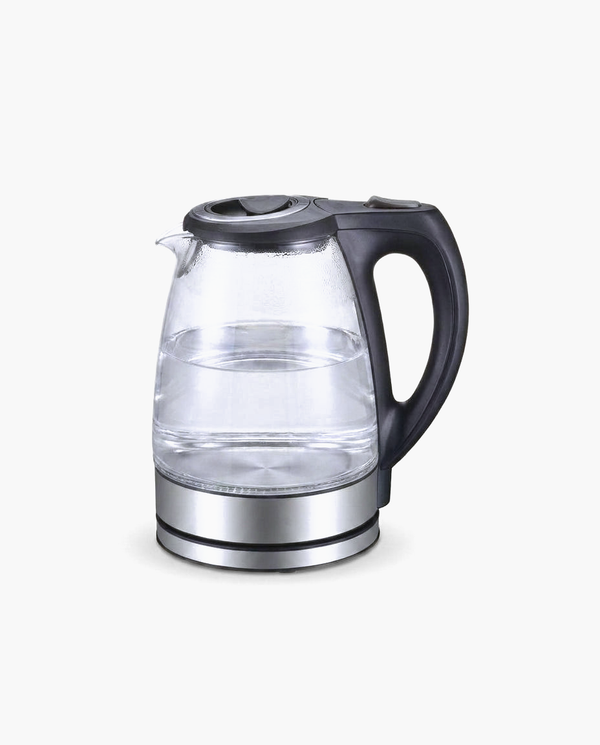
A glass coffee kettle turns boiling water from a guessing game into something you can actually watch. Our Sentinel Glass Kettle is built around that idea: a clear borosilicate body with a blue LED that lights the water as it heats, so you see the exact moment it rolls instead of listening for a click.
Why a Glass Coffee Kettle Changes How You Brew
Most kettles hide the whole process. You wait for a whistle or a click and take the temperature on faith. A clear kettle removes that guesswork: you see the first small bubbles form at the bottom, then watch them grow as the water climbs toward a boil.
That matters because boiling water at 212°F is too aggressive for coffee. It scalds delicate grounds and pulls out bitterness the beans never meant to give up. The window that actually tastes good sits closer to 200°F, and a glass body is the easiest way to catch it, because you can see the bubbles shift from a fine, champagne-like fizz to the larger ones that mean a full boil.
Why Ordinary Glass Cannot Take the Heat
Not every glass kettle can handle direct or repeated heat. Standard glass cracks under thermal shock, the rapid expansion and contraction that happens when temperature changes fast. That is why kettles built for daily boiling use borosilicate glass, a formula mixed with silica and boron trioxide specifically to resist that stress.
- Borosilicate glass: the material that survives repeated heating and cooling without weakening.
- Thermal shock: the fast expansion or contraction that cracks cheaper glass when the temperature changes quickly.
- Cordless base heating: an electric glass kettle heats through a base plate rather than an open flame, which keeps the temperature swing gentler and more even than a stovetop burner.
How Glass Compares to Steel and Copper
Glass is a poor insulator on purpose. A heavy steel kettle holds heat for a long time after it leaves the burner or base, while a glass kettle sheds heat fast. That sounds like a flaw until you realize it means less waiting for your water to drop into the 200°F brewing window.
For the wider picture on kettle shapes and spouts, our complete kettle guide breaks it down further.
Buying Guide: Stovetop Glass, Electric Glass, or Gooseneck
Once you have decided glass is the material you want, the next choice is how it gets hot. Each option trades something for something else.
If seeing the water is the whole point for you, an electric glass kettle is the fit: you keep the transparent body and get an automatic shut-off in exchange for the small amount of pour control a gooseneck spout would add. Browse our full kettles selection to compare shapes side by side, or widen the search to our full Coffee Makers collection if you want to rethink the whole setup, kettle included.

Pouring Technique for a Cleaner Cup
Owning a kettle you can see through is only half the job. How you pour decides whether the coffee tastes sweet or bitter.
Agitation is how much the water disturbs the grounds as it lands. A heavy, careless splash agitates too hard and pulls out bitterness. A gentle, steady stream extracts evenly.
Controlling the Flow From a Wide Spout
- Tilt slowly: find the angle where water just starts to fall in a steady, unbroken line rather than tipping all at once.
- Keep the spout low: the closer it sits to the coffee bed, the less splashing and the more even the wetting.
- Circle the grounds: a slow wrist rotation wets everything evenly and avoids soaking the filter edges.
Your first pour matters most: wet the grounds just enough for the bloom, the release of trapped carbon dioxide, before pouring the rest. The same read on the water matters just as much if you brew full-bodied coffee more often than pour-over, so it is worth a look at our full French Press Coffee Makers collection too.
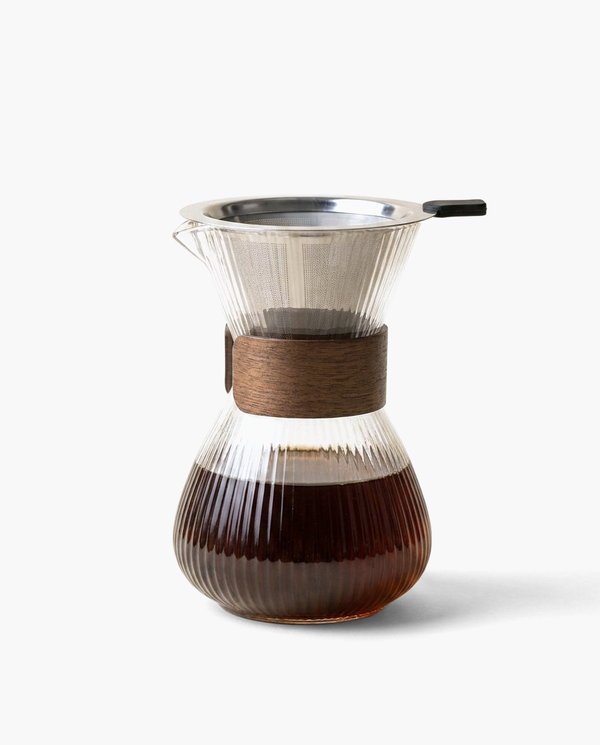
Once the water is poured, the kettle's job is done: the Workshop Pour-Over Set takes it from there, brewing through a conical double-wall stainless filter into its own hand-blown glass carafe and serving through a faucet-style, drip-free spout, so the kettle handles the boil and the Workshop handles the cup.
Keeping the Glass Clear
A glass kettle only earns its keep if you can still see through it. Hard water leaves a cloudy, chalky film after a few weeks, and that film is limescale, the same mineral buildup that slows any kettle's heating.
Our Sentinel Glass Kettle already keeps a fine mesh filter in the spout to catch scale before it reaches your cup, which shortens this table to one real chore: the occasional vinegar soak. For the full four-step method and how often to repeat it, see our guide on how to descale a kettle with vinegar.
If the kettle is tied up soaking, that is also a fine window for a cold batch instead, just double-check your cold brew coffee grind size before you start.
Our Pick for Watching the Water, Not Guessing at It
Plenty of kettles claim to be simple. Few actually let you see what is happening inside them.
Sentinel Glass Kettle, built for visible brewing
The Sentinel Glass Kettle is what we reach for on any morning we want to watch the boil instead of just hearing it.
- See the boil happen: a high borosilicate body plus an integrated blue LED lights the water as it heats, so you catch it climbing toward temperature in real time.
- Nothing plastic touches the water: glass holds no flavor and no residue, so every batch tastes like water and nothing else.
- A fine mesh filter sits in the spout: it keeps scale out of your cup between the vinegar soaks.
- Fast and hands-off: 1500 watts brings a full kettle to a boil in minutes, then auto shut-off cuts power the instant it rolls, with boil-dry protection for the mornings you forget to fill it.
- One fill covers the table: 57 fl oz (1.7 L) clears six to seven pour-over mugs, and the removable cordless base lifts off for a clean pour and an easy refill.
If you want the next step to match the kettle's own care, the Workshop Pour-Over Set is a natural pairing: a hand-blown borosilicate carafe with a turned-wood collar, a conical double-wall stainless filter, and a faucet-style, drip-free spout that serves what it brews, rated from -4°F to 302°F so it takes the same temperature swings the kettle does.
A Plain Glass Stovetop Kettle, the Budget Alternative (About $45)
A plain borosilicate stovetop kettle, around $45, gives you glass without a base. You watch a flame instead of a display, there is no shut-off if you walk away, and the wide spout makes a careful pour-over harder than it needs to be.
Kettles and Habits That Undo the Point of Glass
A few choices quietly cancel out the whole reason you bought a clear kettle.
- Non-borosilicate glass: standard glass cannot take repeated heat cycles and eventually cracks. Confirm borosilicate before you buy, stovetop or electric.
- A tinted or frosted body: some "glass" kettles are tinted dark enough that you lose most of the visibility you paid for. Clear is the point.
- Steel wool on the interior: it leaves fine scratches that fog the glass and give the next round of scale somewhere to grab.
- Standing water overnight: it evaporates and leaves its minerals bonded to the glass, which is how a clear kettle turns cloudy in a matter of weeks.
- A wide spout with no filter: without something to catch loose flakes, whatever breaks off the wall ends up in the cup.
Saturday brunch, and a kitchen full of people who are not watching the kettle except you
Half past ten, plates stacked on the counter, someone's kid drawing at the table with the good markers. You fill the kettle between conversations and set it going without really thinking about it, and it is the small blue glow at the base of the chamber that pulls your eye back over.
The water is still, then trembling, then a scatter of tiny bubbles lifts off the bottom, and you know before anyone else in the room that it is close. Someone across the table catches you staring and asks what is so interesting about a kettle, so you tilt it just enough for them to see the water clear into that fine, fast fizz right before it turns.
You catch it a breath ahead of the rolling boil and start your pour while the kid asks if the light means it is working. Nobody else at the table noticed the water. You did, because for once you could actually watch it.
If you take one thing from this article: a glass kettle does not make better coffee by itself, it just lets you catch the moment that does.
Frequently Asked Questions
Can I put a glass coffee kettle directly on the stove?
Only if it is made from true borosilicate glass, which is engineered to resist thermal shock from a gas or electric burner. Heat it gradually and never set a cold, dry kettle straight onto a hot burner. If you would rather skip that risk entirely, an electric glass kettle like the Sentinel heats through a base plate instead of an open flame.
How do I get rid of the cloudy film inside a glass kettle?
That white film is limescale from your tap water. Fill halfway with equal parts white vinegar and water, warm the mix, let it sit for 20 to 30 minutes, then rinse with two fresh boils. Filtered water slows how fast the film comes back.
Is a glass kettle better than a stainless steel one?
It depends on what you want from it. Glass gives you a visual read on the water, so you know when it has reached the right temperature rather than taking it on faith, and it holds no flavor of its own. Steel holds heat longer and takes more knocking around. Beginners tend to prefer the visibility of glass, while people who travel or want a kettle that never fusses reach for steel.
What is the best kettle for someone new to pour-over coffee?
Start with something you can see into, since watching the water teaches you the timing that recipes only describe in words. The Sentinel Glass Kettle pairs that visibility with an auto shut-off, so there is nothing to remember except pouring.
Does an electric glass kettle take longer to boil than a stovetop model?
Not with a decent element. A 1500-watt electric glass kettle brings a full fill to a boil in a few minutes, comparable to a stovetop burner, and it shuts itself off the moment it gets there instead of leaving you to watch a flame. What you give up is the option to boil directly over an open fire or a camp stove, which a stovetop model still allows.