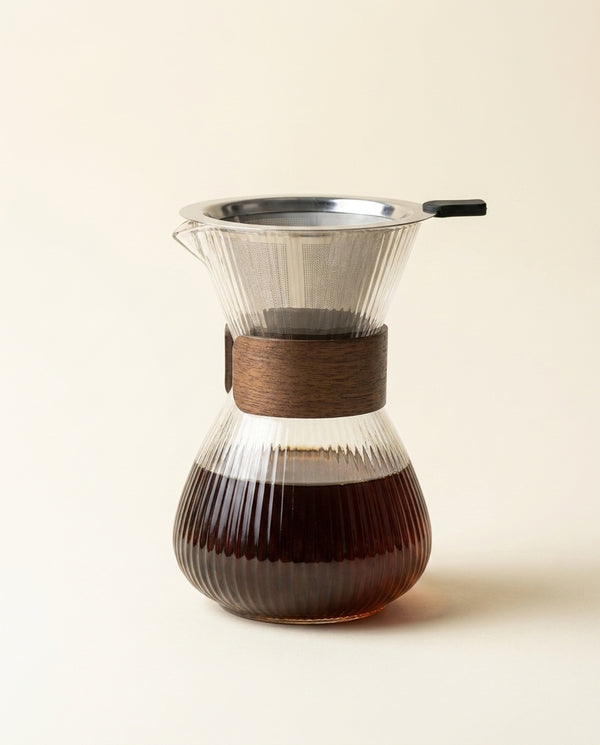
Follow the water through an automatic drip machine and you see why a plastic free drip coffee maker is so hard to buy. Once heated, the water typically climbs a tube, leaves a showerhead and rests in a brew basket, all molded plastic on most models. Drip coffee needs none of that. The Workshop Pour-Over Set makes it by hand: a hand-blown borosilicate glass carafe, a turned-wood collar and a built-in 304 stainless steel cone filter, with no plastic parts listed by the maker. We stock no drip machine, which leaves us free to say where the plastic sits, what four well-known machines say about themselves, and how to get a machine's ease by hand.

Our pick: drip coffee, by hand
A hand-blown borosilicate glass carafe, a turned wood collar and a double-wall 304 stainless steel cone filter. No plastic parts listed by the maker, and no paper filters to buy.
See the Workshop Pour-Over SetQuick Picks: A No Plastic Drip Coffee Maker for One Mug, Three Cups or a Full Pot
Four situations, one row each.
Why a Drip Coffee Maker Without Plastic Is So Hard to Find: Follow the Water
Every automatic drip machine, from the $30 box-store model to the $350 showpiece, moves water through the same seven stations. The materials change with the price. The route does not. "Typically" does honest work in this table: models differ, and makers revise parts quietly.
Reviews dwell on the reservoir because it is the part you can see, yet the water in it is cold. The stretch worth your questions runs from station 3 to station 7, hidden inside the housing.
None of this is exotic or illegal. Food-contact plastics are regulated, and they are why a ten-cup machine can cost forty dollars: plastic molds into a showerhead or a valve in one shot and does not shatter. It is also true that heat increases migration from plastics in general, and that a drip machine applies its heat exactly where its plastic is. Many people simply want those two kept apart, a preference we can serve without a single health claim. Every other brew method gets the same walk in our guide to coffee makers without plastic.
Non Toxic Drip Coffee Maker: A Phrase With No Test Behind It
On a coffee machine box, "non toxic" is a marketing phrase, not a test result. Nobody certifies it. The non toxic drip coffee maker you can actually check is plainer: a machine whose maker will tell you, in writing, what stations 3 to 7 are made of. "BPA-free" does not do that. It reports one compound as absent, which almost always means plastic is present, and it never tells you where.
Stainless Steel Drip Coffee Maker, No Plastic: Ask Which Part Is Steel
On a drip machine, "stainless steel" nearly always describes the housing, the carafe, or both. It says nothing about the basket above the carafe or the tube behind it. If a listing leads with steel and shows only the outside, ask for two photos: the inside of the brew basket, and the underside of the carafe lid. The steel drip brewer we can describe part by part is a simpler object: a stainless cone on a glass carafe.
Best Drip Coffee Maker, No Plastic: What Four Well-Known Machines Say About Themselves
We earn nothing on any of these machines. Prices are typical US street prices, and material notes stop at what the makers say in public. Models change, so confirm the current parts list before you buy.
- Technivorm Moccamaster KBGV Select, about $350. Built by hand in the Netherlands around a copper heating element. Technivorm states that the plastics in its brewers are BPA-free, and its own product pages show a plastic reservoir and brew basket, on what may be the most respected drip machine made.
- Ratio Six, about $350, and Ratio Eight, from about $700. Both are designed around the pour-over cycle: a bloom, then a wide shower. Ratio publishes more about its materials than most makers do. More disclosure does not mean no plastic: ask for the parts list of the exact model, tank and seals included.
- OXO Brew 9-Cup, about $230. Certified by the Specialty Coffee Association for brew temperature and time, with a double-wall stainless steel thermal carafe. OXO describes its food-contact plastics as BPA-free, and, as on most machines, the tank and the basket are where you should expect to find them.
- Bonavita Connoisseur 8-Cup, about $160. One switch, a pre-infusion mode, a steel-lined thermal carafe and the same certification. Bonavita also describes its plastics as BPA-free: good news about one compound, no news about which parts.
Four capable brewers. As far as we can tell from what their makers publish, none is sold as free of plastic from heater to cup. That is not a scandal. It is what an automatic drip machine is today.
Buying a Drip Coffee Maker Without Plastic Parts: 7 Questions for the Seller
If the timer and the ten-cup batch matter most to you, buy a machine with your eyes open. Send the seller these questions before you pay.
- What is the brew basket made of? If it is plastic, is a steel or glass replacement basket sold for this model?
- What is the showerhead made of?
- What carries the water from the heater to the showerhead: silicone, plastic, glass or metal?
- What is the drip-stop valve made of, spring and seal included?
- Does the coffee pass through the carafe lid while brewing? What is the underside of that lid made of?
- Which parts does the word "stainless steel" cover in your listing? Please name them.
- Can you send the materials list in writing?
A maker proud of its materials answers with part names. A reply that repeats "BPA-free" and nothing else has answered a different question.
The Non Plastic Drip Coffee Maker Already Exists: It Is Called Pour-Over
Strip a drip machine down to what it does. It heats water to about 200°F, showers it over a bed of medium-ground coffee, and lets gravity draw the brew through a filter into a carafe. That is the whole method, and it is older than the machine. The better machines advertise a bloom phase because that is what a careful hand does with a kettle.
Do it by hand and every station either disappears or becomes something you can hold up to the window:
- Heater and riser tube: your kettle.
- Showerhead: your wrist, drawing a slow circle.
- Brew basket: a cone. On the Workshop set, a double-wall 304 stainless steel mesh cone built into the carafe.
- Drip-stop valve: gone. Nothing needs stopping.
- Carafe lid: gone. The coffee falls into open glass.
What you give up is real: the timer, the walking away, ten cups at once. What you get back is a brewing path in clear glass and bare steel that you can inspect yourself.
The Best Plastic Free Drip Coffee Maker Is a Pour-Over: Our Picks
Two pour-over sets, then one press for the mornings when a single mug will not do. More shapes and sizes live in our pour-over brewers collection.
1. Workshop Pour-Over Set: Glass, Wood and a Steel Cone

Our first pick is the Workshop Pour-Over Set, chosen for a reason you can verify from across the room: three materials, all visible. Glass, wood, stainless steel. No plastic parts are listed by the maker.
- Glass where the coffee lands. A hand-blown borosilicate glass carafe with vertical striping, in transparent or ash.
- A steel cone in place of a basket. The filter is a conical double-wall 304 stainless steel mesh built into the carafe. It does not come out and it does not take paper, so there is nothing to buy or run out of.
- A collar that is also the grip. Turned solid wood at the neck, doubling as a heat-resistant handle.
- A spout that behaves. Faucet-style and drip-free by design.
- Small on the counter. 5.9 inches tall on a 3.9 inch base, with no cord.
- Backed. 30-day returns, 1-year guarantee.
What it will not do. It brews 13.5 oz, one generous mug or two small cups, not a pot. The steel cone is fixed, so if you want a paper-filtered cup, choose the next pick. It is hand wash only, and the wood collar is glued on: wipe it with a barely damp cloth and keep it out of standing water.
2. Toscana Pour-Over Set: A Glass Cone, in Two Sizes

The Toscana Pour-Over Set is the choice for more volume, or for the very clear cup a paper filter gives. It is a V-shaped filter holder in high borosilicate glass, with a bamboo collar, over a heat-resistant glass carafe with graduated measurement marks and a thickened handle. It comes in 10 oz and 20 oz, and its supplier sheet lists glass and the bamboo collar, nothing else.
One thing to order with it: no filter comes in the box. The cone takes standard size 02 paper filters, and the 20 oz can take one or two, depending on grind and pour rate. Something to restock, and also why this set tastes most familiar after a paper-filter machine. The carafe is dishwasher-safe. The bamboo collar is hand wash only. The 20 oz size suits two people.
3. The Signature Stainless Steel French Press: When It Has to Be a Full Pot

The Signature Stainless Steel French Press is an immersion brewer, not drip: it steeps the coffee and filters it through steel, so the cup is heavier, with a little sediment. It is our pick when it has to be a full pot. The 34 oz size serves four to six.
The body is double-wall 304 stainless steel. The plunger pairs a fine stainless mesh screen with a perforated steel plate, and there is no plastic in contact with your coffee. The double wall keeps the pot hot while the outside stays cool, which retires the hot plate along with the basket. It also comes in 12 oz and 27 oz. We compare it with other presses in our guide to the best plastic free French press.
How to Get Machine-Like Convenience From a Pour-Over
A drip machine sells three comforts: a fixed recipe, a short routine and a result that does not change. All three can be rebuilt by hand in about a week of mornings. The clock barely changes: a machine needs five to seven minutes for a pot, and a mug by hand needs three to four for the kettle and about three and a half for the brew. You simply stay at the counter for four of them.
Batch size: decide once, then stop measuring
A machine has lines on the tank. Give yourself the same: one recipe per brewer, on a card inside the cupboard door. These use about 1 part coffee to 16 parts water.
A 4-step routine that runs itself after a week
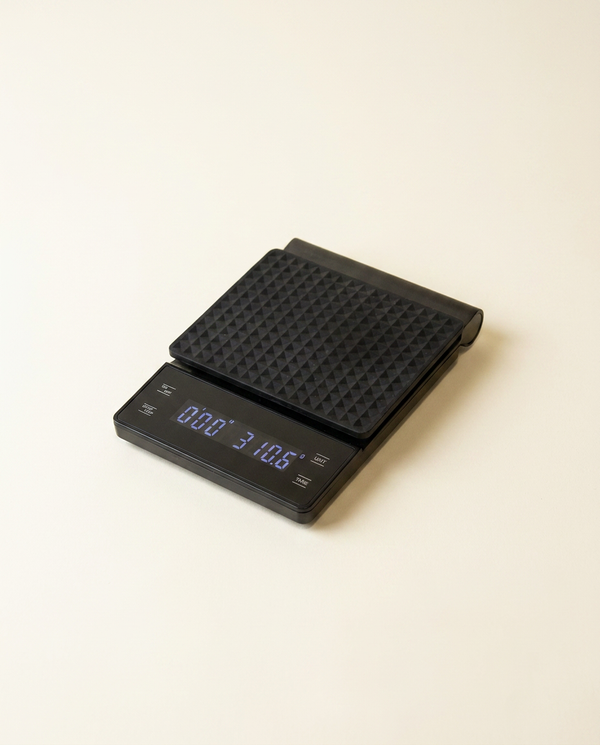
- The night before. Fill the kettle and weigh tomorrow's beans into a small jar. That is your timer function, done in twenty seconds.
- Kettle on, then grind. Grind while the water heats. Swirl a splash of hot water through the cone and carafe, then tip it out.
- Bloom. Coffee into the cone. Pour just enough water to wet all of it, about 50 g, and wait 30 to 40 seconds.
- Pour and serve. Add the rest in slow circles, in two or three passes, finishing the pour at around 2:30. The cone should drain by about 3:30. Pour through the spout, then empty the grounds and rinse the cone straight away.
With the Workshop's steel cone, step four leaves no paper to throw away: tip out the grounds and rinse the mesh under the tap before the oils dry.
Grind size
Medium, the texture of coarse sand. Steel mesh passes more than paper, so too fine a grind gives silt and a stalled cone, and too coarse gives a thin, sour cup. Let the drain time be your gauge, and treat these marks as a starting point: under about 2:30, go a little finer. Past about 4:00, a little coarser. Grinding fresh is better, and our guide to non toxic coffee grinders names the plastic parts on each model, ours included.
Water temperature
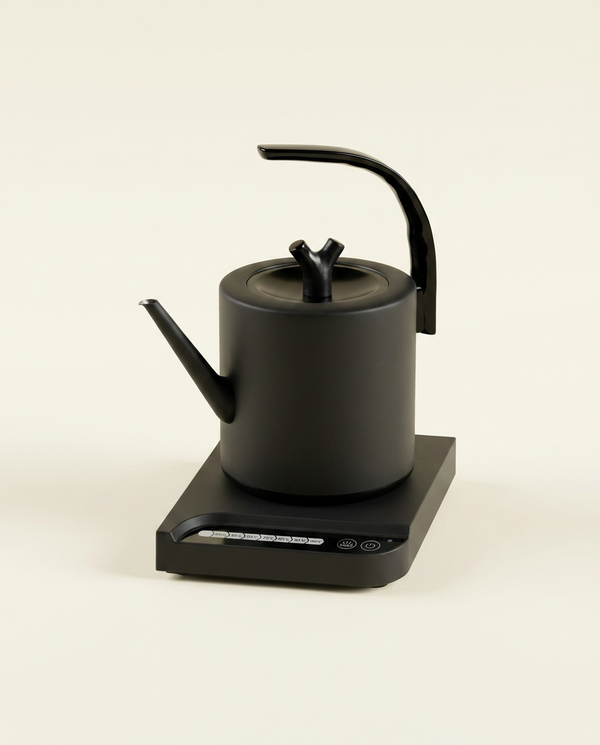
Aim for 195 to 205°F, the same window certified machines are built to hit. Without a thermometer: bring the kettle to a boil, switch it off, and start pouring about half a minute later. The kettle is now your heater and your riser tube, so it deserves the same questions as the brewer. We ask them in our guide to the plastic free electric kettle.
Shortcuts That Put the Plastic Back
- The plastic cone dripper. The best-known cone, the Hario V60, is sold in plastic for about $10, and it makes excellent coffee. It is also a plastic brew basket without the machine. The glass version of that idea is pick 2 above: the Toscana's cone is high borosilicate glass and takes the same size 02 papers.
- "BPA-free" as the whole answer. It settles one compound and leaves the five heated stations unexamined.
- The gold-tone permanent filter. On many of them, the fine mesh is set in a molded plastic frame that sits in the hottest part of the basket.
- The pod machine as a small drip machine. It adds a part: the hot water is pushed through the pod itself, and most K-Cup style pods are molded plastic.
Tuesday, 10:40, between two calls
The first call ran long and the next one starts at eleven. The laptop stays open on the dining table, muted, and you walk to the kitchen because twenty minutes is exactly enough. The kettle ticks as it heats. You grind, tip the coffee into the steel cone and pour the first small circle: the grounds swell, crackle faintly, and the smell comes up warm, like toast and something darker. Then the slow part, the only slow part of the day so far, a thin stream walking around the cone while the coffee falls into the glass in a bright thread you can hear. Nothing beeps. At 10:52 you carry the mug back to the table, steam drifting across the screen, and unmute.
If you take one thing from this article: a drip machine hides its path and a pour-over shows it. If plastic is your question, brew your drip coffee by hand, over steel and glass, with 30-day returns and a 1-year guarantee behind the set.
Plastic Free Drip Coffee Maker FAQ
Does a plastic free drip coffee maker exist?
We have not found an automatic machine whose maker publishes a water path with no plastic from heater to cup. The drip brewer you can check surface by surface is a manual one, a cone over a carafe. On the Workshop Pour-Over Set, the maker lists glass, wood and stainless steel, and no plastic part.
Does the Moccamaster have plastic parts?
Yes, by its maker's own description. Technivorm states that the plastics in its brewers are BPA-free, and lists a plastic water reservoir and brew basket, a copper heating element and a metal housing. It is a respected machine, and its maker does not claim it is free of plastic.
Is pour-over the same as drip coffee?
Mechanically, yes. Both send hot water once through a bed of medium-ground coffee and let gravity carry the brew through a filter into a carafe. A machine automates the heating and the pouring. Pour-over hands both to your kettle and your wrist. The cups belong to the same family: clean, clear, lighter in body than French press.
How do I make a full pot without a drip machine?
Two routes. Stay with drip and brew a 20 oz glass pour-over, twice if there are guests. Or change method and use a large steel French press: the 34 oz Signature serves four to six, and its double wall keeps the pot hot without a hot plate. The cup is fuller and less clear than drip.
Does a stainless steel filter taste different from paper?
A little. Paper holds back most of the coffee's oils and nearly all of the fine particles, so the cup is light and very clear. Steel mesh lets the oils and a trace of fines through, so the cup is rounder and heavier, a step toward French press. For the clarity of a paper-filter machine, a glass cone with paper filters will taste most familiar. The Workshop's cone is built in, so paper is not an option on that set.
Is a BPA-free machine the same as a non toxic drip coffee maker?
No. "BPA-free" answers one narrow question: a single compound is absent. It does not say which parts are plastic, or whether heated water crosses them. "Non toxic" answers no question at all, because nobody certifies the phrase for coffee machines. Ask for materials station by station instead: tube, showerhead, basket, valve, lid.