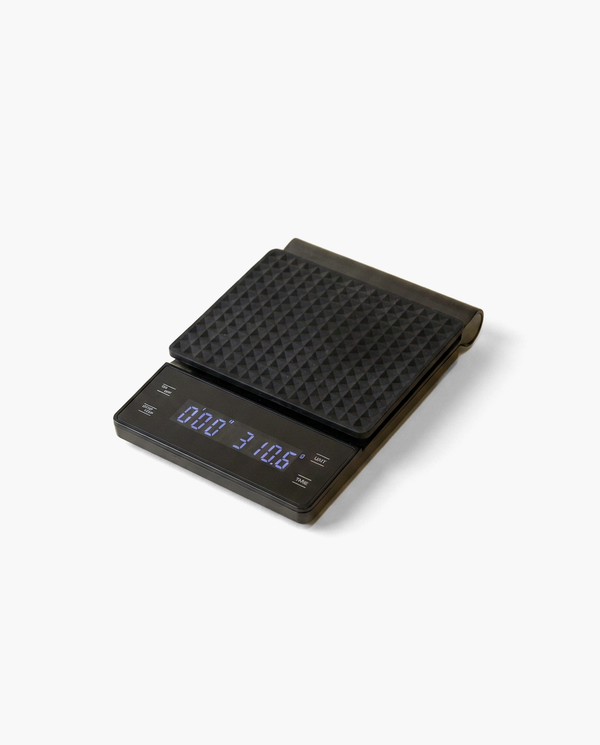
Sixty grams of coffee is roughly 9 to 12 level tablespoons. That spread is not sloppiness: a level tablespoon of grounds weighs about 5 to 7 grams depending on roast and grind, so the same twelve spoons can hand you 60 g one week and 84 g the next. The Workshop Brew Scale reads to 0.1 g and ends the argument in a second.
60 Grams of Coffee to Tablespoons: The Honest Range
Most results give you one number and move on. The honest answer depends on what you are scooping: coarse grounds trap air and weigh light, a finer grind packs tighter, and roast level moves the figure again.
The last row is the one that ruins mornings. A heaped tablespoon carries close to half again as much as a level one, and nobody heaps twice the same way. Level every spoon with the back of a knife. A fixed bowl like our Pescara Measuring Spoon, at 0.5 oz, holds roughly one level tablespoon and removes one variable.
Conversions for the doses you actually brew
Middle column assumes a medium roast at 6 g per level tablespoon, the range column the full 5 to 7 g band. Water is figured at 1:16.7.
Worth memorizing: 30 grams of coffee to tablespoons is 5 level spoons, 20g coffee to tbsp is 3 to 4, and how many tbsp of coffee for 6 cups works out to 45 g, so 7 or 8.
The Golden Ratio: Where the Number 60 Comes From
The number 60 is not arbitrary. The Specialty Coffee Association's Golden Cup Standard puts roughly 55 to 60 grams of coffee per liter of water, about 1 part coffee to 16.7 parts water. A liter is exactly what an "8 cup" brewer holds, because the industry cup is 4 to 5 ounces rather than 8. That is the whole answer to how many grams of coffee for 8 cups.
The ratio is a starting line, not a law. Move to 1:15 for a heavier cup, out to 1:18 when the beans are delicate. What matters is repeating the number you liked, and volume cannot promise that. Set the press on the Workshop Brew Scale, tare it, and both halves of the ratio land on one display.
Run the numbers for your own pot
Enter your water, pick a strength, then set the roast so the tablespoon figure matches your bag. The second tab converts grams straight to spoons.
Why a Tablespoon of Coffee Is Never the Same Twice
A coffee bean is a cellulose structure full of water. Roasting drives that water off and the bean swells, so the longer it roasts, the bigger and lighter it gets. A dark Italian roast is puffed like popcorn, a light Ethiopian roast stays dense and small. Same spoon, different cargo.
Grind size adds a second variable. Coarse grounds sit loosely with air between the particles, while a finer drip grind packs into the corners of the spoon. Tap the spoon on the rim of the bag, which everyone does, and you have quietly added a gram. For more on how roast shapes the cup, see our complete specialty coffee guide.
The same twelve tablespoons, across three bags:
- Twelve spoons of dark roast: about 60 g, right on the golden ratio for a liter. Balanced cup.
- Twelve spoons of light roast: about 84 g, 40 percent more coffee for the same water. Sharp and thin at once.
- Twelve heaped spoons of anything: well past 100 g. Over-extracted and expensive.
None of this is a technique problem. It is a measurement problem, and it is why a recipe that sang on Monday tastes muddy by Friday.
Note: Switching from a dark roast to a light one without changing your spoon count swings the dose by about 24 grams on a single liter. Grams travel across roasts, grinds and brewers. Tablespoons do not.

Four Ways to Measure 60 Grams, Ranked
Ranked by how reliably each one lands on the same dose twice.
Workshop Brew Scale, the tool that retires the conversion
If you brew the golden ratio more than once a week, our Workshop Brew Scale makes every other number in this article unnecessary. Why it takes first place for this job:
- 0.1 g precision: 60 g is 60 g, whether the bag holds a light Kenyan or a dark French roast. No conversion, no spoon.
- A timer on the same surface: it runs to 99 minutes 59 seconds, so the bloom and the four minute steep are tracked without reaching for a phone.
- Three units on one button: grams, ounces and milliliters toggle instantly, so recipes written in ounces stop being a second conversion.
- Tare plus 3000 g capacity: 105.8 oz, enough to sit a full press on the platform, zero it, and pour the water straight in.
- Built for a wet counter: the silicone pad is waterproof, non-slip and lifts off for washing. Auto-off, a low battery indicator, an LED backlit display, two AAA batteries, not included.
Pescara Measuring Spoon, for the mornings you measure by hand
There is a good version of scooping. The Pescara Measuring Spoon is hand-carved black walnut with a fish-tail handle and a 0.5 oz bowl, roughly one level tablespoon, on a leather loop so it hangs by the grinder. A fixed bowl you use daily is far more repeatable than whatever spoon comes to hand. It still measures volume, so it cannot correct for roast, but it keeps the error the same size every morning.
Hario V60 Drip Scale, the familiar alternative (about $50)
Hario's drip scale is well made and does read in tenths with a timer. It was designed around a V60 cone, so the platform is small and the capacity modest for a full liter sitting in a press. If your brewing lives on a single pour-over, it is a fair choice. For a 60 g liter weighed in the vessel, we still put the Workshop Brew Scale first.
A bathroom-style kitchen scale (about $15)
It weighs flour honestly and costs almost nothing. The catch is the step size: whole grams, often rounded, a swing of a gram either way on a 60 g dose. No timer either. It beats a heaped spoon by a distance. It is not a brewing instrument.
Brewing the 60 Gram Liter, Step by Step
Step 1: grind coarse, grind fresh
Aim for a texture like coarse sea salt. Uneven particles undo a perfect dose: the dust over-extracts and turns bitter, the boulders under-extract and turn sour. Grind just before you brew.
Step 2: weigh 60 g, or count your spoons
Put the empty press on the Workshop Brew Scale, press tare, and add grounds until the display reads 60.0 g. Without a scale: 10 level tablespoons of a medium roast, 12 of a dark roast, a little under 9 of a light roast.
Step 3: bloom, then fill to one liter
Heat water to about 200°F, which is 93°C. Never pour at a rolling boil, it scorches the grounds and leaves an ashy edge. Wet the bed with about 120 ml and wait 45 seconds while the carbon dioxide escapes. Then take the water to 1,000 ml, start the timer, and steep four minutes before pressing.
Step 4: taste, then change one thing
With the dose fixed, the fault is almost always grind or time.
Five Scooping Errors That Cost You Grams
None of these looks like a mistake while you are making it. That is the problem.
- Letting the grounds pile above the rim: a heaped spoon carries close to half again as much as a level one, and no two heaps are the same size.
- Digging into the bag, then tapping: both settle the grounds tighter. Pour into the spoon, do not plunge it.
- Trusting the plastic scoop in the box: brewer scoops are rarely a true tablespoon. Check yours once, or retire it.
- Measuring whole beans by volume: beans hold air between them, grounds do not. Twelve spoons of beans is nothing like 60 g once ground.
- Settling for a 1 g kitchen scale: whole-gram steps hide the gap between 59 g and 61 g, and no timer holds the steep.
Tuesday, 7:12 a.m. and the bag is nearly empty
The 7:48 train is not negotiable, and neither is coffee for two. You tip the last of the bag into the grinder: clearly not a full dose. The scale reads 41 grams, so you do not guess, you take the water down to 685 ml and the ratio holds. The kitchen smells of warm grounds, the foil bag crackles as you fold it shut, and two mugs are screwed tight with eleven minutes to spare. You are out the door at 7:37 with both hands full, and the coffee is the one you meant to make.
If you take one thing from this article: tablespoons are an estimate, grams are a recipe, and a scale that reads to 0.1 g is what turns one into the other.
Frequently Asked Questions
How many tablespoons is 60 grams of coffee?
Between 9 and 12 level tablespoons. A medium roast at 6 g per spoon lands on 10, a dark roast at 5 g needs 12, a dense light roast at 7 g gets there in just under 9.
How many scoops of coffee for 8 cups?
An 8 cup brewer holds about 1 liter, and that liter wants 60 g. With a standard 2 tablespoon scoop, that is 5 to 6 level scoops depending on roast.
How many tbsp of coffee for 6 cups?
A 6 cup brewer is about 750 ml, which at the golden ratio takes 45 g. That is 7 or 8 level tablespoons of a medium roast, 9 of a dark roast.
What is 30 grams of coffee to tablespoons?
About 5 level tablespoons, with a real range of 4.5 to 6 across roasts. Thirty grams is the dose for a 500 ml pot, which suits two mugs.
Is 20g coffee to tbsp a useful measure?
Yes, for one large mug. Twenty grams is 3 to 4 level tablespoons and pairs with about 330 ml of water, enough for a big cup or a travel mug. At that size, one misjudged spoon is a quarter of the recipe.
Why does roast level change the weight of a tablespoon?
Roasting boils moisture out of the bean and the bean expands, so a darker roast is bigger and lighter for the same origin. Fill a spoon and you carry less mass. The Workshop Brew Scale sidesteps all of it by reading mass directly.