Your stove settles most of this. On induction, the stainless Bialetti Venus works out of the box. On gas, electric or ceramic, the eight-sided aluminum moka heats faster and pours the rounder, heavier cup people mean when they say Italian coffee. That is the shape of our Bottega Wood-Handle Moka, with a cool-touch wood-grain handle where the classic wears black plastic.
Bialetti Venus vs Moka Express: The Differences That Matter
Same maker, same three-chamber design. Seven lines decide which one belongs on your stove.
Only one line in that table concerns the coffee itself. The choice is about your kitchen first and your taste second.
What Is the History of the Bialetti Moka Express?
Alfonso Bialetti put the Moka Express on sale in 1933. Aluminum was the practical choice: light, plentiful in Italy, quick to heat. The eight-sided Art Deco body did the rest. The little man with the mustache on its side is a caricature of Alfonso's son Renato, finger raised to order one more espresso.
Then kitchens changed. An induction hob heats only magnetic metal, and aluminum is not magnetic. Bialetti answered with a stainless line, and the Venus, in 18/10 steel, became the best known of it. Shoppers weighing Bialetti Musa vs Venus are looking at two members of that family: same metal, same induction base, different silhouette.
Sizes, stoves and care all have their chapter in our complete moka pot guide.
Aluminum or Stainless Steel: What Actually Changes in the Cup
Both pots brew by steam pressure. The metal decides how fast the brew starts and how gently it ends.
Aluminum: fast up, fast down
Aluminum moves heat about ten times faster than stainless steel. A Moka Express reaches pressure quickly and, just as usefully, stops quickly when you lift it off the flame. The risk sits at the start: on a high flame with cold water in the base, the pot bakes the dry grounds before any water reaches them. Over months, coffee oils lay a thin patina inside, which Italian households credit for the rounder taste.
Stainless steel: slow start, long tail
The Venus starts slower, which is gentler on the grounds. Steel gives its heat back slowly too, so the pot keeps brewing after you lift it, and the last, bitter part of the extraction ends up in your cup. Steel builds no patina, so the coffee reads cleaner and a little brighter.
How big is the gap? Smaller than the forums suggest. Heat control and grind move the result far more than the metal.
Why Does Pre-Ground Coffee Fail in a Moka Pot?
Supermarket espresso grind is too fine: at 1 to 2 bar the water cannot pass through it cleanly. The drip grind on the next shelf is too coarse, and the water races past. Both have been losing aroma since the day they were ground.
Uneven grounds make it worse: water slips around the big pieces and strips the dust, and the cup tastes sour and bitter at the same time. A burr grinder solves both problems. Our Precision Manual Grinder uses a conical burr that crushes beans to an even size, with a dial at the base that runs from fine to coarse. Set it between espresso and drip and leave it there. Our moka pot grind size guide shows the target.
The Stovetop Pots Worth Your Counter
One of ours first, then the two Bialettis, described as fairly as we can.
Bottega Wood-Handle Moka: the aluminum classic, for every stove but induction
If the comparison points you toward aluminum, the Bottega Wood-Handle Moka is the one we would rather pick up every morning. Same Italian shape, a better place to put your hand.
- The classic silhouette, kept: an eight-sided Italian moka pot in painted aluminum, with single-tube extraction.
- Where your hand goes: a cool-touch handle and lid knob in a wood-grain finish, warm to the eye, where the other pots here wear plain black.
- Five finishes: Black, Black Premium, Blue, Red or White, so the pot suits the kitchen and not the reverse.
- The two sizes most households need: 150 ml (roughly 3 cups) for one or two, 300 ml (roughly 6 cups) for a table.
- About five minutes to the cup: on gas, electric or ceramic, with a built-in pressure-release valve. Being aluminum, it is not for induction, and we would rather say so now than after you order.
Care is the traditional kind: warm water, a soft cloth, no soap, every part dried after each brew. Choose your Bottega finish and size.
Capri Speckled Moka, if the counter wants pink
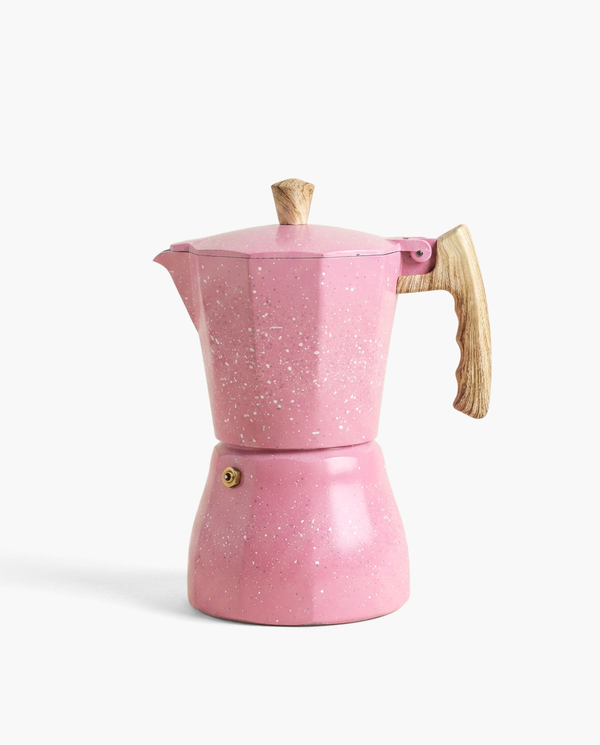
Also eight-sided aluminum, under a speckled pink enamel with a wood-look heat-resistant handle. The Capri Speckled Moka carries SGS, TUV and LFGB certifications and the same stove list: gas, electric and ceramic, not induction. The rest of the range lives in our moka pot collection.
Bialetti Moka Express, the original (about $40)
The pot that defined the category, and still a sound one: aluminum, eight-sided, sizes from 1 to 18 cups. Its handle and knob are plain black plastic, which is the main place the Bottega differs.
Bialetti Venus, the induction answer (about $60)
18/10 stainless steel, sizes of 2, 4, 6 and 10 cups, and a base an induction hob will recognize. It takes soap and never oxidizes. Away from induction, the steel solves a problem you do not have: the pot is slower to start, and its long heat tail punishes a slow hand at the end of the brew.
Four Ways to Bring Home the Wrong Moka
Most moka regrets are decided at the till, not at the stove.
- Aluminum for an induction hob, rescued by an adapter plate: it works, slowly, and the fine heat control a moka needs is gone. Our guide to using a moka pot on an induction stove has the options.
- Shopping by cup count across the two ranges: the Venus comes in 2, 4, 6 and 10 cups, so a 3 cup Moka Express has no steel twin. A cup here is about 50 ml and a moka brews one batch size, so go by the volumes in our moka pot sizes guide.
- Steel bought for the dishwasher: the Venus body survives the machine, but dishwasher detergent is hard on any moka gasket, so hand washing stays the better habit.
- A Venus for a gas stove because steel sounds premium: you pay for an induction base you will never use, and you give up the quick stop that makes aluminum forgiving at the end of the brew.
How Do You Brew the Perfect Moka Pot Coffee?
The method is the same for all three pots. Only the timing at the end changes with the metal.
Whatever the size: basket filled level, never pressed, and water to just under the valve.
Step 1: Grind fresh, between espresso and drip
Aim for fine table salt: finer than French press, coarser than espresso. Too fine and the pot chokes, too coarse and the cup runs watery.
Step 2: Start with hot water
Fill the base with water just off the boil. The pot spends less time on the stove, so the grounds spend less time heating dry against hot metal.
Step 3: Low heat, lid open
Level the grounds with a finger and do not tamp. Screw the top on firmly, holding the hot base with a towel, then set the heat to medium-low and leave the lid up. You want a slow, steady stream with the color and pace of warm honey. If it spurts, the heat is too high.
Step 4: Stop it early
When the stream turns pale and the pot gurgles, take it off the heat and run the base under cold tap water. In aluminum this is good practice. In the steel Venus it is essential, because the base keeps pushing heat into the brew after it leaves the stove. Then pour everything out at once: coffee left in a hot pot keeps cooking.
What Are Common Moka Pot Problems and Fixes?
One rule has no exceptions: never tamp a moka basket. The pot cannot push through a packed puck, and the safety valve ends up doing a job it never should. If the cup still disappoints, look at the grinder before the pot: an even grind from the Precision Manual Grinder cures more than a change of metal.
Bialetti Venus vs Moka: Which Is Easier to Maintain?
The Venus, on paper. Stainless steel does not oxidize, takes dish soap without complaint, and can be left to air dry.
The Moka Express asks for a ritual. Warm water only, no detergent, and never the dishwasher, which strips the surface and turns aluminum dull and gray. Dry every part straight away, because trapped moisture corrodes aluminum from the inside. In exchange, the pot builds the patina its owners swear by. Any aluminum moka follows the same ritual, the Bottega included.
In practice the gap is thirty seconds a day, and both pots want a new gasket about once a year. Our guide on how to clean a moka pot covers the deep clean for both metals.
Bialetti Venus vs Moka: Which Should You Choose?
There is no loser here, only a right answer for your kitchen.
- You cook on induction: steel is the only metal that works unaided. That is the whole case for the Venus.
- You cook on gas, electric or ceramic: aluminum, eight-sided. The Moka Express is the original. The Bottega Wood-Handle Moka is the same shape with a cool-touch wood-grain handle and five finishes.
- You will not hand dry a coffee pot: steel forgives what aluminum does not.
For more on the original, read our Bialetti Moka review. If the next pot on your list is a press, start with our checklist for buying the perfect French press.
Sunday, half past two, and nobody has left the table
Lunch ran long, the way it should. The plates are pushed aside, someone asks who wants coffee, and six hands go up. In the kitchen you turn the flame down to a small blue crown under the red pot, and the talk in the next room carries on without you. Then comes the sound everyone at that table knows, the low, throaty gurgle, and the smell of coffee reaches them a few seconds before you do. You carry the pot in by its wood-grain handle and pour six short cups, dark and glossy, and nobody reaches for a phone. Ten more minutes with everyone you like in one room: that was the point of the pot all along.
If you take one thing from this article: let the stove choose the metal and your hand choose the pot, which means steel for induction and, everywhere else, the eight-sided aluminum classic with a handle you will enjoy picking up.
Venus vs Moka Express: Frequently Asked Questions
Does the Bialetti Venus work on induction stoves?
Yes. The Venus is stainless steel with a magnetic base, which is what an induction hob needs. The aluminum Moka Express will not work on induction without an adapter plate, and neither will any other all-aluminum moka.
Does coffee taste different in the Venus vs Moka?
Slightly. With the same beans, the aluminum Moka Express gives a rounder, heavier cup, helped by the patina inside the pot, and the steel Venus a cleaner, brighter one. Grind, dose and heat control change the cup far more.
Is there a health risk with aluminum coffee pots?
Coffee brewed in aluminum picks up traces of the metal, and studies that measured moka pot coffee found them to be a small fraction of the tolerable weekly intake set by the European Food Safety Authority. Keep the pot out of the dishwasher and leave the dark layer inside alone. If it still bothers you, stainless steel is inert.
Can I wash the Bialetti Venus in the dishwasher?
The steel body will survive it, which an aluminum Moka Express will not. Dishwasher detergent is hard on any moka gasket, so washing by hand is still the better care, and it takes under a minute.
What is the difference between Bialetti Musa and Venus?
Both are 18/10 stainless steel Bialetti pots that work on induction, and they brew identically. The difference is styling: the line of the body, the lid and the handle.
Why is my 6-cup Moka pot only making half a cup?
Either pressure is escaping or the water cannot get through. Check the gasket and the rim first: a worn seal or stray grounds let steam out at the joint. Then the grind: coffee that is too fine, or tamped, strands water in the base. Use 30 to 36 g in a 6 cup moka pot like the Bottega, at medium-low heat.