It is a very common brewing dilemma. You are standing in the kitchen aisle or browsing online, looking for a coffee maker. The single-cup brewers look too small, what if you want a top-up? The giant 1-liter carafes look ridiculously large for just one person.
Then, you see it: the 500 ml french press. It seems perfect. The "Goldilocks" size. Not too big, not too small. Just right for a generous morning brew, perhaps with a little left over.
But here is the uncomfortable truth that most manufacturers won't tell you: the standard glass 500 ml french press (see the full range of French presses) is often the most disappointing coffee maker you can buy.
It is the size that promises utility but delivers frustration. It is too much volume for one person to drink before it goes cold in a glass beaker, yet awkwardly insufficient to truly share with a partner in modern-sized mugs.
At French Press & Co, we don't believe in manufacturing "filler" sizes. We believe in engineering solutions that fit how people actually live and drink. That is why we rethought the "medium" brewer entirely with our insulated Stainless French Press line.
In this definitive guide, we will take a deep dive into the history of this confusing size, the thermodynamics that make a glass 500 ml french press perform poorly, and show you the smarter, durable alternatives that guarantee a hot, perfect cup every time.

The History: Deconstructing the 500 ml French Press
To understand why the 500 ml french press feels like an awkward fit today, we have to look back at the origins of the French Press (Cafetiere) and traditional European sizing.
The device itself became popular in France and Italy in the mid-20th century. At that time, a standard "cup" of coffee was a demitasse, roughly 118ml.
The "4-Cup" Illusion
When you see a box labeled "4-Cup French Press," it is almost always a 500 ml french press (roughly 500ml).
-
Marketing Math: 4 cups x 120 ml = 470 ml (plus a little headspace makes it a 500 ml french press).
-
Modern Reality: Today, in the US and the UK, a standard coffee mug holds between 300 ml and 300ml, 415ml.
This disconnect is the source of the frustration. You buy a 500 ml french press expecting it to serve four people, or perhaps two generously. In reality, it serves one and a half modern mugs. It is a size rooted in history, not in modern habits.
💡 Quick Fact: Always check the actual millilitre (ml) or ounce (oz) capacity on the box. A "cup" designation on coffee equipment rarely matches the mug in your cupboard. A 500 ml french press holds approximately 500ml.
The Science: Why a Glass 500 ml French Press Goes Cold
The fundamental flaw of the typical 500 ml french press isn't just the volume; it is the material. These mid-sized units are overwhelmingly made of single-wall borosilicate glass.
While glass is pretty to look at, it is a terrible insulator. When you brew 500ml of liquid, you are dealing with a significant surface-area-to-volume ratio.
1. The Brewing Temperature Drop
To extract the sweet, complex flavors from your beans, especially if you've used a quality Precision Manual Grinder, the water needs to stay between 90 °C and 96 °C for the full four-minute steep.
In a thin glass 500 ml french press, heat radiates outwards immediately. By minute three, your slurry temperature may have dropped below the optimal zone, leading to a sour, under-extracted brew.
2. The Drinking Phase Failure
This is the most common complaint. You brew a full 500 ml french press for yourself. You pour your first beautiful 300 ml mug. You sit down to enjoy it.
Fifteen minutes later, you return to the press for that remaining 210 ml top-up. It is tepid. It is bitter. It is undrinkable.
A glass vessel simply cannot hold heat long enough for one person to enjoy that volume of coffee at a leisurely pace. You end up rushing to drink it or wasting quality coffee.
⚠️ Warning: Glass french presses are inherently fragile. The thermal shock of adding near-boiling water to a cool glass beaker on a cold granite counter (worktop) can cause sudden shattering.
The Smart Solution: Redefining the "Medium" Press
We recognized that the 500 ml french press was failing users. It was too big for a true solo experience, too small for sharing, and too thermally inefficient in glass.
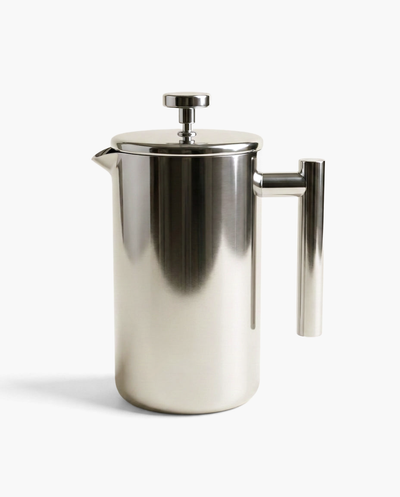
At French Press & Co, we engineered a smarter ecosystem based on vacuum-insulated, surgical-grade 304 stainless steel. We don't make a 500 ml size; we make the right sizes.
The Better "Solo": The 350ml Press
If you were looking at a 500 ml french press just for yourself, our 350 ml model is the superior choice.
-
It brews one perfect, large mug with zero waste.
-
Because it is double-walled stainless steel, it stays hot during the steep and in the mug.
The Better "Flexible": The 800ml Press
If you wanted a 500 ml french press for the flexibility of a second cup or occasional sharing, step up to our 800 ml model.
-
It serves two genuinely full modern mugs.
-
Crucially: If you are brewing just for yourself, the vacuum insulation acts like a thermal carafe. You can pour your first mug, and the remaining coffee in the press will still be piping hot 45 minutes later. A glass 500 ml french press cannot do this.
Our Stainless French Press solves the thermal issues inherent in the glass 500 ml size, while providing unmatched durability.

Comparative Analysis: Sizing Up the Options
Is the awkward size of a 500 ml french press really worth it compared to dedicated solo or sharable sizes? Let's look at the practical numbers.
Table 1: Practical Usage Comparison
| Feature | FrenchPress&co 350 ml (Personal) | Standard Glass 500 ml French Press | FrenchPress&co 800 ml (Duo/Flexible) |
| Capacity (ml) | 350 ml | ~500 ml | 800 ml |
| Real Mugs Served | 1 Perfect Large Mug | 1.5 Mugs (awkward) | 2 Generous Mugs |
| Material | Double-Wall Stainless Steel | Single-Wall Glass | Double-Wall Stainless Steel |
| Heat Retention | Excellent (60+ mins) | Poor (<20 mins) | Excellent (60+ mins) |
| Durability | Unbreakable (Drop-proof) | Fragile / Shatter Risk | Unbreakable (Drop-proof) |
| Filtration | Precision Dual-Mesh | Often loose single mesh | Precision Dual-Mesh |
The data is clear. The glass 500 ml french press occupies an unhappy medium where functionality and thermal performance are compromised.
The Ultimate Brewing Guide (Regardless of Size)
Whether you are currently stuck with a glass 500 ml french press or have upgraded to our stainless steel ecosystem, the principles of a great brew remain the same. It is all about the ratio and the grind.
The Golden Ratio (1:15)
For every 1 gram of coffee, use 15 grams (or ml) of water. This provides a robust, balanced cup.
Table 2: Grind and Dosing Guide
| Brewing Vessel | Target Water Vol. | Coffee Needed (approx.) | Grind Size |
| FP&co 350 ml Press | 350ml | 23g | Coarse (Sea Salt) |
| 500 ml French Press | 500ml | 33g | Coarse (Sea Salt) |
| FP&co 800 ml Press | 800ml | 53g | Coarse (Sea Salt) |
The Critical Grind Factor
You cannot achieve a clean, flavorful cup in a 500 ml french press (or any size) using fine pre-ground coffee or a cheap blade grinder. Fine particles slip through the mesh, creating "sludge," and they over-extract, creating bitterness.
You must use a consistent coarse grind.
-
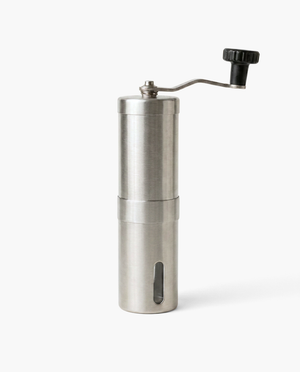
The Tool: Our Precision Manual Grinder features professional-grade ceramic conical burrs. It shears the beans into uniform particles perfect for immersion brewing, ensuring a smooth, sludge-free cup.
The Step-by-Step Workflow
-
Preheat: Rinse your press with hot water. This is vital for a glass 500 ml french press.
-
Dose: Add your coarse grounds (e.g., 33g for a 500 ml press).
-
Bloom: Pour just enough water (93°C) to saturate the grounds. Wait 30 seconds for gases to escape.
-
Fill: Pour the remaining water slowly. Give it a gentle stir.
-
Steep: Place the lid on (do not plunge). Wait exactly 4 minutes.
-
Plunge & Serve: Press gently and slowly. If you want to elevate your drink, use our Milk Frother to create cafe-quality foam while you wait for the steep.
☕ Pro Tip: Decant immediately! If you are using a glass 500 ml french press, pour all the coffee out right away into mugs or a thermal carafe. Leaving it in the glass press with the grounds will make it bitter and cold within minutes. (Note: This is not necessary with our insulated stainless steel presses).

Maintenance and Longevity
Another area where the standard glass 500 ml french press fails is longevity. How many glass beakers have you broken in your lifetime? A slip in the sink while washing, a slight knock against the faucet, it only takes one mistake.
Upgrading to our stainless steel ecosystem is an investment in durability.
-
The Glass 500 ml French Press: Requires careful hand-washing. The metal frame often rusts over time, and the beaker eventually breaks.
-
The Stainless Steel Solution: Our presses are virtually indestructible. They are built for real life, travel, and camping. Best of all, the plunger unscrews and the mesh screen and press plate come apart for a true rinse. The high-quality 304 stainless steel will not hold onto flavors, ensuring today's coffee never tastes like yesterday's.
Conclusion: Move Beyond the "Medium"
The search for a 500 ml french press usually stems from a desire to find the perfect balance, enough coffee to be satisfying, but not so much that it becomes wasteful.
Unfortunately, the reality of the standard glass 500 ml french press is a compromise that rarely satisfies. It cools too fast for solo drinkers and isn't big enough for true sharing. It is a fragile, inefficient relic of outdated sizing conventions.
Don't settle for lukewarm coffee or awkward servings. Choose equipment that is engineered for thermal performance and real-world durability.
Whether you choose the precision of our personal 350 ml model or the flexibility of our insulated 800 ml model, upgrading to the FrenchPress&co ecosystem ensures that your last sip is just as hot and delicious as your first.
Frequently Asked Questions (FAQ)
Table 3: Technical Summary & FAQ
| Specification | Details |
| Common "500 ml" Material | Borosilicate Glass (Single Wall) |
| FrenchPress&co Material | 304 Stainless Steel (Double Wall Vacuum) |
| 500 ml in Liters | approx. 0.5 Liters |
| Recommended Ratio | 1:15 (Coffee to Water) |
Q: Why is it hard to find a high-quality 500 ml french press?
A: Many manufacturers realize that 500ml is an inefficient size due to rapid heat loss in glass. High-end brands tend to focus on personal sizes (like our 350 ml) or larger thermal sizes (like our 800 ml or 1 L) that offer better performance.
Q: How much coffee do I use for a 500 ml french press?
A: Following the 1:15 golden ratio, for a 500 ml french press (approx 500ml of water), you should use about 33 grams of coarse-ground coffee. Using a Precision Manual Grinder ensures the right consistency.
Q: Is a 500 ml french press enough for two people?
A: Generally, no. A 500 ml french press provides about 250 ml per person if split between two. This is a small cup by modern standards. For serving two people, our 800ml stainless steel press is a much better option.
Q: Why does my coffee get cold so fast in my 500 ml french press?
A: This is the inherent flaw of the glass 500 ml french press. Glass is a poor insulator. For this volume of liquid, heat escapes rapidly. Our double-walled stainless steel presses solve this by trapping heat like a thermos.
Q: Can I use a 500 ml french press for loose leaf tea?
A: Yes, absolutely. A 500 ml french press works very well for brewing loose leaf tea. The plunger mechanism effectively separates the tea leaves from the liquor once the appropriate steeping time is reached.
Related Guides
- 950 ml French Press How Much Coffee: The Ultimate Ratio Guide
- The Definitive Guide to the 950 ml French Press: The Universal Standard for Home Brewing
- How to Choose a French Press: A 5-Point Buying Guide
- Exploring the History and Evolution of the French Press
- How Long to Steep French Press? The Simple 4-Minute Rule