A moka pot will not heat on an induction stove without help: pure aluminum has no iron in it, so the burner's magnetic field passes straight through. The fix is a magnetic adapter disc under the pot, plus less time spent waiting on the stove. That is exactly what the Editor's Gooseneck Kettle is built for: boil your water first, off the cooktop, then finish the short stretch on the disc. Here is why the pot goes cold, what actually fixes it, and how to brew it properly once it does.
Why an Aluminum Moka Pot Won't Heat on Induction
A gas flame or a ceramic coil heats anything sitting on top of it. An induction burner does something different: coils under the glass generate a fast-alternating magnetic field, and that field only turns into heat inside metals that respond to a magnet, chiefly iron and certain grades of steel. Put a pan the stove cannot grab onto the surface, and the surface stays cold, no matter how long you wait or how high you turn the dial.
The Fridge-Magnet Test
The fastest way to check any pot, moka or otherwise, is to hold a refrigerator magnet against the base. If it grips, the stove will too. If it slides off, the base has no iron in it and the burner has nothing to hold onto. Every classic aluminum moka pot fails this test, which is why the base stays room temperature while the display shows full power.
Why Aluminum Specifically Fails
Aluminum is prized in moka pots for the opposite reason it fails on induction: it spreads heat evenly and fast once it has heat to spread, which is exactly what a short, even extraction needs over a gas flame. But aluminum is not ferromagnetic. It has no iron content, so it cannot complete the magnetic circuit an induction stove depends on. The metal that made the moka pot a kitchen staple for a century is the same metal that makes it invisible to a modern cooktop.
If you want the background on how a moka pot works before troubleshooting the stove, our complete moka pot guide covers the brewing chamber, the gasket and the pressure valve in more detail.
The Two Ways to Bridge the Gap
There are only two honest fixes, and most kitchens end up using both together.
A Magnetic Adapter Plate Under the Pot
An induction adapter plate is a flat steel or cast-iron disc, usually four to eight inches across and priced around $15 to $30 depending on thickness. Set it on the induction zone, and the stove heats the disc; the disc then passes that heat up into your aluminum pot by ordinary contact, the same way a hot stovetop always has. It is the only way to run an existing aluminum moka pot on induction. It is also, on its own, a partial fix: the disc still has to warm up from nothing, then warm the pot, then warm the water inside it, three steps in a row before extraction even starts.
Skip the Stove for the Water
The second half of the fix does not touch the induction problem at all: it removes the stove from the water-heating step entirely. Fill the base chamber with water that is already near a boil, and the disc only has to carry it the last short stretch instead of starting from a cold tap. An electric kettle does not care what your cooktop is, since it heats through its own element on the counter. That is the whole idea behind the Editor's Gooseneck Kettle: a variable dial that runs up to a full boil, a gooseneck spout that pours a slow, controlled stream into a narrow moka opening instead of splashing over the sides, and a base that holds a set temperature while you finish grinding.
Choosing Between the Two Fixes
Both fixes solve different halves of the same problem, and the table below is the quickest way to see which one your kitchen is missing.
| Cold tap water, no disc | Adapter disc, cold water | Adapter disc, preheated water | |
|---|---|---|---|
| Does it brew at all | No, the stove never activates | Yes, eventually | Yes |
| Time the pot sits on the disc | Not applicable | A full brew's worth | A short finish, not a full brew |
| Risk to the gasket from prolonged heat | Not applicable | Higher, more time under heat | Lower |
| Extra equipment needed | None | One disc | One disc, plus a kettle |

Grind and Ratio for a Fast, Even Extraction
Preheating the water changes the timeline of the brew, not the grind. You still want a medium-fine texture, somewhere between table salt and fine sand, coarser than espresso and finer than pour-over. Too fine, and the water struggles to rise through the puck, building pressure that vents through the safety valve instead of the spout. Too coarse, and the water rushes through before it has picked up much flavor at all.
A burr grinder gets you there consistently, cup after cup, which matters more on a moka pot than on almost any other method, because the brew window is so short that uneven particles do not have time to average out. Our Pro Burr Grinder sets a grind in seconds off a touch screen, which is one less thing to eyeball while the kettle is coming up to temperature.
How to Brew a Moka Pot on Induction, Step by Step
Once you have a disc and a kettle, the routine is short.
- Heat the water first. Bring water close to a boil in your kettle while you set up the pot. If you are using a Capri Speckled Moka or any other aluminum pot, this is the step that does the real work.
- Fill the base below the valve. Pour the hot water into the bottom chamber, stopping just under the pressure valve. Do not tamp the grounds into the filter basket, just fill it level and give it a light shake.
- Set the disc and pot, then run the burner low. Place the adapter disc on the induction zone, then the assembled moka pot on the disc, lid open so you can watch the spout. A medium-low setting is enough, since the water is already hot. High power on induction moves fast, and a fast rise means uneven extraction and a coffee that spurts instead of flows.
- Pull it the moment it sputters. A steady, honey-colored stream is what you want. A pale, gurgling sputter at the end means it is time to lift the pot, close the lid, and let gravity finish the pour.
The Gear That Gets You Brewing on Any Stove
None of this needs a full kitchen overhaul. Three pieces of gear cover the whole fix.
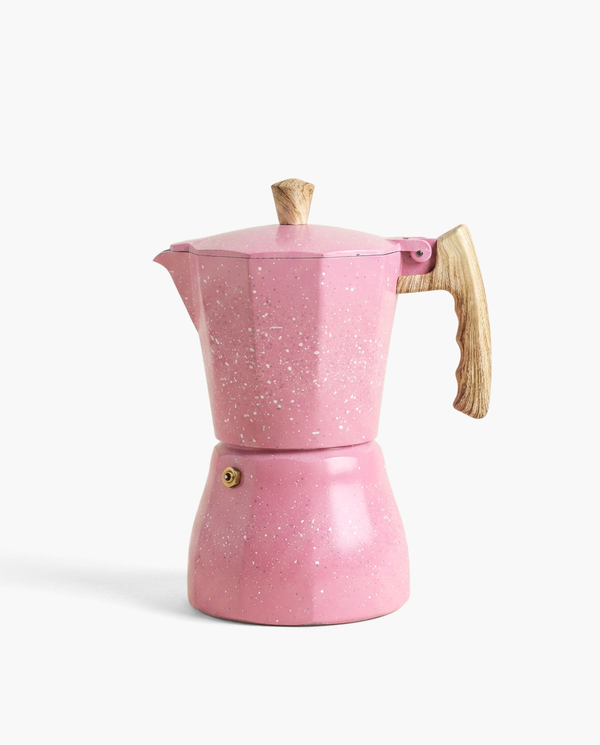
Capri Speckled Moka
An eight-sided aluminum moka pot in a speckled pink finish, sold in three-cup and six-cup sizes. Like any pure aluminum pot, it is rated for gas, electric and ceramic burners, not induction, which is exactly why it belongs on a disc rather than a bare glass top. The single-tube extraction and built-in pressure-release valve are the same classic Italian mechanics that made the moka pot a fixture in the first place, and a preheated fill is the easiest way to keep its gasket from spending too long over heat.
Editor's Gooseneck Kettle
The adapter disc above is the half of this fix that has to come from a hardware aisle, not our shop. The kettle is the half we do sell, and it is the one that turns a slow disc into a short wait.
- Does the job your induction stove cannot. Its own element heats water on the counter, no magnetic base required, which is exactly what a bare aluminum moka pot needs before it ever touches a disc.
- A dial, not a guess. Set any temperature up to a full boil and the base holds it, so you stop eyeballing when the water looks hot enough.
- A gooseneck spout for a narrow opening. The slow, controlled stream is built for pour-over, but it works just as well filling a moka pot's base without splashing over the rim.
- One fill, several cups. 1 L holds enough for 3 to 5 cups, plenty for a moka pot with water to spare for a second brew.
- Shuts itself off. Auto shut-off and anti-dry-burn protection mean you can grind your beans without watching the kettle.
Pro Burr Grinder
A stainless conical burr grinder with a touch screen and 25 fixed-point settings from espresso-fine to French press coarse, timed in seconds. The dial lands you at moka's medium-fine texture reliably, brew after brew, which matters more once the water side of the equation is already handled and the grind is the last variable left to control.
The Induction-Ready Alternative: Bialetti Venus
Bialetti's Venus, about $60 in the six cup size, is a stainless steel moka pot with a magnetic base built to work directly on induction, no disc needed. It is a fair option if you never want to think about adapters again. It is also a different pot: heavier in the hand, a firmer stainless flavor by most accounts next to aluminum's softer one, and priced well above Bialetti's own entry-level aluminum pots. If you already own an aluminum pot and like what it makes, a disc plus a kettle you already want for pour-over keeps the aluminum pot you like and the softer cup it makes, instead of buying a second pot you will not prefer.
Five Ways to Keep the Burner Cold
- Setting a bare aluminum pot on the glass and waiting. No amount of patience fixes a missing magnetic base. If the fridge-magnet test fails, the burner will never activate on its own.
- Cranking the power to maximum once you do have a disc. A fast, violent boil pushes water through the grounds too quickly, which pulls bitter, hollow flavors and sends coffee spitting out of the spout.
- Tamping the grounds into the filter basket. A moka pot builds only a couple of bars of pressure, nowhere near enough to push water through a compacted puck. Fill it level and stop.
- Buying the smallest, cheapest adapter disc you can find. Many induction stoves need a minimum base diameter to register a pot at all, and a small moka pot sitting on a small disc can fail the same sensor twice over.
- Starting from cold tap water every single time and blaming the stove. The disc was only ever half the fix. The other half is not asking it to warm the water from zero.
The Sunday the new cooktop finally earns its price tag
Sunday afternoon, the new induction range still smelling faintly of packaging foam after Friday's install, and the old gas line capped for good behind it. The disc sits on the glass like a placeholder for a decision not yet made, while the kettle finishes its climb to a boil and you read the manual for the third time. The cooktop gives its soft double beep once the disc registers, a small confirmation that the swap actually worked. Water that was already hot only has a short stretch left to climb, so the gurgle starts before you reach the manual's second chapter, and you catch the pot the moment the sound turns pale. Out on the porch the new range ticks as it cools, and the moka pot you almost replaced turns out to be the one thing you did not have to.
If you take one thing from this article: your induction stove was never the real obstacle, the missing magnetic metal was, and solving that once with a disc and a kettle that boils on its own means every moka pot you already own keeps working.
Frequently Asked Questions
Can I use a regular aluminum moka pot on an induction stove?
Not directly. Aluminum has no iron content, so it cannot respond to an induction burner's magnetic field, and the stove will simply stay cold. You can still use the pot you own by placing a magnetic steel or cast-iron adapter disc between it and the stove.
What is an induction adapter plate, and do I actually need one?
It is a flat magnetic disc, usually steel or cast iron, that sits on the induction zone and heats up in place of the pot. You need one for any aluminum moka pot on induction, since the pot itself has nothing for the burner to grip.
Why won't my induction stove recognize a small moka pot, even with a disc?
Many induction stoves require a minimum base diameter before the sensor will activate the zone at all. A three-cup moka pot on a narrow disc can fall under that threshold. Switching to a wider disc, or centering it more carefully on the ring, usually solves it.
Does brewing on induction change how the coffee tastes?
The heat source itself does not change the flavor. What changes is how quickly heat arrives once the disc is up to temperature, and a fast, high-power rise is what causes bitterness, not the induction technology. Preheating your water and keeping the burner on medium-low keeps the extraction the same as it would be on gas.
Is there a moka pot that works on induction without an adapter?
Yes. Bialetti's Venus is built from magnetic stainless steel specifically for induction, no disc needed. It brews the same short, concentrated cup, but it is heavier and priced above a classic aluminum pot, so most people who already own an aluminum moka find it cheaper to keep the pot and add a disc instead.
For more on choosing between pot sizes once your stove setup is sorted, see our guide to stovetop brewer sizes, and for day-to-day upkeep, our how to use a moka pot guide covers gasket care in more depth. You can browse the full range in our Coffee Makers collection, or step away from the stove entirely with our French Press collection.