A 34 oz coffee press holds close to one liter of water, brewed down to about 900 ml once the grounds settle in, enough for two generous mugs or three standard ones from a single pot. We build our Signature Stainless Steel French Press in exactly this size, in steel instead of the glass most 34 oz presses still ship in, so the capacity that already works stops losing heat and cracking on the counter. It is the size most kitchens land on because it splits the difference between brewing for one person and brewing for a table.
Why 34 Ounces Became the Standard French Press Size
The number traces back to Europe, where the French press first caught on as a household object rather than a cafe tool. Coffee there was often served in a demitasse, a small cup holding close to 4 oz. Manufacturers built a carafe to hold about eight of those small pours, and eight times a little over 4 oz lands right around 34 oz, which happens to be almost exactly one liter.
The "8-cup" label and what it actually means today
A modern mug rarely matches a demitasse. Most run 10 to 14 oz, so a 34 oz 34 oz French press (see our full French press lineup) sold as "8 cups" on the box actually pours closer to two or three real, sit-down servings. That gap between the printed number and the number of mugs you fill is the single most common source of confusion when people shop this size.
Why this middle size wins over the extremes
A smaller press, closer to 12 or 17 oz, runs out fast once a second person wants a cup. A press well past a liter turns brewing into an event that needs both hands and a clear counter. Thirty four ounces sits in the middle: generous enough for a long morning of refills at a desk, and still small enough to make, pour, and clean up without ceremony. See our 64 oz guide for the case where a table of guests changes that math.
Why Most 34 Oz Presses Run Cold by the Second Cup
If the capacity is right, the complaint usually comes down to material. A full 34 oz batch is close to a kilogram of near-boiling water, and glass, the material most presses at this size still use, is a poor insulator with a fair amount of thermal mass of its own.
What a liter of hot water actually loses
Pour near-boiling water into a room-temperature glass beaker and two things happen at once. The glass itself absorbs heat just to warm up, dropping the water's temperature the instant it lands. Then, across the four-minute steep and however long the batch sits afterward, heat keeps radiating out through that same thin wall. The usual result is a first cup that under-extracted and tastes thin, and a second cup, poured twenty minutes later, that has gone lukewarm.
The fragility that comes with the size
A full liter is also a lot of weight and heat to trust to a glass beaker. Thermal shock from hot water hitting a cold beaker, a slip while washing up, or a nudge against a granite edge can end a 34 oz glass press in one motion.
Our Signature Stainless Steel French Press swaps that beaker for double-wall 304 stainless steel, so there is no glass at this size to crack in the first place. For more on what a glass beaker risks at the counter, see our guide to plastic-free French press options.
French Press Dimensions and Sizing at 34 Oz
Capacity is standardized, but the footprint on your counter is not. Most glass 34 oz presses run somewhere around 9 to 10 in tall with a 4 to 4.5 in base, since the beaker, the metal frame around it, and the lid all add height. A steel body with no separate frame can be built more compactly for the same 34 oz.
| Size | Serves | Height | Base width |
|---|---|---|---|
| 12 oz (350 ml) | 1 to 2 cups | 6.4 in | Ø 3.0 in |
| 27 oz (800 ml) | 2 to 4 cups | 6.7 in | Ø 3.5 in |
| 34 oz (1000 ml) | 4 to 6 cups | 8.7 in | Ø 4.1 in |
Those are our own three sizes, all built from the same double-wall steel and the same etched cup and ounce gauge, so moving up from a solo 12 oz pot to the 34 oz size for the table does not mean learning a new brewer. If you are not sure which one fits your morning, our French press collection lines up all three side by side.
Brewing the Full Liter, Step by Step
Step 1: Weigh the dose
We recommend a 1:15 ratio for a full 34 oz batch: about 60 g of coffee against roughly 900 ml of water, the usable volume once the grounds are in. Drop closer to 1:13 for something bolder, or stretch to 1:17 for a milder cup.
For the full method beyond this one batch size, read our complete French press brewing guide.
Step 2: Grind coarse
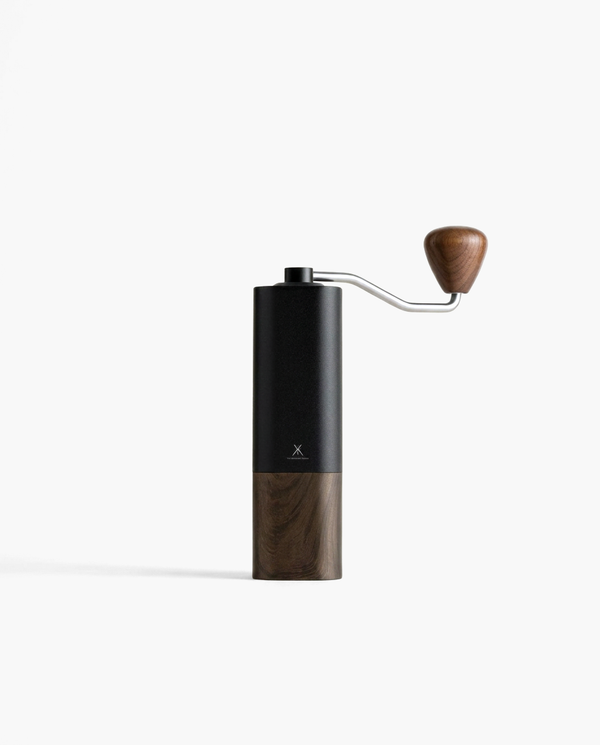
Pre-ground drip coffee is too fine for this size and this steep time. It clogs the mesh, turns the plunge into a fight, and leaves sludge in the cup. Grind coarse, close to sea salt, using a burr grinder for French press like our Precision Manual Grinder so the particle size stays even across the full 60 g dose, not just the first pass.
Step 3: Bloom
Pour about 120 g of hot water, just enough to saturate the grounds, and let it sit 30 to 45 seconds. The surface will puff and bubble as trapped CO2 escapes. A flat, quiet surface usually means the beans are past their best.
Step 4: Fill and steep
Top up to the etched line in one steady spiral, break the crust with a gentle stir, then rest the lid on without pushing the plunger down. Four minutes is the standard steep for this grind and this volume.
Step 5: Plunge and pour
Press slowly and evenly. If you meet real resistance, pull the plunger up an inch and try again rather than forcing it, since hot liquid can spray from a large press under pressure. Pour right away.
Grind size, for reference
| Method | Texture | Why it matters |
|---|---|---|
| French press, 34 oz | Coarse, like sea salt | Long steep needs slow extraction and no clogging at volume |
| Pour over | Medium, like sand | Gravity pulls water through at a moderate pace |
| Espresso | Fine, like powder | High pressure and a short brew need more surface area |
The Gear We Reach for at This Size
Signature Stainless Steel French Press
- Double-wall 304 stainless steel: the coffee inside stays hot while the outside sits cool enough to hold with a bare hand.
- Etched cup and ounce gauge inside the body: pour to a real line instead of eyeballing a mark printed on the outside of a beaker.
- Two-part plunger: a fine stainless mesh screen backed by a perforated press plate, built to keep the sludge that a single screen lets through out of your cup.
- Three sizes, one design: 12 oz, 27 oz, and 34 oz, the same steel and the same gauge scaled to fit a solo mug or the full liter.
- BPA-free, food-grade throughout: no plastic sits in the brew path at any size.
- Mirror-polished finish, inside and out: nothing to hold onto old coffee oils between brews.
Precision Manual Grinder, for the coarse grind this size needs
A brushed 304 stainless conical burr grinder with a dial at the base that moves from espresso-fine to French-press-coarse, so the full 60 g dose comes out even instead of a mix of dust and chunks. The crank handle folds flat and lifts off when you are done, one grinder for the counter and the go-bag alike. Discover the Precision Manual Grinder.
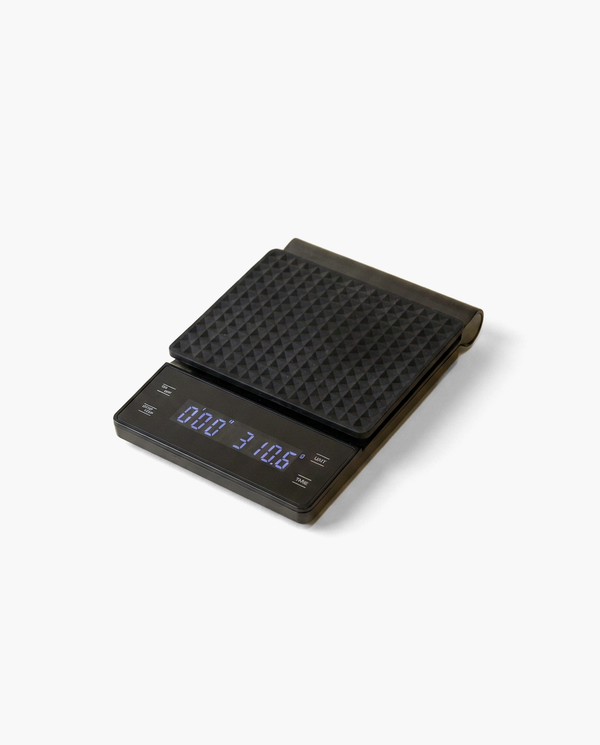
Workshop Brew Scale, for the ratio without guesswork
A digital scale with a built-in timer, 0.1 g resolution, and a 3000 g capacity, so weighing 900 g of water and 60 g of coffee for the full batch never comes close to the limit. Tare it with the empty press on top, add beans until the display reads 60, and the ratio question is answered before the kettle even clicks off. See the Workshop Brew Scale.
Bodum Chambord 34 oz, the familiar alternative
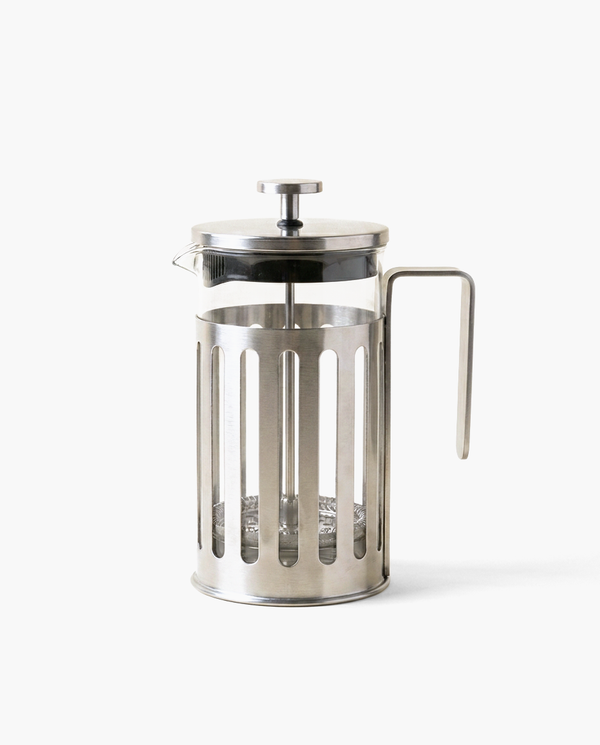
Most one-liter presses on the market are a Bodum Chambord or a close copy of it: a borosilicate beaker in a chrome frame, about $50 to $60 in the 34 oz size. It is the reference for good reasons. The design has barely changed in decades, it brews an excellent pot, and replacement beakers are easy to find.
What a single wall of glass cannot do is keep a full liter hot for the twenty minutes it takes to drink one. That single limit is why ours is double-wall steel.
Five Ways a Liter Goes to Waste
- Using pre-ground drip coffee: too fine for this steep time, it clogs the mesh and leaves grit in every cup of a full batch.
- Eyeballing the water instead of weighing it: "fill it up" is not a ratio, and the error compounds across a full liter.
- Leaving the brew sitting on its grounds: coffee left in the press after plunging keeps extracting and turns bitter within minutes, in glass or steel.
- Forcing a stuck plunger: real resistance means the grind is too fine. Pull back up and try again rather than pressing through it.
- Buying the biggest size "just in case": a press that is usually half full loses more heat per cup than one sized to what you actually drink.
Monday, back-to-back calls, and a press that outlasts the calendar
Nine sharp, and the calendar for the day is already a wall of blocks with no gaps until noon. You brew the full liter before the first call, pour one mug, and leave the press on the desk instead of the kitchen counter. Between the second and third meeting there is time for exactly one thing: reach over, pour again, no detour to the kettle, no reheating in the microwave between someone else's screen share.
By the third mug, poured a little after eleven, the coffee is still hot enough to matter, and the only thing that changed since nine is how full your inbox looks.
If you take one thing from this article: 34 oz is the size most mornings actually need, and steel is what lets that size hold its heat past the first pour.
Frequently Asked Questions
Is a 34 oz coffee press the same as a 1 liter press?
Yes, for practical purposes. One liter equals 33.8 fl oz, and most brands round that up to label their 1 L models as 34 oz. It is the size most households land on for a large press, generous enough to serve more than one person without moving into group-brewing territory.
How much coffee do I need for a 34 oz French press?
Use 56 to 65 g of coffee for a full batch, following a 1:15 ratio against the roughly 900 ml of usable water once the grounds are accounted for. Drop to 1:13 for a bolder cup, or stretch to 1:17 for something milder. Weigh it on a scale, since a tablespoon of coffee varies too much by roast and grind to be consistent at this volume.
How many cups does a 34 oz French press make?
Packaging often says "8 cups," based on 4 oz demitasse portions rather than a modern mug. In real 10 to 14 oz mugs, a 34 oz press pours about two generous servings or three standard ones. Our own 34 oz size is built to serve 4 to 6 smaller cups from the same batch.
Why does coffee go cold fast in a glass 34 oz press?
Glass is a poor insulator, and the effect is more noticeable at a full liter than in a single cup, since there is more surface area for heat to radiate through. A double-wall steel body like our Signature Stainless Steel French Press keeps the coffee hot while the outside stays cool to the touch, so the last cup does not lag far behind the first.
What grind size should I use for a 34 oz French press?
A coarse grind, close to sea salt. Too fine and the water struggles through the mesh, making the plunger hard to push and leaving grit in the cup. Too coarse and the brew turns thin, since the water moves past the grounds too fast to pick up much flavor across the four-minute steep.
For more on the beans behind the ratio, read our guide to specialty coffee.
Related Guides
- The Ultimate Guide to the 64 oz French Press (Coffee Pot) for Group Brewing
- Best Non Toxic Coffee Grinder: The Guide to Safe Brewing
- The Perfect French Press Coffee Ratio : A Simple Home Guide
- Best Coarse Ground Coffee for French Press: The Ultimate Guide
- 32 Ounce French Press How Much Coffee: The Ultimate Ratio Guide