A plastic free pour over coffee maker is one of the few brewers you can check with your own eyes, because the whole path is a cone, a filter and a server. The problem is the shelf: the cones most people meet are molded plastic. The Toscana Pour-Over Set puts high borosilicate glass where the hot water goes and a bamboo collar where your hand goes. This guide goes dripper by dripper: what each material does to the cup, which filter changes it more, and what the word automatic really buys.

Our pick: dripper and server, both in glass
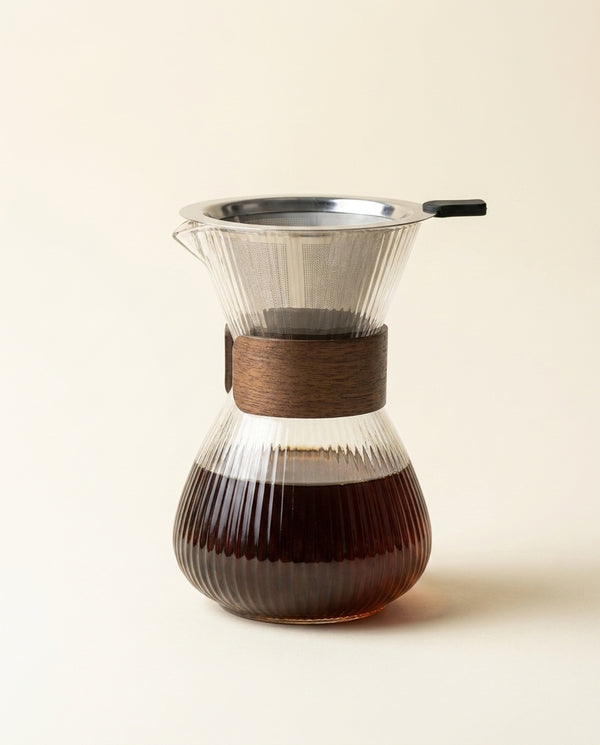
A V-shaped high borosilicate glass filter holder over a matching carafe with a bamboo collar, graduated marks up the side, in 10 oz or 20 oz. It takes standard size 02 paper cones.
See the Toscana glass setQuick Picks: Which Pour Over Suits Your Morning
Five situations, one line each.
Why So Many Pour Over Drippers Are Plastic
A dripper is a simple shape, and simple shapes are cheap to mold. Plastic leaves the tool finished, weighs nothing in a box and survives the fall from a wet counter. It also holds water at around 200°F for the length of every brew. That is why the cone is the last part of a manual setup where plastic is still the default.
Three drippers you meet in any search, with typical US street prices. We earn nothing on them, and all three brew well.
- Hario V60, about $10 in plastic. The best known cone in the world, and the one most cafes hand a beginner. Hario sells the shape in several materials, and the molded one travels furthest. Nothing is hidden here: it is openly a plastic funnel holding near-boiling water for three minutes.
- Kalita Wave in stainless steel, about $30. A flat-bottomed dripper with three small holes, more forgiving of an uneven pour than a V shape, and with no molded part to wonder about. Budget for its own wave-shaped papers and for a server.
- Chemex Classic, about $50. One piece of glass with a wood collar, brewer and server in a single object. Its papers are proprietary and thicker than most, so the cup is very clean and each brew costs more.
A plastic cone brews well and forgives a clumsy morning. It also scratches, clouds and holds stale oils as it ages, and it is the one material of the four whose exact composition a listing almost never names. A pour over without it is not a rare object, just not the one the market pushes.
Plastic Free Pour Over, Part by Part
Five parts, five lines on a spec sheet. A seller who answers all five has told you everything a pour over can hide.
- The cone. Glass, ceramic, steel or plastic. It holds hot water and coffee together for the whole brew.
- The filter. Paper, metal mesh, or mesh in a molded frame. Every drop you drink passes through it.
- The collar or handle. Wood, bamboo, silicone or plastic. Outside the path, worth knowing.
- The server. Usually glass. Check its lid and the band holding the handle.
- The kettle. The water runs through its spout, so a glass cone fed by a plastic water path answers half the question.
Non Toxic Pour Over Coffee Maker: Read the Cone, the Collar and the Filter
No authority tests a dripper and grants it the words non toxic. A page can print them without naming one material. The non toxic pour over coffee maker you can verify is the one whose listing reads like a parts list instead. A BPA-free badge is no help either: it almost always means plastic is present, and it never tells you where. Ask which of the five parts above it covers, and our guide to BPA free coffee makers takes that label apart.
Plastic, Ceramic, Glass or Steel: The Four Dripper Materials
Four things you can judge at the counter: how the cone holds heat, what happens when it hits the floor, whether it flavors the cup, and how easily you can confirm what you are holding. This is not a health ranking.
Glass Pour Over Coffee Maker: The Brew in Plain Sight
A glass pour over coffee maker answers the material question by showing you the answer. Borosilicate is the laboratory grade, built to take a sudden change of temperature, and it is what any decent glass cone is made of. Nothing porous, so last week's dark roast leaves no trace. Nothing opaque, so you see the bed drain and the carafe ask for a rinse. The cost is a thin wall that loses heat, and an edge that will not survive a tile floor.
Ceramic Pour Over Dripper: Heat That Sits Still
A ceramic pour over dripper is the heavy option, and the heat is why people love it. Fired clay is slow to warm and then barely moves, which keeps a long brew steady from bloom to last pour. Two conditions. Preheat it, because a cold ceramic cone pulls heat from your water faster than anything else here. And read what the maker says about the glaze, the only surface the coffee touches and the one part you cannot inspect.
Paper, Metal or Cloth: The Filter Changes More Than the Cone
The cone shapes the flow. The filter decides what reaches the cup, and the difference shows up in a mouthful.
Paper, bleached or unbleached
Paper holds back nearly all the fines and most of the oils, which is where the clean, bright, tea-like cup comes from. White filters are bleached, usually with oxygen rather than chlorine on the brands sold for coffee, and brown ones are the unbleached version of the same paper. We have nothing to tell you about health here. What you can taste is a papery note in a filter that went in dry, and a hot rinse removes it while warming the cone. What you can measure is one filter a day, compostable with the grounds.
Stainless Steel Pour Over Filter: More Oils, More Weight in the Cup
A stainless steel pour over filter is a fine mesh, and mesh lets through what paper keeps: the oils, and a trace of the finest particles. The cup arrives rounder and heavier, closer to a press, and there is nothing to restock. Most steel cones are the filter as well as the dripper, which is why steel is a taste decision and not only a material one. Two habits make it work: grind a little coarser than you would for paper, and rinse the mesh under the tap before the oils dry into it.
Cloth, the middle road with a chore attached
Cotton passes some of the oils and stops most of the fines, and it gives the softest cup of the three. It is also the only filter that can spoil: rinsed clean, kept wet in the refrigerator, boiled every couple of weeks. Lovely if you enjoy the ritual, a trap if your mornings are rushed.
Automatic Pour Over Coffee Maker, No Plastic: What You Are Actually Buying
Shop for an automatic pour over coffee maker with no plastic and you meet a plain fact: the category is a drip machine with better manners. They heat their own water, pause for a bloom, then pulse it over the bed through a showerhead instead of dribbling it in one stream. The brewing idea really is closer to a careful hand. The plumbing is a machine's: a tank, a heating element, a line to the head, a brew basket, a carafe with a lid.
That plumbing is where shopping gets hard: on most models the parts after the heater are molded plastic, and few makers publish them one by one. We stock no machine, so nothing here is a sales pitch. If the timer matters more than the material, our guide to the plastic free drip coffee maker names the stations and the questions to send a seller. If the material matters more, the rest of this page is your answer.
The Best Plastic Free Pour Over Coffee Maker for Each Kind of Morning
Four sets, described by the materials their spec sheets give. Other shapes sit in our pour-over brewers collection, and every other brew method gets the same treatment in our guide to coffee makers without plastic.
1. Toscana Pour-Over Set: the one we would buy first

Our first pick is the Toscana Pour-Over Set, and the reason is coverage: it settles the cone and the server in one purchase.
- Glass on both halves. A V-shaped filter holder in high borosilicate glass over a matching carafe, with a bamboo collar at the neck. No plastic part is listed by the maker.
- Boiling water is a routine event. Its glass carries a stated tolerance for instant temperature swings up to 356°F.
- You brew by eye. Graduated measurement marks run up the carafe, so the recipe becomes a line instead of a scale. The handle is thickened where you grip it.
- Two sizes. 10 oz for one cup, 20 oz when someone stays for breakfast.
- It washes back to neutral. Carafe and filter holder are dishwasher-safe, though hand washing is kinder. The bamboo collar is hand wash only.
- If it disappoints. 30-day returns and a 1-year guarantee.
The limits. No filter comes in the box and the cone takes standard size 02 paper cones, so add a pack to your first order. Glass breaks. And it brews a cup or two, never a pot.
2. Workshop Pour-Over Set: the set with nothing to restock

If buying filters forever is what put you off pour over, the Workshop Pour-Over Set removes the question. Its filter is a conical double-wall 304 stainless steel mesh, integrated into the carafe and not removable, so paper is not an option here. The carafe is hand-blown borosilicate glass with vertical striping, in transparent or ash, and the collar is turned solid wood. No plastic parts are listed by the maker.
It brews 13.5 oz, one generous mug, and the faucet-style spout is designed not to run down the side. Care is strict: hand wash only, rinse the mesh as soon as the grounds are out, and keep the wood collar out of standing water, since it is glued in place.
3. Pastorale Pour-Over Set: ceramic dripper and gooseneck, in one box

For a reader starting with nothing, the Pastorale Pour-Over Set is the shortest route to a first cup: a ceramic V-shaped dripper, a borosilicate glass server with etched measurement lines, a stainless steel stovetop gooseneck kettle in 15 oz or 20 oz, and forty paper filters. Six color combinations pair the dripper finish with the kettle material.
Two things before you choose it. The kettle takes gas, electric and ceramic hobs, but not induction. And the maker's sheet lists ceramic, glass, steel and paper, with no plastic part named, yet says nothing about the kettle handle or the bronze finish, so we stop where the sheet stops.
4. The Signature Stainless Steel French Press: if you want a full pot

Pour over is a cup at a time, and some mornings need more. The Signature Stainless Steel French Press is the change of method for those: steeping instead of dripping, a double-wall 304 stainless steel body, a two-part plunger of fine mesh over a perforated plate, and no plastic in contact with your coffee. The 34 oz size serves four to six without a warming plate.
A Starting Recipe for the 10 oz and the 20 oz
Numbers to begin with, not a tested protocol. Brew each twice, then move one dial at a time. Both use roughly 1 part coffee to 16 parts water.
- Rinse and warm. Pour hot water through the paper into the carafe, then tip it away. The papery note goes with it and the glass warms up.
- Grind and level. Medium, between table salt and raw sugar. Shake the bed flat.
- Bloom. Wet every grain with the first pour and stop. The bed swells and hisses for 30 to 45 seconds.
- Pour in circles. Slow spirals from the center out, stopping short of the paper, letting the level fall by half between pours.
- Read the marks. Stop at the line you want, lift the cone away and swirl the glass carafe once before pouring.
The two dials worth turning
Grind first. If the bed drains early and the cup tastes thin and sour, go finer. If it stalls and turns bitter, go coarser. Temperature second: 200°F sits mid-range, and without a thermometer you get there by boiling the kettle, lifting it off the heat and counting to thirty.
Does the kettle need a gooseneck?
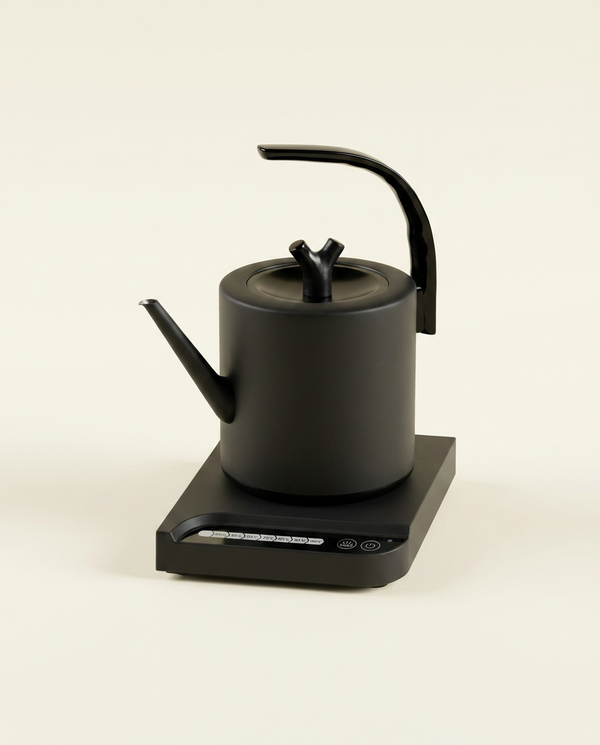
It helps more than any other accessory. A narrow swan neck turns a gush into a thread you can steer, which is most of what separates an even bed from a crater. A standard kettle works if you pour low and slow. One caution: plenty of electric goosenecks list plastic parts on their supplier sheets, stovetop ones are the plain option, and our guide to the plastic free electric kettle goes model by model, ours included.
What We Would Not Buy for This Job
- A glass server under a plastic cone. The upgrade that looks right and changes nothing. The carafe holds finished coffee for a minute, the cone holds hot water and grounds for three.
- A mesh filter in a molded frame. Many reusable cones are steel only in the mesh, with a rim or base ring molded around it, right where the water pools.
- The collapsible travel dripper. The one that folds flat for a suitcase folds because it is silicone or plastic. Excellent for a tent.
- A label instead of a list. A badge that names no part is decoration. A line naming glass, wood or a steel grade is information.
- A pour over machine bought for the material. Buy one for the convenience if you want it. Buying one to avoid plastic works against itself.
Friday, the first warm morning of spring
You open the window before you fill the kettle, because the air has turned and the street smells of wet stone instead of cold. The grinder is the loudest thing in the apartment. Water goes in a first small circle, the bed lifts and breathes, and the bloom climbs the glass in a slow brown dome you watch from the side, elbows on the counter. Then the thread, the circles, the color deepening one mark at a time. Nothing in front of you but glass, paper and coffee, and it takes four minutes you were in no hurry to save.
If you take one thing from this article: the cone is the part that holds hot water and coffee together, so buy it in a material you can name, and let the price of the plastic one tell you what you are choosing between.
Plastic Free Pour Over Coffee Maker FAQ
Can a pour over be built with no plastic at all?
This is the brew method that comes closest. A cone, a filter and a server can each be glass, ceramic, steel, wood or paper, with no seal, no pump and no tubing. Check the five parts listed above, the kettle included, and count a silence on a spec sheet as unknown rather than as absent.
What is the best non toxic pour over coffee maker for one person?
For a single drinker we would take a glass cone over a glass carafe in the smaller size: every surface settled in one purchase, and all of them visible. The 10 oz Toscana set is our pick for that morning. If buying filters annoys you more than body in the cup does, take the steel-filtered set.
Is a glass pour over coffee maker safe with boiling water?
Borosilicate is made for exactly that, and a good one states a tolerance: ours is rated for instant swings up to 356°F. Two habits keep it whole. Warm it with a rinse before the first pour, and never set hot glass on a cold wet surface. The enemy of a glass brewer is impact, not heat.
Is a ceramic pour over dripper better than glass?
Better at one thing. Ceramic holds a steadier temperature through the brew, which shows on longer recipes. Glass gives you the bloom and the drawdown in plain sight, and a shorter preheat. Both are neutral and both break. Pick ceramic if you brew big and slow, glass if you like to see what you are doing.
Can you make pour over coffee without a paper filter?
Yes, with metal or cloth. A steel mesh cone passes the oils and a few fines, so the cup gains body and loses a little clarity, and nothing needs buying again. Cloth lands between the two and has to be stored wet. Grind a notch coarser for either, and rinse a mesh filter before the oils set.
Is there an automatic pour over coffee maker with no plastic?
We have not found one whose maker publishes a heated path free of it. These machines are drip brewers with a pulsed showerhead, and after the heating element most use molded parts for the line, the head and the basket. If you want one anyway, shop it on published materials rather than on a badge, and expect less plastic rather than none.