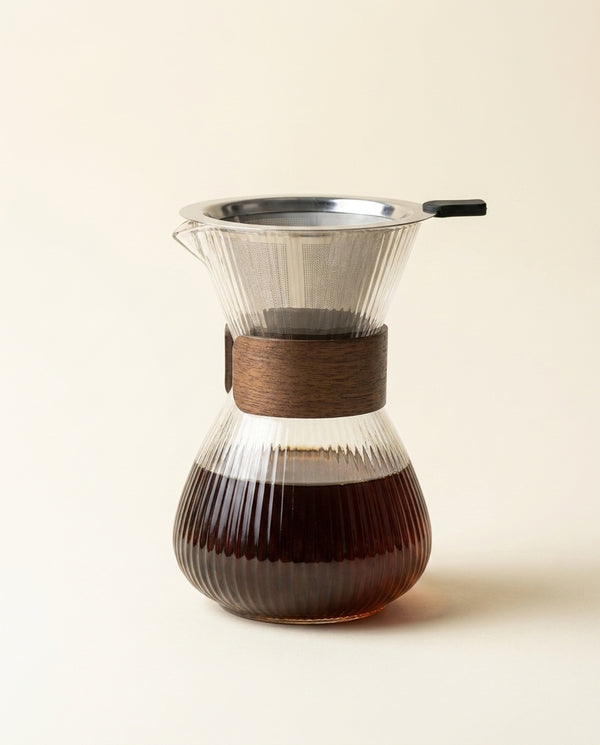
Turn the box over. "BPA-free" means one compound was left out of the plastic. It almost always means plastic is present, and it never says where. If you searched for a BPA free coffee maker, the simplest answer is a brewer where the coffee runs through glass and you see every drop, like the Toscana Pour-Over Set: a high borosilicate glass filter holder and carafe with a bamboo collar, and no plastic part listed by its maker. This guide reads the label, compares the five materials a coffee maker can be made of, and ends with seven checks for any listing, ours included.

Our pick: glass, top to bottom
A high borosilicate glass dripper and carafe with a bamboo collar, in 10 oz or 20 oz. It takes standard size 02 paper cone filters, and you watch every drop of the brew.
See the Toscana Pour-Over SetWhat a BPA Free Coffee Maker Label Actually Tells You
BPA is short for bisphenol A, a building block of certain hard, clear plastics once common in kitchen gear: water tanks, carafes, pitcher lids. Shoppers asked for products made without it, makers reformulated, and "BPA-free" became one of the most printed phrases in the appliance aisle.
What BPA does or does not do in the body is a question for your doctor and for regulators, not for a shop that sells coffee gear. What we can do is read the label the way a careful buyer would.
What the label says
One thing. The plastic parts of this product were made without bisphenol A. A narrow claim, and on an established brand a reliable one.
What the label does not say
- That there is no plastic. Usually the reverse. A brewer made of glass and steel has little reason to print the phrase.
- Which parts are plastic. One word covers the tank, the basket, the lid and the tubing, and describes none of them.
- Whether those parts meet heat. A cold water tank and a brew basket full of near-boiling coffee get the same word.
- What the plastic is made of instead. The label names what was removed, never what was used.
BPA free coffee machine: the stretch of the path that counts
On an automatic drip brewer the tank is nearly always plastic, and it matters least: the water in it is cold. The stretch to study begins at the heating element. On most models the heated water goes up a riser, out through a showerhead, into a brew basket and past a carafe lid. On a typical BPA free coffee machine, several of those parts are molded plastic. Pod machines typically add internal lines and the pod itself.
All of it is lawful, regulated material. It is simply not what the badge leads many shoppers to picture. For the machines themselves, part by part, see our plastic free drip coffee maker guide.
BPA free coffee pot: look at the lid, not the glass
The pot is the easy half, since the vessel is usually glass or stainless steel already. The plastic, when there is some, sits in the lid, in the band that holds the handle, and on thermal carafes typically in the pour-through stopper. So a BPA free coffee pot is often a glass or steel pot with a plastic lid that happens to be BPA-free. For a pot with no plastic to wonder about, look at manual brewers whose server is a single piece of glass, or at presses built in steel from lid to filter.
What Is the Healthiest Coffee Maker? Five Materials Compared
Type "healthiest coffee maker" into a search bar and what you usually want is checkable: as few materials as possible between hot water and the cup, each one easy to identify. Many people also prefer to keep hot coffee away from plastic, and heat does increase migration from plastics in general. That much a coffee shop can help with. What is healthy is a question for a doctor: we sell coffee gear, not medical advice.
So here are the five materials compared on what anyone can verify: taste, how the material fails, the care it asks for, and how easily you can confirm what you are holding. The order is ours, from the easiest to check to the hardest. It is not a health ranking.
Borosilicate glass

Glass asks you to take nothing on trust. It is non-porous, so it does not keep yesterday's coffee, and soap does not change the taste. It is clear, so you can see that it is clean. Borosilicate, the laboratory kind, tolerates sudden heat: the glass of our Toscana set is rated for instant temperature swings up to 356°F, far above a boiling kettle. Its weakness is the obvious one: a hard knock ends it. And a glass brewer can still carry a plastic lid or filter holder, so read those lines too.
Stainless steel
The natural choice for anyone who has already broken a glass brewer. It does not shatter, a double wall holds the heat with no warming plate, and it cleans with soap and water. Look for a named grade, 304 being the usual one for cookware. Two drawbacks. Steel is opaque, so clean it on a schedule and not on sight. And some drinkers notice a faint metallic note in the first few pots, which generally fades.
Remember that on a machine, "stainless steel" often describes the housing. On a press like The Signature Stainless Steel French Press, it describes the body, the lid and the two-part plunger.
Ceramic and enamel
Glazed ceramic (drippers, mugs, some pots) and enamel over steel or cast iron follow the same logic: a glassy, fired surface over a body. Both taste neutral, hold heat well once warmed, weigh a lot, and chip. What you cannot see is what the glaze is made of, so buy from makers who state in writing that the surface is food safe. Then treat it gently: no scouring pads, no drops.
Aluminum
The classic moka pot metal: light, inexpensive, quick to heat, and needier than steel. Dishwasher detergent dulls and pits it, so it gets water and a soft cloth, and a new pot can lend a metallic taste for its first few brews. Some readers skip bare aluminum altogether, others have used the same pot for thirty years. That choice is yours. The moka pots we stock are aluminum, and their pages say so.
Food-contact plastics
Plastic comes last in this order, not banned from it. It weighs little, costs little and survives a fall, and the grades used in coffee makers are regulated for food contact. Its faults are practical: it scratches, it clouds, and it tends to hold coffee oils that go stale. It is also the hardest material to verify, because listings rarely name the resin. "BPA-free" tells you one thing it is not. If your plastic brewer suits you, keep it clean and replace worn parts.
Healthiest coffee machine: if you want to keep the plug
No drip machine on our shelves, so no model to push. To find the healthiest coffee machine on these criteria, apply the same comparison to the heated stretch only: tube, showerhead, brew basket, carafe lid. Few makers publish those materials. Expect to pay more, and expect "less plastic" more often than "none". Our guide to coffee makers without plastic goes through every brew method, automatic machines included.
The Best BPA Free Coffee Makers Skip the Plastic: Our Three Picks
The twist in any list of the best BPA free coffee makers: the brewers that settle the question most completely never need the sticker. These three are described by their materials, as their spec sheets give them. More shapes of the first one are in our pour-over brewers.
1. Toscana Pour-Over Set: Glass Dripper, Glass Server, Two Sizes
Our first pick is the Toscana Pour-Over Set, a complete glass pour-over system: a V-shaped glass filter holder with a bamboo collar, paired with a heat-resistant glass carafe that carries graduated measurement marks and a thickened handle. Water in at the top, coffee in glass below, and you see every drop on the way.
- Glass where the coffee runs. Dripper and server are high borosilicate glass. The collar is natural bamboo. No plastic part is listed by the maker.
- Nothing out of sight. The drip is visible from start to finish: the bloom rising, the color deepening, the level climbing the marks.
- Boiling water is a non-event. The glass is rated for instant temperature swings up to 356°F.
- It washes back to neutral. Soap does not affect the taste. Carafe and filter holder are dishwasher-safe, though hand washing is gentler. Hand wash the bamboo collar.
- Two sizes. 10 oz for a solo cup, 20 oz to share.
- Guaranteed. 30-day returns and a 1-year guarantee.
No filter comes in the box: it takes standard size 02 paper cones. The limits: those filters to restock, a cup or two per brew, and glass that will not forgive a tile floor.
2. The Signature Stainless Steel French Press: For Kitchens Where Glass Does Not Last

If glass has a short life in your house, the Signature press is the steel answer: a double-wall 304 stainless steel body, a knobbed steel lid and a two-part plunger, fine stainless mesh over a perforated steel plate, with no plastic in contact with your coffee. No paper to buy. The double wall keeps the coffee hot while the outside stays cool, and it comes in 12 oz, 27 oz and 34 oz, the largest serving four to six.
It is the pick when "coffee maker" means a full pot. The fine print on lids and plungers is in our guide to the plastic free French press.
3. Walnut Glass Press: Glass, Without the Pouring Technique

Pour-over rewards a steady hand. For glass without technique, the Walnut Glass Press is a French press whose carafe is double-wall heat-resistant glass, under a rosewood lid, with a stainless steel mesh screen for a filter. Two sizes, 12 oz and 20 oz. The maker lists glass, rosewood and steel, and no plastic part. Glass and steel can go in the dishwasher, the rosewood lid is hand wash only. One thing to watch: if the air gap between the walls ever fogs, the seal is broken and the carafe should be replaced.
Two BPA Free Brewers Everyone Knows
Two products you will meet in any search, each described by its maker as BPA-free as far as we know. Both make good coffee.
- Cuisinart 14-Cup Programmable, about $100. The Cuisinart BPA free coffee maker most shoppers land on: glass carafe, programmable clock. As on most drip machines, the brew basket and the parts after the heater are typically plastic. BPA-free, and plastic.
- AeroPress Original, about $40. Loved by travelers, and declared BPA-free by its maker. It is also a plastic brewer, chamber and plunger alike. The label is true. The picture many shoppers form from it is not.
None of this makes them bad brewers. It leaves one question open: what does my hot coffee touch? On our first pick the answer fits in a line: glass, the paper filter you put in it, and a bamboo collar around the cone.
How to Read a BPA Free Coffee Maker Listing: Seven Checks
A badge is one word. A listing holds a good deal more. These seven checks need nothing but the product page and a minute.
- Find the materials line. Scroll past the badges to the specifications. You want nouns: glass, stainless steel, ceramic, aluminum, wood, or the name of a plastic.
- See whether the badge names a part. "BPA-free tank" tells you something. "BPA-free" alone does not.
- Look for the name of the plastic. A listing that names it (polypropylene, Tritan) is telling you more than one that only says what it left out.
- After "glass", read what is attached. The lid, the handle band, the filter holder. The word describes the vessel, not its fittings.
- Read the filter. Paper, metal mesh, or nylon mesh in a plastic frame. All of your coffee passes through it.
- Look for seals and gaskets. Sealed lids, moka pots and machines have them, and listings rarely name the material. Count a silence as "unknown", not as "none".
- Zoom in on the photos. The underside of the lid, the brew basket, the filter holder: molded parts show in pictures even when the text skips them.
The checklist cuts both ways. Run on our own catalog, it takes our electric grinders, our cold brew towers and most of our electric kettles off this page, because their supplier sheets list plastic.
Four Phrases That Sound Like an Answer
- "BPA-free" in large type, materials in none. When the badge is the only material information on the page, you have learned one thing the product is not.
- "Food grade" or "food safe", with no material named. Every coffee maker legally sold has to be. It is a floor, not a description.
- "Non toxic", or "toxic free coffee maker". The words have no official definition for brewers, so a page can print them without listing a single part. Look for the list.
- "Stainless steel" in the name of a machine. The name describes what you see on the counter. Look for what you do not see: the basket, and the lines behind it.
Brewing in Glass, and Keeping It Clear
Set a cone filter in the glass holder, rinse it with hot water to warm the carafe, and empty the carafe. Add medium-ground coffee, about the texture of sea salt. Wet the grounds with water a few seconds off the boil, from a kettle you have checked too (our guide to the plastic free electric kettle covers it), give the bloom thirty seconds, then pour in slow circles up to the mark you want. Three to four minutes in all. Grind fresh if you can: our guide to non toxic coffee grinders reads grinder parts lists the same way.
Care is short. Rinse the carafe after each brew: coffee oils stick to glass if left to dry, especially around the spout. Once a month, soak it for 15 minutes in equal parts water and white vinegar, then rinse. Wipe the bamboo collar with a damp cloth, dry it straight away, and keep it out of the dishwasher, which splits the wood over time. That is the whole maintenance schedule of a borosilicate glass pour-over set.
Decaf after dinner, the last light on the table
A little after seven, the plates pushed to the middle of the table. Someone asks for coffee, the kind that will not keep anyone up, so the decaf comes down from the shelf. The kettle tips in slow circles, the grounds swell and settle in the glass cone, and the thin stream below it ticks against the server. It fills one measurement mark at a time, and the last of the window light passes through it the color of dark honey. Nobody asks what the brewer is made of. They can see it.
If you take one thing from this article: "BPA-free" tells you what one plastic leaves out, a materials list tells you what your coffee touches, and the Toscana's list is short enough to read at a glance, glass and bamboo, with 30-day returns and a 1-year guarantee behind it.
BPA Free Coffee Maker FAQ
Is a BPA free coffee maker free of plastic?
No, and usually the reverse. The phrase describes plastic parts made without bisphenol A, so it almost always appears on products that contain plastic. A BPA free coffee maker can have a plastic tank, brew basket and lid and carry the label honestly. If your goal is less plastic, look instead for a parts list that names glass, stainless steel or ceramic wherever hot water and coffee go.
What is the healthiest coffee machine?
What you can check is plastic in the heated stretch: riser, showerhead, brew basket and carafe lid, all after the heating element. If by healthiest coffee machine you mean the least plastic touching hot water, shortlist the makers who publish those materials. A manual brewer in glass or steel is easier still: every surface is there to inspect. No label certifies a machine as healthy, and health is not ours to judge.
What is the healthiest coffee pot?
The one where you know what the coffee touches. Borosilicate glass is non-porous, neutral in taste and transparent, and it breaks if dropped. Stainless steel is neutral for most drinkers, far harder to break, and opaque. With either, check the lid, where a pot usually carries its plastic. We compare taste, breakage and care, not health effects. For a server in plain glass, see the glass pour-over set we picked.
Is there a BPA free coffee pot with no plastic at all?
Yes, once you leave the plug behind. A glass pour-over server, a steel French press and a stainless stovetop percolator can all be built with no plastic, and then the BPA free coffee pot question has nothing left to apply to. Read the lid and the filter lines to be sure. On plug-in machines the pot may be plain glass or steel, while the parts the coffee crosses before it are typically plastic.
Is the AeroPress BPA free?
Its maker states that it is, and we have no reason to doubt it. It is also a brewer made of plastic. Both statements are true at once, which is the point of this article. If the plastic does not bother you, keep it. If you had been reading "BPA-free" as "no plastic", a glass pour-over or a steel press is closer to what you were looking for.
Is glass or stainless steel better for a coffee maker?
Glass wins on neutrality and on proof: it is non-porous, and you can see that it is clean. Steel wins on survival and heat: it does not break, and a double wall keeps a full pot hot. Choose glass for a cup or two and gentle hands, steel for a busy kitchen. Our glass French press sits between the two: a glass carafe with a steel mesh plunger.