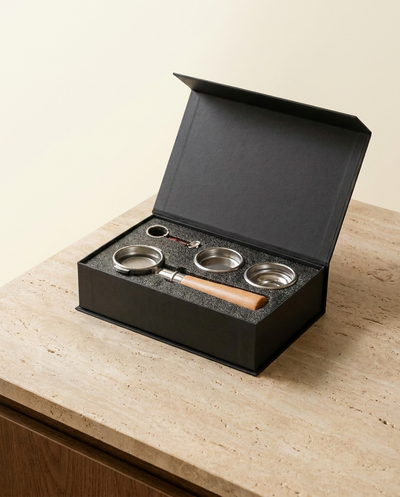
The best bottomless portafilter for a Breville is the one cut for its group head: 54mm with three lugs for the Bambino and every Barista model, Breville's own two-ear 58mm pattern for the Dual Boiler and the Oracle family. Buy it in stainless steel, with a single wall basket, and slide a Pocket Pour Scale under the cup. The naked basket shows you where a shot goes wrong. Grams and seconds tell you by how much.

Our pick
Pocket Pour Scale
Slide it under the cup: shot weight and shot time on one display, 0.1 g resolution, with tare and a built-in timer.
What Size Portafilter Does Your Breville Use?
Commercial machines have worked around a 58mm basket since the Faema E61 of 1961. Breville, sold as Sage in the UK and Europe, built most of its home machines around a smaller 54mm group and kept 58mm for the top of the range. Diameter is half the answer. The locking ears are the other half.
Accessories follow the basket, so a 54mm machine wants a 54mm funnel and a tamper of about 53.3mm. And a 58mm handle built to the E61 pattern, the kind made for Rocket, Profitec or ECM machines, is not a Breville handle: Breville's 58mm group sits deeper and takes thinner ears.
Why the Stock Breville Portafilter Hides Your Mistakes
An espresso machine pushes water through the puck at about nine bars. In a good shot it crosses the whole bed at one speed. In most home shots it finds a crack, a clump or a thin edge and rushes through. That is channeling: the coffee along the channel turns bitter, the rest stays sour, and the cup manages to be both.
A spouted handle blends every stream before you see any of it. The pour looks fine, the taste is muddy, and nothing tells you why. Take the floor off the handle and the underside of the basket becomes a gauge: jets spraying sideways, a bald patch, one side running blond before the other has started. Barista Hustle has written at length on why evenness, more than strength, makes a shot sweet. A bottomless portafilter is the cheapest way to see it.
The dual wall basket is part of the disguise
Most Breville machines ship with dual wall, or pressurized, baskets. They force the coffee through a single pinhole, which whips up a foam that passes for crema even with stale coffee. In a naked handle, that pinhole fires one thin jet past your cup. A bottomless portafilter wants a single wall basket and freshly ground coffee.
For a deep dive, read our complete espresso machine guide.
Best Bottomless Portafilter for Breville: The 3 Upgrades That Matter
The handle is one third of the upgrade. The other two decide whether it improves your coffee or only dirties your counter.
Upgrade 1: a bottomless handle that fits your group
Start from the table above, then check three things.
- The listing names your machine: "fits Breville 54mm" plus your model beats "universal" every time. For a Dual Boiler or an Oracle it has to say Breville 58mm, two ears.
- A stainless steel head: it holds heat and takes years of knock box abuse.
- A basket and a retaining spring in the box: usually an 18 g single wall basket, held in place when you knock out the puck.
Breville sells its own naked handle for the Dual Boiler and Oracle family. For the 54mm machines, third-party handles run roughly $40 to $70 with a basket.
Upgrade 2: a precision single wall basket
The stock single wall basket works. A precision basket, with evenly machined holes and straighter walls, flows more evenly, and the naked handle shows it as a calmer stream. IMS makes them for the 54mm Breville, and on the 58mm machines both IMS and VST fit, for about $30 to $40. Expect to grind a step or two finer.
Upgrade 3: a scale and a timer under the cup
A bottomless portafilter shows you that a shot went wrong, not how far off it was. The shot buttons on a Breville stop at a preset volume, and volume is a poor witness: crema is mostly gas, so the same line on the glass can sit several grams apart from one bag to the next. This is the upgrade we make ourselves: see the Pocket Pour Scale, which reads the weight in the cup and the length of the shot on one display.
Dose, Yield and Time: The Numbers to Aim For
One recipe covers most of what you will pull: a 1:2 ratio, twice the weight of espresso out as ground coffee in.
These are starting points. Count the time from the moment the pump starts, pre-infusion included, and weigh the yield in grams, never in milliliters.
What We Put Under a Naked Handle
Our part of this upgrade sits beneath the handle.
Pocket Pour Scale, the first thing we would add
The Pocket Pour Scale is a compact digital coffee scale with an integrated timer. It answers the two questions every bottomless shot raises: how much, and how fast.
- Dose and yield to the tenth: 0.1 g resolution, so 18.0 g in the basket means 18.0 g, and you stop the shot at 36 g instead of somewhere near it.
- Grams and seconds together: the digital LCD shows weight and timer simultaneously, so the whole shot reads in one glance.
- The shape a drip tray asks for: flat and palm-sized. Measure your tray before ordering any scale, this one included.
- Tare in one press: cup on, zero, pull. A removable clear tray covers the platform, and a non-slip rubber mat base keeps it still.
- What it is not: waterproof. A naked basket sprays while you learn, so dry spills at once and never rinse the scale. It runs on two AAA batteries, not included.
The Precision Manual Grinder, for a Breville with no grinder attached
A Bambino has no grinder, and a single wall basket has no patience for pre-ground coffee. The Precision Manual Grinder is a brushed 304 stainless steel hand grinder with a conical burr and a dial at the base that runs from espresso-fine to French-press-coarse. Count a minute or so of cranking per dose, a fair trade for one or two shots a day. For more, see our coffee grinders.
The Doppio Espresso Set, to read the shot after it lands
The Doppio Espresso Set is four 2.5 oz double-wall borosilicate glasses. The crema reads through the clear wall, the outside stays cool while the shot stays hot, and a 36 g double fits with room to spare.
Acaia Lunar, the café standard (about $250)
Acaia built the Lunar for café drip trays: 0.1 g, water resistant, rechargeable, with a flow-rate readout and timers that start on the first drop. A superb instrument, at about three times the price of a handle and a precision basket together. Landing 36 g in 28 seconds takes two numbers, not six. Our coffee scale guide and the coffee scales collection cover the rest of the field.
How to Use a Bottomless Portafilter on a Breville, Step by Step
Five steps, same order every time.
Step 1: Heat the handle
Run a blank shot, water only, through the locked handle, then wipe the basket dry. Cold metal makes sour espresso, and wet metal starts a channel before you have tamped.
Step 2: Grind fresh and fine
Aim for powdery sand, slightly finer than table salt, ground right before the shot. Too coarse and the water gushes through. Uneven, and the basket sprays.
Step 3: Dose and distribute
Weigh 18 g for a standard 54mm double basket. Stir the grounds with a WDT tool, a few fine needles set in a cork, down to the bottom of the basket. Break every clump and leave the bed level.
Step 4: Tamp level, not hard
Press until the coffee stops giving way, and no further. Force matters less than a surface parallel to the rim, because water runs to the low side of a tilted bed.
Step 5: Pull, watch, weigh
Set the cup on a 0.1 g scale with its own timer, tare, and start the timer as the pump starts. Dark beads should appear across the whole basket, join into a single central stream, and lighten slowly toward blond. Stop at 36 g, somewhere between 25 and 30 seconds. Then taste, and change one thing.
One safety habit: after a choked shot, leave the handle in place for thirty seconds. The puck is still under pressure and can spit hot grounds.
Bottomless portafilter troubleshooting: reading the basket
Cleaning and Maintenance
Coffee oils go rancid, and every later shot carries the taste. With no spouts for old coffee to hide in, a bottomless portafilter is the easiest handle to keep clean. After each session, knock out the puck, rinse the basket under hot water and wipe it dry. Once a week, soak the basket and the steel head for ten minutes in hot water with an espresso cleaning powder such as Cafiza, grip kept dry. Held up to a window, every hole should show light.
For the rest of the station: the best place to buy a coffee maker bundle and the beginner espresso setup.
Naked Portafilter Buys That End Up in a Drawer
Five ways to pay for a naked handle and learn nothing from it.
- A 58mm E61 handle for a Breville: right diameter on paper for a Dual Boiler, wrong ears in the group, and no chance at all on a 54mm machine.
- A 51mm or "universal" handle: the Bambino is small, and it is still a 54mm machine.
- Plated or bare aluminum heads: plating wears at the lugs, and a light head sheds heat.
- Keeping the dual wall basket: one jet, borrowed crema, nothing to read.
- Going naked with no scale and no WDT tool: you will see the problem in high definition and have no way to measure the fix.
The morning the towel stays dry
For the first week you kept a dish towel draped over the backsplash. This morning it is still dark outside, and you crouch a little under the cabinet light to watch the underside of the basket. The hum of the pump drops a note as the pressure builds, then dark beads appear across the whole steel face at once, swell, and pull together into one thin tail the color of hazelnut. The display climbs, 12, 24, 31, and you stop the shot at 36.2 g as the timer reads 28. The glass smells of toasted sugar and orange peel, and the towel is dry. Tomorrow you will not hope for this shot, you will repeat it.
If you take one thing from this article: match the handle to your Breville's group, then set a 0.1 g scale with a timer beneath it, because a naked basket shows the fault and only grams and seconds show the fix.
Bottomless Portafilter for Breville: Frequently Asked Questions
What size portafilter does Breville use?
Most Breville home machines, from the Bambino to the whole Barista range, use a 54mm portafilter with three lugs. The Dual Boiler and the Oracle family use 58mm baskets in a two-ear handle specific to Breville. Sage machines are identical.
Why is my bottomless portafilter spraying everywhere?
Spraying is channeling made visible: water has found a weak spot in the puck. The usual causes are clumpy grounds, a tilted tamp, or a grind too coarse for the dose. Stir with a WDT tool, tamp level, and check the recipe on a scale with a timer: 18 g in, 36 g out, 25 to 30 seconds.
Do I need a specific basket for a bottomless portafilter?
You need a single wall, non-pressurized basket. The stock Breville one works, and a precision basket from IMS, or VST on the 58mm machines, flows more evenly. A dual wall basket in a naked handle produces one thin jet and teaches you nothing.
Does the weight of the portafilter matter?
Somewhat. A portafilter that goes in cold pulls heat out of the brew water, and a shot brewed too cool tastes sour. A heavier stainless steel head holds heat better between shots than a light aluminum one, but preheating matters more than mass.
Can I use a 58mm tamper on a 54mm Breville?
No. A 58mm tamper will not enter a 54mm basket. A 53.3mm tamper gives the snuggest fit in Breville's 54mm baskets. On a Dual Boiler or an Oracle, standard 58mm tampers work, since the basket, unlike the handle, is a common size.
Is a bottomless portafilter worth it on a Barista Express or a Bambino?
Yes, if you are willing to look at what it shows you. On its own it does not improve the coffee. It turns every shot into feedback on grind, distribution and tamp. Expect a messy first week, then sweeter, more repeatable shots.