A 470 ml glass of black cold brew has 5 to 10 calories, no sugar, no fat, and somewhere between 150 and 250 mg of caffeine. Every bigger number you have seen on a menu board was poured in after the brewing. Make it at home in the Kyoto Ice Tower and both figures, calories and caffeine, become yours to set.
Cold Brew Nutrition Facts: How Many Calories Does It Have?
A typical 473 ml serving of black, unsweetened cold brew contains:
So is the "cold brew has 0 calories" claim true? Close enough that the label rules agree. In the United States a serving under 5 calories may be declared as zero, which is why one bottle says 0 and the next says 10 for the same liquid. The traces come from oils and soluble protein in the bean, and they are irrelevant: nobody gains weight from black cold brew.
What no label can tell you is your serving: a 300 ml glass packed with ice and a 700 ml tumbler are both "one cold brew", so know what your own drinkware holds.
Why Does Cold Brew Have More Caffeine?
Per ounce it does, but only while it is still a concentrate. Hot drip uses about 1 part coffee to 15 to 17 parts water. Cold brew concentrate uses 1 part coffee to 5 to 8 parts water, for hours. Two to three times the coffee means roughly two to three times the caffeine per ounce.
Then the concentrate gets cut, usually one to one, and poured over ice. In the cup the gap mostly closes, and sometimes reverses. Starbucks lists 205 mg for a grande cold brew, 165 mg for a grande iced coffee, and 310 mg for a grande hot Pike Place.
How Much Caffeine Does Cold Brew Have Compared to Other Coffee Drinks?
Count caffeine in grams of coffee, not in cup sizes
Arabica is about 1.2 percent caffeine by weight, robusta nearly double, and roast level barely matters. So 10 g of arabica holds about 120 mg, no method can extract more than the bean contains, and the dose gives you a ceiling:
Weigh the dose, then divide by the glasses the batch gives you: 60 g across four glasses is 15 g a glass, so 180 mg at most. Any gram scale will do. The Workshop Brew Scale reads to 0.1 g.
The FDA cites 400 mg a day as a safe amount for most healthy adults, and obstetricians advise under 200 mg during pregnancy. If concentrate feels like too much, brew at 1:10 for about 12 hours: ready to drink, with caffeine close to ordinary drip.
How Many Calories Are in Sweet Cream Cold Brew?
Between about 110 and 240 for a 470 ml chain drink. The cold brew underneath is still worth 5 calories. Everything above that is cream and syrup.
How Do Black and Sweet Cream Cold Brew Compare in Calories and Caffeine?
These are the values Starbucks publishes at the time of writing. Caffeine dips because cream displaces coffee. And 26 g of sugar is about six and a half teaspoons, the whole daily allowance of added sugar the American Heart Association suggests for women (about 25 g), in one cup.
What each addition costs at home
Milk is cheap, cream is expensive, syrup is sugar. And people sweeten cold brew to cover bitterness. A muddy, over-steeped batch asks for cream. A clean one does not. That is the practical case for a slow drip brewer such as the Kyoto Ice Tower, which produces a clean, low-acidity concentrate you can pour straight over ice: the 5 calorie version of this drink.
Is Cold Brew Different From Iced Coffee?
Yes. Iced coffee is brewed hot in minutes, then chilled over ice. Cold brew never meets hot water. Nutritionally they sit close, with three small differences and one overstated one.
- Calories. Both are essentially calorie-free black. Some chains sweeten iced coffee by default, so ask.
- Caffeine. Cold brew runs a little higher at the same size, 205 mg against 165 mg for a Starbucks grande.
- Antioxidants. Hot water extracts more of them, so iced coffee is slightly richer in polyphenols.
The overstated one is acidity. You will often read that cold brew is "67 percent less acidic". That figure traces back to cold brew equipment marketing rather than to published research. When chemists at Thomas Jefferson University measured it (Rao and Fuller, Scientific Reports, 2018), hot and cold brews from the same beans had nearly the same pH, between 4.85 and 5.13. What differed was total titratable acidity: hot water pulled out more acid compounds overall. A rounder cup, then, but a smaller difference than the slogan suggests.
Is Homemade Cold Brew Cheaper Than Store-Bought?
Yes, by far. Typical cost per liter:
- Homemade: about $4, using 100 g of coffee from a $20 per pound bag.
- Bottled cold brew (Stumptown, Chameleon and similar): $12 to $18.
- Coffee shop: $10 to $20, depending on how much of the cup is ice.
Price is the smaller half. Home is the only place where you know the dose in grams, choose the bean (our Stumptown picks are a good start) and decide what goes in afterwards. If you brew in a jar, filter twice, through metal mesh and then paper: fines that slip through keep extracting in the fridge, and turn the batch bitter. Our cold brew guide covers the method, and a separate piece covers how long cold brew lasts.
A Home Setup That Puts You in Charge of Both Numbers
A nutrition label describes somebody else's recipe. These pieces, two from our cold brew collection, let you write your own.
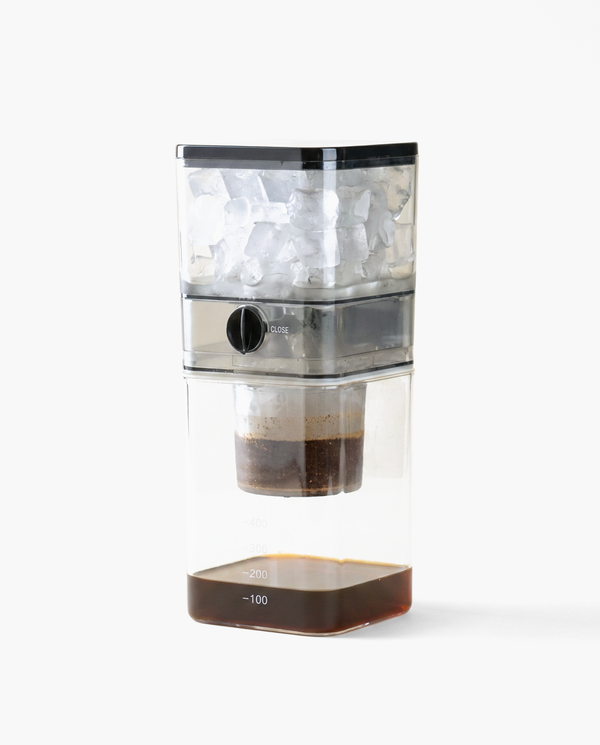
Kyoto Ice Tower, our pick for a cold brew that needs nothing added
The Kyoto Ice Tower is a Kyoto-style cold drip brewer scaled down for a home counter: ice and water on top, grounds in the middle, concentrate in the carafe below. The water never sits in the coffee. It passes through, one drop at a time.
- A clean, low-acidity concentrate, in the sense explained above: lower in total acids, not in pH. When black tastes good, the cream and syrup stop being necessary.
- A drip rate you set yourself. The valve is dial-controlled: faster for an afternoon batch, slower for an overnight one.
- Ready in roughly 4 to 6 hours at around one drop per second, against 12 to 24 hours for a jar in the fridge.
- Dilution happens in your glass. Pour the concentrate over ice, or stretch it with water or milk. The biggest caffeine lever stays in your hand.
- Glass, no power, no tools. Heat-resistant clear glass with BPA-free fittings, gravity-fed, with stacking chambers that assemble by hand.
A full carafe gives several servings over ice. See the Kyoto Ice Tower.
Workshop Brew Scale, because caffeine starts as grams
The ceiling table needs a known dose. The Workshop Brew Scale has 0.1 g resolution, a 3,000 g capacity, a tare function and a built-in timer. Weigh the grounds going in and the concentrate coming out, and you have your own nutrition label.
Slow Cold Drip Tower, when you want to choose the batch size
The Slow Cold Drip Tower works on the same gravity-fed principle: a glass carafe, an adjustable drip valve and a reusable stainless steel mesh filter, so no paper to buy. It comes in 600 ml or 800 ml, and the smaller size suits one drinker.
What a Toddy and a Hario Mizudashi do
The Toddy Cold Brew System, around $40, is the classic immersion brewer: a plastic container, a felt filter, a glass decanter, and a large, cheap batch of concentrate. The trade: a 12 to 24 hour steep, and filters to buy again. The Hario Mizudashi, around $25, is the easiest way in: a glass pitcher with a mesh basket, about a liter at drinking strength after eight hours in the fridge, nothing to adjust.
On price, both beat us. On the criterion of this article, a clean cup you can drink black at a drip rate you set, the Kyoto Ice Tower is where we land.
Health Benefits and Concerns
What are the benefits of low acidity?
If hot coffee bothers your stomach, cold brew deserves a fair trial. Many people with reflux or a sensitive stomach find it easier to live with, most likely because of the lower total acids. The evidence is experience more than clinical trial. Beyond that, large observational studies link moderate coffee drinking with a lower risk of several chronic diseases. None of it survives 26 g of sugar.
Are there any downsides to cold brew?
On flavor, a little: the bright, fruity notes of a light roast are muted, and cold brew leans toward cocoa and nuts. For the antioxidants of hot coffee in a cold glass, try flash chilling: brew hot with half the water, directly onto the other half as ice.
The real concern is dose. Cold brew is smooth, so it goes down fast, and 470 ml in ten minutes lands differently from the same caffeine sipped through a morning. A 900 ml trenta at Starbucks lists 360 mg, most of a day's 400 mg in a single cup.
How a 5 Calorie Cold Brew Ends Up at 240
- Ordering by name instead of by recipe. "Cold brew" on a menu can mean 5 calories or 240. Order it black and add your own milk.
- Trusting a bottle because it says cold brew. Vanilla and mocha versions can carry 20 g of sugar or more. Read the panel, not the front.
- Pouring concentrate as if it were ready to drink. Cold hides strength, so the caffeine doubles without the taste warning you. Measure one to one until you know your glass.
- Steeping longer for a stronger kick. In lab tests (Fuller and Rao, 2017), caffeine in cold brew stopped climbing after six to seven hours. A 24 hour steep buys bitterness, not buzz, and bitter coffee gets sweetened.
- Putting up with a muddy brew. A coarse basket lets fines into the fridge, where they keep extracting until the batch turns harsh. Filter properly, or use a drip brewer.
Should You Worry About Cold Brew's Calories or Caffeine?
If you drink it black: no to the calories, and about the caffeine only enough to keep count. One 470 ml glass sits comfortably inside 400 mg a day. A second is where you start counting. If you take it with sweet cream: count it as food, in the same mental column as a pastry. If you are sensitive to caffeine, or pregnant: weigh the dose, dilute further, or brew at 1:10.
Running shoes by the door, and a glass you can do the math on
Late August, the street not yet awake. You turned the dial to its slowest before bed, and the tower kept its own time through the night: the ice has gone from the top chamber, and the last drop lets go of the valve and lands with a small, exact tick. The carafe smells of cocoa and something close to almond. You weighed the dose last night and did the division once, so you know what the glass in your hand carries: at most 120 milligrams of caffeine, 5 calories, and nothing that needs adding. You drink it standing in the open doorway while the light comes up over the roofs. Twelve miles feel possible.
If you take one thing from this article: the cold brew itself is worth about 5 calories, so brew one clean enough to drink black, and count its caffeine in grams of coffee rather than in cup sizes.
Frequently Asked Questions
How many calories does cold brew coffee have?
Black cold brew has 5 to 10 calories per 470 ml serving, which is effectively nothing. Additions change that quickly: a 470 ml cream cold brew at a national chain runs from about 110 to 240 calories.
How much caffeine is in a 470 ml cold brew?
Typically 150 to 250 mg once diluted, and Starbucks lists 205 mg for its grande. To know your own number, weigh the coffee: every 10 g of arabica in your glass caps out at about 120 mg.
Does cold brew have sugar?
Black cold brew has 0 g of sugar. If yours has sugar, somebody added it: you, a barista with a syrup pump, or a bottler. "Cold brew" on a label does not mean unsweetened.
Is cold brew healthier than regular coffee?
Not in calories, and not in antioxidants, where hot coffee is slightly ahead. The pH is nearly identical, but cold brew is lower in total acids, and many people with reflux or a sensitive stomach find it gentler.
Does cold brew help with weight loss?
Only in that black cold brew is almost calorie-free and caffeine gives a small, temporary lift to metabolic rate. Cream and syrup reverse that: a 240 calorie cold brew every day is roughly 87,000 calories a year. Drink it black, which is easier when the brew is clean: a slow drip brewer such as our glass ice drip tower helps there.