Fill the kettle halfway with equal parts white vinegar and cold water, boil it, let it stand twenty minutes, then rinse with two fresh boils. That is the whole job, about four minutes of hands-on work. The one thing that makes it easier is seeing what you are cleaning, which is why we keep a Sentinel Glass Kettle on the counter.
Why a Kettle Builds Up Scale, and Why It Ruins Coffee
Hard water carries dissolved calcium and magnesium. Heat it, and the water leaves as steam while the minerals stay behind. Every boil adds a layer.
What the boil leaves behind
The chalky white crust is mostly calcium carbonate, and it acts like a blanket over the heating element. Your kettle draws more power and takes longer to boil, and left long enough that layer runs the element hot enough to shorten its life.
Scale also flakes: the white specks on your coffee are pieces of the kettle wall that let go. For the wider context, see our complete kettle guide.
How mineral buildup flattens the cup
Water is most of what you drink. High calcium buffers the acids that give a good bean its brightness, and the cup goes muddy and slightly metallic, which is the point of the Specialty Coffee Association's work on water and coffee acidity. People taste it and blame the roaster.
What You Need to Descale a Kettle Naturally
Four things, three already in your kitchen.
- Distilled white vinegar: roughly 5% acetic acid, strong enough to break calcium carbonate apart.
- Cold tap water: the dilution half. Neat vinegar is not faster, only smellier.
- A soft sponge or nylon brush: for the loosened flakes once the soak has done the work.
- A microfiber cloth: to dry the interior and the base contacts, which is where corrosion starts.
Keep steel wool and scouring pads away from the inside: they leave grooves, and fresh scale settles there faster than on a smooth wall. For the spout and the corners, the Barista Care Kit carries two slim twisted wire brushes for that job, alongside our cleaning kits.
Pro tip: use plain distilled white vinegar only. Cider, wine and balsamic vinegars carry sugars and pigments that scorch onto a hot element and stain the interior.
How to Descale Your Kettle with Vinegar in 4 Steps
The sequence matters. Acid dissolves the mineral, heat speeds the reaction, time finishes it, rinsing takes the taste away.
Step 1: The ideal vinegar to water ratio
Use a one to one ratio: equal parts distilled white vinegar and cold water. Cover the scale line, then stop well below the maximum fill mark, because the mix foams as it heats. On a 1.7 liter kettle that is roughly 400 ml of each.
Step 2: The boiling phase
Bring the mix to a full boil. On an electric kettle, one press and the auto shut-off handles the rest. On a stovetop, keep the flame at medium so the foam does not climb. The kitchen will smell sharp for a few minutes, so open a window.
Step 3: The soaking period
Switch the kettle off and unplug it, then leave the hot solution to sit for at least twenty minutes, up to two hours for a year-old crust. The reaction runs the whole time, which is why patience beats scrubbing.
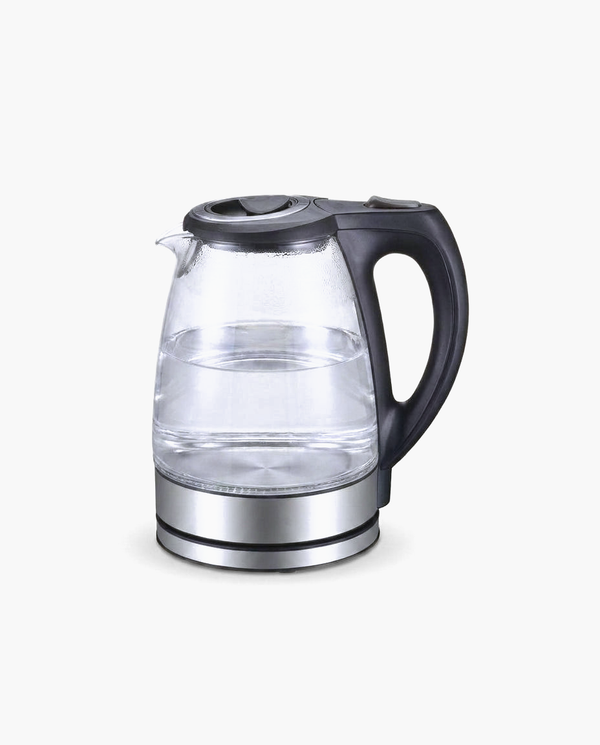
This is where a clear body earns its place. In a glass kettle like the Sentinel you watch the white film retreat from the walls and know when to stop waiting. In an opaque kettle you are guessing, and guessing costs a second cycle.
Step 4: The final rinse cycle
Pour the cloudy solution away, wipe the base with a soft sponge to lift loose flakes, then fill with fresh water, boil, and discard. Do that twice. One rinse leaves a sour edge that shows up in the first cup; two do not.
The same protocol works on the carafes in our coffee makers range and the beakers in our French press collection.
Note: Boil a fifty-fifty mix, soak for twenty minutes, rinse with two fresh boils. The second rinse is the step people skip, and it is the one that removes the vinegar taste.
Comparing Descaling Methods: Vinegar vs. Commercial Cleaners
Vinegar is not the only acid that works, just the one that is food-safe and hard to get wrong.
Our preference for vinegar is practical: an imperfect rinse costs you a sour sip, nothing worse. If your kettle hides electronics under the base, our guide on how to clean an electric kettle covers the contacts.
When to use lemon juice instead
If the smell of boiling vinegar is a deal breaker, lemon works. Squeeze one lemon into the kettle, drop the rinds in, top up with water, boil, and leave it an hour. Citric acid is milder, so it needs the time and will not touch a year-old crust.
Daily Habits to Prevent Limescale Buildup
Not needing to descale beats descaling. Four habits do most of the work.
- Empty it after every pour: standing water evaporates overnight and leaves its minerals bonded to the base. A dry interior grows nothing, and this habit changes more than the other three combined.
- Boil only what you need: less water in, less mineral left behind, fresher brew water.
- Filter before you fill: a charcoal pitcher filter removes much of the calcium and magnesium before they meet heat. Hard water areas notice within a month.
- Book the first of the month: a recurring reminder titled "descale kettle" turns a twenty minute job into a habit.
For a benchmark on the rest of the setup, the SCA's certified home brewer program is a useful reference.
Pro tip: store the kettle empty with the lid propped open. Airflow dries the last drops from the base, and minerals cannot bond to a dry surface. Wipe the metal base contacts too, since water pooling there corrodes the connection.
Our Picks for a Kettle You Can Keep Clear
Every kettle scales. What differs is how easily you can see it, reach it, and confirm it is gone.
Sentinel Glass Kettle, our pick for anyone who descales
The Sentinel Glass Kettle is the one we reach for when we want the cleaning to be honest work rather than guesswork.
- You can see the scale: the body is high borosilicate glass and an integrated blue LED lights the water as it heats, so a mineral film shows from across the kitchen. You descale when it needs it, and stop the soak the moment the walls read clear.
- Nothing plastic touches the water: glass holds no flavor and no residue, so a vinegar cycle leaves nothing behind and the next batch tastes like water and nothing else.
- A fine mesh filter sits in the spout: if a flake breaks loose before your next descale, it stays in the kettle, not in the mug.
- It empties easily, so it stays dry: 1500 watts, 1.7 L, six to seven pour-over mugs per fill, on a cordless base that lifts off for a quick shake out over the sink.
- It handles the empty boil: auto shut-off cuts power the instant the water rolls, and boil-dry protection covers the morning you forget to fill it.
The Barista Care Kit, for the spout and the corners
Vinegar handles flat surfaces. The spout, the neck and the curve where base meets wall need a tool. Our Barista Care Kit is a seven-piece set for glass and carafes: two slim twisted stainless wire brushes that thread into spouts and gooseneck necks, two nylon brushes for the base and the curves, foam sponge heads on long handles, and a gripper tool. The foam is softer than glass, so nothing leaves a scratch for the next scale to hide in.
Fellow Stagg EKG, the precision alternative (about $165)
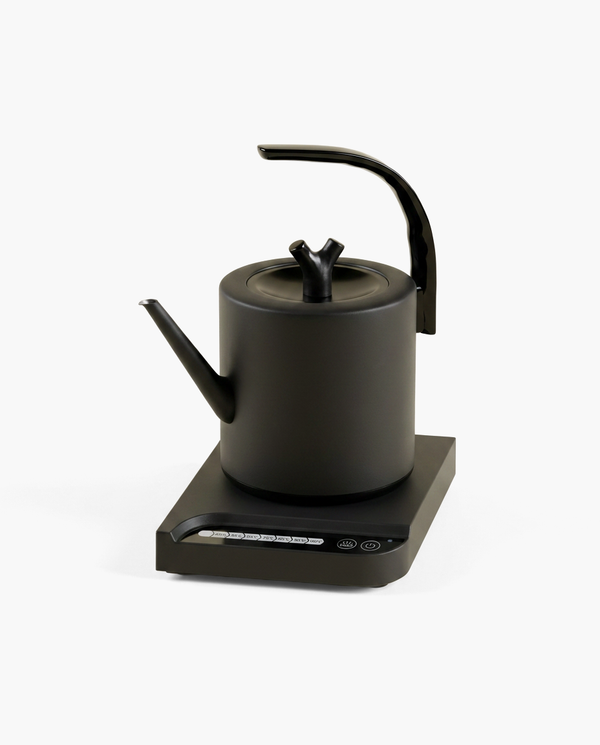
The Stagg EKG is a genuinely good kettle: variable temperature, a counterbalanced handle, a pour that pour-over people love. For descaling, the trade-off is the steel body. You cannot read the interior from outside, so you check by torchlight through the lid.
Cuisinart electric kettle, the supermarket default (about $80)
Cuisinart's electric kettles boil reliably and cost less than most of the category. Built to a price usually means plastic fittings around the lid and the water gauge. Plastic holds the vinegar smell for a day or two, and the narrow gauge window is where scale hides longest.
Where Descaling Quietly Goes Wrong
Four things to steer away from, however cheap or clever they look.
- Plastic-tank kettles: the interior cannot be inspected, and the plastic keeps the vinegar smell long after the minerals are gone. You rinse four times and still taste the vinegar.
- Baking soda as a descaler: it is alkaline, scale is alkaline, nothing happens. Save it for burned-on marks outside and use an acid inside.
- Steel wool and scouring pads: they take the crust off and leave a scratched surface that scales faster than the smooth one did.
- Cider or wine vinegar: the sugars caramelize on a hot element and the pigments stain. Plain distilled white vinegar, every time.
The first boil after a descale, and how different it sounds
Saturday, a little after four, the window open on a cold afternoon and the kitchen still faintly sharp with vinegar. You fill the kettle for the first real brew since the descale and press the switch, and the sound is wrong in the best way: none of that gritty rattle a scaled element makes, just a low rush that builds clean and stops.
The blue light goes out, the steam lifts, and the water sits perfectly clear with nothing drifting in it. You pour a slow circle over the grounds, the bloom rises even, no white specks on the crust. The first cup is brighter than this morning's, and you did not change the beans.
If you take one thing from this article: scale is the cheapest problem in your kitchen to fix, and a kettle you can see into is the only one that tells you when the fix has worked.
Frequently Asked Questions About Kettle Cleaning
Can boiling vinegar damage my electric kettle?
Diluted white vinegar is safe in the great majority of modern electric kettles. At a one to one dilution the acid is strong enough to dissolve calcium carbonate and far too weak to attack stainless steel or glass. Never fill past the maximum line, because the mix foams as it heats. And if your kettle has rubber or silicone seals, keep the soak to twenty minutes rather than two hours.
How do I fully remove the lingering vinegar taste?
Two full boils of fresh water, poured away each time, with a wipe of the interior between them to lift residue from the base and the rim. If a trace remains after that, the culprit is usually plastic, which absorbs the smell. A glass body like the Sentinel Glass Kettle holds no flavor and no residue, so the taste leaves with the water.
Why use vinegar instead of a commercial descaler?
Cost, availability and peace of mind. A bottle of white vinegar descales a kettle for a few cents, sits in every supermarket, and is food-safe if a rinse is imperfect. Commercial descalers work faster on heavy crusts and make sense for a sealed espresso boiler you cannot inspect. For an open kettle you can see into, vinegar does the same job.
Is it safe to leave standing water in my kettle overnight?
It is not dangerous, but it is the main reason kettles scale as fast as they do. Overnight, some of that water evaporates and its dissolved minerals stay behind, bonded to the base. Tip out whatever is left as soon as you have poured, and leave the lid open so the last drops dry. This habit alone can double the time between descales.
Can I use baking soda to descale my coffee kettle?
No. Baking soda is alkaline and limescale is alkaline, so there is no reaction to work with. It is a mild abrasive, useful on burned-on marks outside the kettle and useless against the crust inside. For the interior you need an acid: white vinegar, lemon juice or citric acid powder.
How often should I descale a kettle?
Once a month in a hard water area, once a quarter in a soft one. Two signs you are overdue: the boil takes noticeably longer than it used to, and the kettle rattles rather than rushes as it heats. Both mean the element is working through a layer that should not be there.