A 6 cup moka pot takes roughly 30 to 36 g of medium-fine coffee for about 300 ml of water, which works out to five or six level tablespoons. The quickest way to hit that without a scale is one level scoop of the Walnut Measuring Spoon, repeated until the funnel is level. Here is the dosing math, the grind, and the brew.
How Much Coffee Does a 6 Cup Moka Pot Need?
Thirty to thirty-six grams, and the range matters more than the midpoint. A dark roast is bulkier per gram, so a full funnel lands nearer 30 g. A dense light roast packs tighter and lands nearer 36 g. Both fill the same basket, because a moka pot doses by volume whether you like it or not.
In tablespoons, that is five to six level scoops, never heaped. A level tablespoon of medium-fine grounds weighs 5 to 6 g, so six land inside the range almost every time.
One caveat on the water. Pots vary, so the real instruction is to fill just below the safety valve. The valve is the rule, 300 ml is the guide. For sizing and stove compatibility, see our 6 cup moka pot guide.
The Moka Pot Ratio, and Why It Lands Near 1:10
Thirty grams into three hundred milliliters is a 1:10 ratio. Push the dose to 36 g and you sit near 1:8. Drip coffee runs at 1:16. That gap is the personality of the method: moka is concentrated by design, a small dark cup rather than a mug of breakfast coffee.
The catch is that you do not get to pick the ratio. The funnel holds what it holds, the boiler fills to the valve, and the pot has already chosen for you. So "how much coffee for a 6 cup moka pot" is really a question about repeatability: not finding a secret number, but hitting the same one tomorrow.
Why a Kitchen Tablespoon Gives You a Different Dose Every Day
A tablespoon from the cutlery drawer is a serving spoon, not a measuring tool. Depending which one you grab it holds 10 to 18 ml, and two spoons from the same drawer can differ by a third. Scoop six times and that error compounds into a dose swinging from 26 g to 40 g, on the same beans.
Roast level adds a second layer. Roasting expands the bean, so dark roasts take more space per gram. A funnel brimmed with a dark Italian roast holds around 30 g. The same funnel with a dense light roast holds closer to 40 g. The basket looks identical. The cup does not.
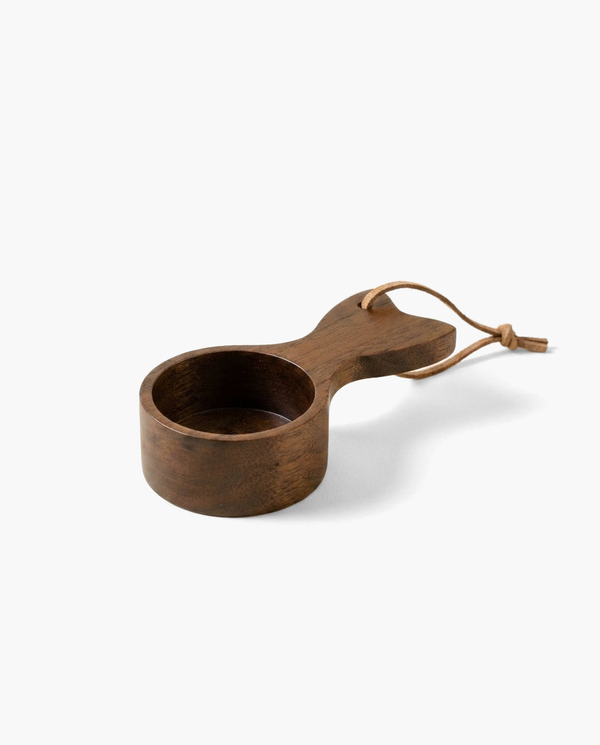
A dedicated coffee scoop removes the first problem and narrows the second. The Walnut Measuring Spoon has a deep 15 ml bowl engraved to that capacity, so a level scoop is a level scoop whichever hand holds it. Six of them, swept flat with a thumb, and the funnel is full. No weighing, no arithmetic at seven in the morning.
What Grind Size Goes With That Dose?
Medium-fine, roughly the texture of table salt. Finer than drip, coarser than espresso. Dose and grind work as a pair: 33 g of espresso-fine powder chokes the pot, while 33 g of coarse grounds lets water sprint through and gives you hot brown water.
Skip supermarket pre-ground labeled for espresso. It is milled for a pump machine, far too fine for 1 to 2 bars of steam, and it is the most common reason a moka pot refuses to run. Grind fresh: slightly gritty, no dust clinging to the skin. Our grinder comparison covers the burr options.
One adjustment rule: bitter and ashy means go a notch coarser, sour and thin means a notch finer, and never change two things at once.
How to Brew a 6 Cup Moka Pot, Step by Step
Step 1. Boil the water first. Fill the boiler with already-hot water, to just below the safety valve, about 300 ml. Starting cold leaves the grounds stewing above a slowly heating chamber, and that is where the scorched, metallic note comes from.
Step 2. Dose 30 to 36 g. Six level scoops of the Walnut Measuring Spoon straight into the funnel, or 33 g on a scale if you prefer the number.
Step 3. Level, do not tamp. Tap the funnel once on the counter, then sweep the surface flat with a finger. A moka pot builds 1 to 2 bars of steam, not the 9 bars of a pump machine, and a tamped puck simply blocks it.
Step 4. Medium heat, lid open, watch the stream. Screw the top on firmly over medium heat. Within two or three minutes a dark, syrupy stream should rise slowly. The moment it pales to honey and starts to hiss, lift the pot off and run the base under cold water. Pour immediately: coffee left in a hot aluminum chamber keeps cooking.
The Gear That Makes the Dose Repeatable
Walnut Measuring Spoon, the fastest route to a consistent 6 cup dose
The Walnut Measuring Spoon is the tool that answers this question: it turns 30 to 36 g into a gesture you repeat without thinking.
- A fixed 15 ml bowl, about 15 ml, the equivalent of one tablespoon. Six level scoops fill a 6 cup funnel, and the measure does not change because you reached for a different spoon.
- One-piece 304 stainless steel, so no joint traps old grounds and no coating wears off. It will not rust, bend, stain or hold odors.
- A long flat handle that reaches the bottom of a deep bean bag without putting your fingers in the coffee.
- An oblong hanging hole in the handle, so it hangs by the grinder. A scoop you cannot find is a scoop you do not use.
- Dishwasher safe, top or bottom rack, and engraved "Coffee Scoop 15 ml".
The practical argument is speed. A scale asks you to power it on, tare, pour, correct and wipe it down. A scoop asks you to scoop six times. On a weekday, the second one is the habit that survives.
Workshop Brew Scale, for the weekend you dial it in
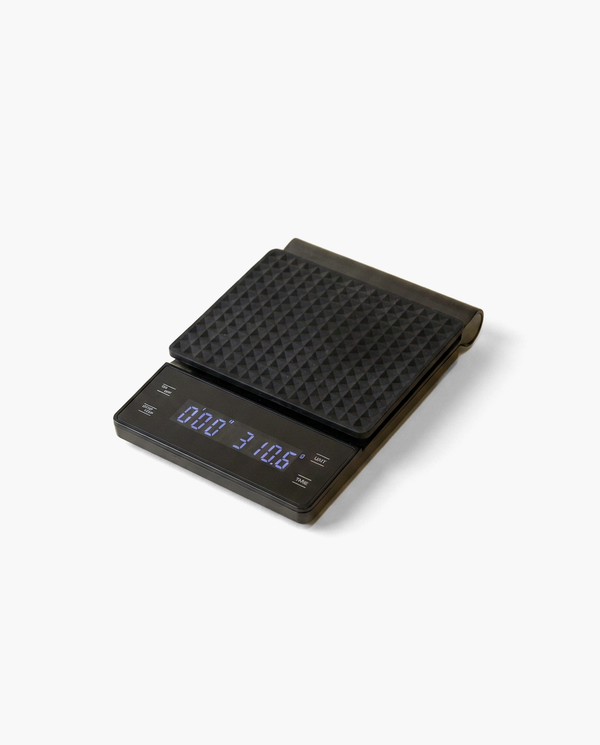
When you change beans and want to know whether 31 g or 35 g suits the roast, weight beats volume. The Workshop Brew Scale reads to 0.1 g, has a tare function and a built-in timer, and toggles between grams, ounces and milliliters on one button. Use it for a week to learn what a properly full funnel weighs, then go back to scooping.
Bottega Wood-Handle Moka, if the pot itself is the weak link
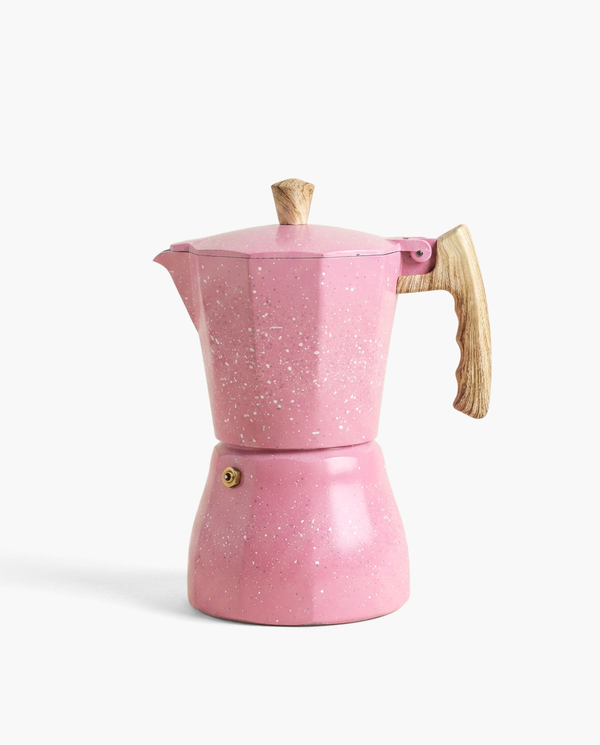
The Bottega Wood-Handle Moka comes in a 300 ml version, about 300 ml, the 6 cup format this guide is built around. Classic eight-sided painted aluminum, single-tube extraction, a built-in pressure-release valve, a wood-grain cool-touch handle. Gas, electric or ceramic, in about five minutes. Not induction. More in our moka pot collection.
Hario V60 drip scale, around $50
A well-made scale with a clear display and a timer, built around pour-over workflow where you watch weight climb second by second. That is its strength, and also why it is oversized here: a moka pot has no pour to follow, the dose is fixed by the funnel and the water by the valve. You weigh one static number, once.
Bialetti Moka Express 6-cup, around $45
The original, and genuinely good at what it does. Gaskets and spare parts are everywhere, and its basket takes the same 30 to 36 g. If you already own one, nothing here asks you to replace it: dose, grind and timing are identical. Our Bialetti Moka review goes deeper.
Dosing Habits That Flatten a 6 Cup Moka
- Heaping the spoon. A heaped tablespoon carries close to half again as much as a level one. Six heaped scoops is nearer 50 g than 36 g.
- Half-filling the funnel for a smaller batch. A 6 cup pot cannot brew three cups. The headspace lets steam bypass the bed. Brew the full 300 ml, or use a 3 cup pot.
- Tamping. No pump, no puck. Pressing the grounds down raises resistance past what steam can overcome, which vents the safety valve or sends nothing through at all.
- Supermarket pre-ground espresso. Milled for 9 bars, not 1.5. Even at a perfect 33 g it clogs, sputters and tastes ashy.
The Dose Is Right and the Cup Still Fails
One maintenance note: rinse in warm water after every brew and dry the three parts separately. On a glass cooktop, extra rules apply, covered in our glass top stove guide.
Thursday, 6:40 a.m., and the fourth moka of the week tastes like the first
The kitchen is half dark and the radiator is still ticking. You take the scoop off its hook without looking, six level pulls from the bag, thumb across the funnel. The boiler goes on the small burner and you stand there in socks, listening. At three minutes it starts, that low brown sound, and the smell of cocoa and warm metal reaches you before the cup does. It tastes exactly like it did on Monday, and on the two mornings in between. That is the whole point: not a better cup, but the same good cup, on a day when you had no attention to spare.
If you take one thing from this article: a 6 cup moka pot needs 30 to 36 g, and a 15 ml scoop you can reach for without thinking is what turns that number into a habit instead of a calculation.
Frequently Asked Questions
How many tablespoons of coffee for a 6 cup moka pot?
Five to six level tablespoons of medium-fine grounds, which is 30 to 36 g. Level, not heaped. Because roast level changes what a spoonful weighs, a fixed 15 ml measure such as the Walnut Measuring Spoon is more repeatable than whatever is in the cutlery drawer.
What is the coffee to water ratio for a moka pot?
Roughly 1:10. For a 6 cup pot that is about 30 g of coffee to 300 ml of water, moving toward 1:8 if you fill the funnel generously at 36 g. Far stronger than drip at 1:16, which is why the output is a concentrated 240 ml rather than a full mug.
Do you fill the moka pot basket all the way?
Yes. Fill it loosely to the rim and level the surface with a finger. Do not build a mound, and do not press the grounds down. A partially filled funnel lets steam find a path around the bed instead of through it.
Why is my 6 cup moka pot coffee watery?
Usually the grind is too coarse, so water races through the bed without dissolving enough. The second cause is an underfilled funnel, below about 30 g. Grind one notch finer, confirm the basket is level-full, and keep the heat at medium.
Is moka pot coffee as strong as espresso?
Close, but not the same. Espresso machines brew at around 9 bars, a moka pot at 1 to 2 bars. The result is rich and heavy-bodied, with real depth, but without the dense crema of a pump machine.
Do I need a scale, or is a scoop enough?
A scoop is enough for daily brewing, because the funnel fixes your dose within a narrow band anyway. A scale earns its place when you switch beans. The Workshop Brew Scale reads to 0.1 g with a built-in timer, more than enough resolution for a moka dose.
Related Guides
- Can You Use Moka Pot on Glass Top Stove? The Safe Guide
- 6 Cup Moka Pot: The Ultimate Guide to Stovetop Espresso
- 4 Cup Moka Pot: The Ultimate Guide to Stovetop Espresso
- Bialetti Moka Review: The Iconic Italian Coffee Maker Tested
- Master Your Bialetti Moka Express 3 Cup for the Perfect Brew
- The Complete Moka Pot Guide