The pressure of an espresso machine finds every flaw in your coffee puck. You need a grinder that crushes beans to a uniform dust and lets you adjust the size across multiple settings. That is why the Pro Burr Grinder belongs on the counter for morning shots. It handles the fine adjustments espresso demands, and the timed dose keeps the counter clean.
Why Espresso Demands a Specific Type of Grinder
The pressure problem
Pulling a great shot of espresso requires a fine, consistent texture that most standard appliances cannot achieve. High pressure extraction exposes every flaw in your coffee bed. When water hits your coffee at nine bars of pressure, it hunts for the easiest path through the grounds. If your grinder produces boulders and dust in the same batch, the water channels through the large gaps. This leaves you with a sour, watery mess.
Blade appliances chop beans randomly by spinning a metal propeller at high speeds. This chaotic method guarantees that particle sizes will vary from fine dust to large chunks. Such inconsistency makes brewing balanced espresso impossible. High-speed blades also scorch the coffee oils, adding a burnt flavor before you even begin brewing. You can never recreate the same grind twice because a blade relies on manual timing.
You need a dedicated tool built for precise resistance. A proper burr mechanism feeds the beans through a fixed gap, crushing them to a uniform size. This creates a level bed in your portafilter. The water meets even resistance, extracting the sweet oils and rich flavors uniformly.
Conical vs. Flat Burrs for Home Espresso
The shape of the crush
The heart of any capable machine is its burr set. This determines how your coffee beans are crushed into powder. Conical and flat burrs both create beautiful coffee, but they behave differently in the cup and on the counter. The shape of the grinding teeth heavily influences the flavor profile and body of your final shot.
Conical burrs feature a cone-shaped inner burr that spins inside a fixed outer ring. They operate quietly and efficiently at lower speeds. This low speed prevents heat buildup, protecting the delicate aromatic oils in the beans. Conical mechanisms reliably produce a classic, thick espresso texture with a heavy body and a prominent crema. They are forgiving and easy to adjust, which is why they dominate the home espresso market.
Flat burrs use two parallel rings with tiny teeth facing each other. The beans are drawn through the flat horizontal gap. This geometry produces a highly uniform particle distribution, which highlights bright fruit flavors and floral notes. However, flat burrs require faster, louder motors to push the beans through, and the machines are often larger and more expensive. For daily home use, steel conical burrs remain the most dependable choice.
The Grinders That Make Dialing In Easy
Finding the best coffee grinder for espresso comes down to evaluating performance, interface, and counter space. You need a tool that handles tiny adjustments effortlessly while keeping your kitchen clean. We stock coffee grinders that prioritize repeatable results.
1. Pro Burr Grinder
Most electric grinders stop at a dial and a button. The Pro Burr Grinder adds a touch screen and a timed grind by the second. You can dial in the time, start the motor, and step away. It stops on its own, delivering the same dose every morning.
- Stainless steel conical burrs: A steady crush that produces the fine, uniform particles espresso requires.
- 25 fixed-point settings: Setting 1 produces espresso-fine grounds, while the higher numbers handle coarse French press brewing.
- Touch-screen timer: Set the grind time in seconds for repeatable dosing without standing over a scale.
- Vertical Italian stand: Holds standard 51 mm and 53 mm portafilters directly under the spout so you grind straight into the basket.
- Anti-flying powder design: A concentrated spout that reduces static scatter and keeps coffee off your counter.
2. Le Modèle Burr Grinder
If you lack nearby wall outlets or travel often, Le Modèle Burr Grinder is a rechargeable electric option built like a flashlight. It features a brushed stainless steel body, a transparent catch chamber, and a knurled adjustment ring. You charge it via USB-C and use it fully cordless. The stepless dial lets you make micro-adjustments for fine grinds, though it is tuned more for drip and immersion than tight espresso.
3. Precision Dial Grinder
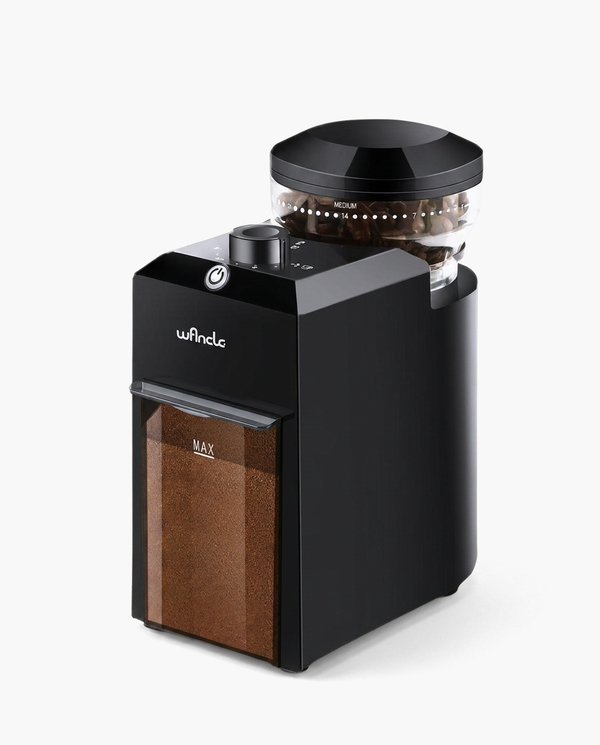
For a straightforward, quiet morning, the Precision Dial Grinder uses a front-facing numbered dial. You turn the collar fine for a moka pot or espresso, push the single button, and the burrs do the rest. The transparent hopper shows your beans, and the removable container catches the grounds up to a MAX fill line. It is a compact machine that fits under low kitchen cabinets.
Baratza Sette 270
Priced around $400, this electric burr grinder is designed for home espresso. It uses a macro and micro adjustment ring system to dial in shots. The straight-through drop mechanism limits retention. The motor is known for being loud, and the interface relies on physical buttons rather than a modern touch screen.
Breville Smart Grinder Pro
At a typical street price of $200, this grinder features a digital LCD screen and 60 step settings. It accommodates a portafilter. The internal chute can trap older grounds, which requires you to purge a few beans each morning to get a fresh dose.
Features That Ruin the Morning Routine
A cheap grinder will cost you bags of ruined coffee. If you want to pull consistent shots without frustration, avoid these common pitfalls when selecting your gear.
- Blade mechanisms: They chop instead of crush. You get boulders and dust in the same batch, leading to severe channeling and sour coffee.
- Wide stepped adjustments: If a grinder only has ten settings, the gap between each click is too large. One setting will choke the machine, and the next will pour too fast.
- High retention chutes: Horizontal grinding paths trap coffee grounds inside the machine. Yesterday's stale coffee ends up in today's fresh shot.
- Flimsy portafilter forks: If the grinder requires you to balance your heavy portafilter on a thin piece of plastic, you will eventually drop it and spill grounds everywhere.
What Makes the Best Coffee Grinder for Espresso
Micro-adjustments and retention
Precision is non-negotiable because espresso is sensitive to minor particle changes. If you mostly use French presses, a wider grind range is fine. For true espresso brewing, tiny adjustments are your steering wheel. Moving the dial by one millimeter can change the extraction time by five seconds.
Static electricity builds up as coffee beans are crushed rapidly. This causes messy clumps to spray across your counter. A high-quality machine utilizes targeted anti-static design, like a concentrated spout, to drop grounds neatly into your portafilter. This keeps your morning routine tidy and ensures all the coffee you grind makes it into the basket.
Low retention designs are equally important. You do not want leftover grounds sitting inside the machine overnight. Stale grounds ruin the taste of fresh beans the next morning. A clean exit path prevents old coffee from ruining your fresh extraction.
Dialing In Your Grind Like a Pro
The golden ratio
Once you unbox your new equipment, learning to refine your beans is a rewarding process. Dialing in means finding the grind size that produces a balanced, sweet shot. A systematic approach prevents wasted beans and morning frustration. You must change only one variable at a time.
Keep your dose locked down. A classic starting point is 18 grams of dry coffee in, yielding 36 grams of liquid espresso out. You want that liquid yield to drop into your cup in roughly 25 to 30 seconds. If your grinder outputs 18 grams in eight seconds, set the Pro Burr Grinder timer to eight seconds and leave it there.
Next, you watch the extraction. If the 36 grams of espresso takes 40 seconds to pour, the water is struggling to get through the puck. You need to adjust your grinder one notch coarser. If the espresso gushes out in 15 seconds, the water is finding no resistance. You need to turn the dial one notch finer. By changing only the grind size, you master your extraction.
PRO TIPAlways run your electric grinder while turning the adjustment collar finer. Adjusting it while stationary can jam the burrs tightly with unground beans.
Keeping Your Espresso Grinder Running
Weekly and monthly habits
A great coffee grinder will start producing bitter shots if old coffee oils accumulate inside. Regular maintenance takes just a few minutes and extends the lifespan of your equipment. A clean grinding path guarantees bright flavors in the cup.
Every week, remove the bean hopper and the upper burr. Use a brush to sweep coffee fines and oils from the burr chamber. This keeps the grind uniform and prevents a stale taste. Different beans leave different oils, so a clean hopper prevents cross-contamination when you switch roasts.
Once a month, disassemble the hopper, burrs, and catch bin. Wash the removable plastic parts with warm soapy water, rinse them, and dry them before reassembling. Never submerge the motor base in water. Use a soft, barely damp cloth to wipe the touch screen, avoiding abrasive sprays that can damage the delicate sensor.
Tuesday morning, rain on the window, and eight seconds on the timer
Tuesday morning, rain on the window, and you lock the portafilter into the vertical stand. You tap the screen, the burrs hum for eight seconds, and the grounds fall clean into the basket. No static spray on the counter, no weighing spoon. You tamp the bed level and pull the lever.
The extraction starts as a slow drip, builds into a steady stream, and stops right at thirty-six grams. The crema is thick, the taste is sweet, and you still have time to drink it before you leave the house.
If you take one thing from this article: espresso is a science of tiny variables, and a burr grinder with a digital timer locks those variables down so you can just drink your coffee.
Frequently Asked Questions
Why can't I use a regular blade grinder for espresso?
Blade appliances chop beans randomly, creating a chaotic mix of huge chunks and fine dust. When water hits this uneven bed under high pressure, it channels through the large gaps immediately.
This channeling leaves your shot tasting sour and bitter. A dedicated burr mechanism ensures uniform particles.
How does the touch-screen timer work?
Set your grind time in seconds on the touch screen, then start. The grinder runs for the time you set and stops on its own, so every dose is repeatable.
What is the vertical Italian stand for?
It holds an espresso portafilter directly under the grinder spout so you grind straight into the basket. No scoop, no spills, less static mess. It fits standard 51 mm and 53 mm portafilters.
How do I know if my grind is too fine?
If your grind is too fine, the water will struggle to push through the densely packed coffee puck. You will notice the espresso dripping out slowly, taking over forty seconds.
The resulting liquid usually tastes harsh, ashy, and over-extracted. Adjust the collar coarser by one notch.
Does it produce a lot of static?
Some, especially in dry winter air. The anti-flying powder design and concentrated spout reduce scatter, and a quick spritz of water on the beans before grinding clears most static cling.