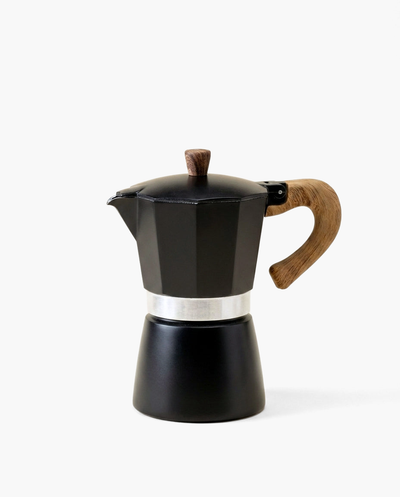
Yes, you can use a moka pot on a glass top stove, and the one on our own radiant cooktop most mornings is the Bottega Wood-Handle Moka. Aluminum pots and stainless pots both brew well on radiant glass. What decides the outcome is a flat, dry base sitting inside the burner ring, medium heat, and lifting the pot straight up instead of sliding it. Induction is the one glass surface that changes the rules.

Our pick
Eight-sided aluminum with a flat base and a wood-grain handle. Brews on glass-top (radiant), gas and electric stoves, not induction. 3 or 6 cup sizes.
See the Bottega MokaCan You Use a Moka Pot on a Glass Top Stove? The Short Answer
Yes. Aluminum and stainless mokas both work on a radiant glass ceramic cooktop, the black surface with painted rings that glow underneath. An element heats the glass, and the hot glass passes that heat into whatever touches it.
Three conditions decide whether the brew is good and the cooktop stays unmarked. The base must be flat, clean and dry. It must sit inside the burner ring, never hanging past its edge onto unheated glass. And the dial stays at medium or a shade below, never high.
The exception is induction, which also looks like black glass but works by magnetic field, and an aluminum moka gives that field nothing to grip. To tell them apart, switch a zone on under a pan of water: a ring that glows red is radiant, a surface that stays dark is induction.
A word of history, because it explains the confusion. Alfonso Bialetti patented the moka pot in 1933, when a narrow aluminum base sat over an open gas crown. Glass ceramic arrived about four decades later, flat and thermostatic, and since the pot never changed the technique had to. For the wider method, see our complete moka pot guide.
Why a Glass Top Stove Brews Differently From Gas
None of this makes a moka pot unsafe, only less forgiving, in three ways.
Contact replaces flame. On gas, heat wraps around the lower chamber. On glass, all of it travels through the disc of metal touching the surface. A domed, scored or crusted base leaves air gaps, and air insulates: one side of the puck scorches, the other stays under-extracted.
The element pulses. A radiant zone holds its setting by switching on and off, which is why the ring glows and fades while you watch. A moka builds pressure steadily and dislikes that rhythm: pressure sags when the element rests, jumps when it fires, and the coffee spits. Hot water and a low dial flatten those swings.
The glass stays hot. Cut the gas and the heat is gone. Cut a radiant ring and the glass holds enough energy to keep cooking your coffee for minutes. Bitterness on a glass top usually starts right there.
Moka Pot Coffee-to-Water Ratio by Size
Aluminum vs Stainless Steel Moka Pots on a Glass Top
Both metals brew on radiant glass. They behave differently once the element starts pulsing, and each asks for a small adjustment.
On radiant glass the metal matters less than the base and your hand on the dial. We brew on aluminum: the Bottega Wood-Handle Moka is painted aluminum, listed for gas, electric and ceramic, and it reaches the cup in about five minutes. Stainless earns its place only if you also brew on induction.

The Moka Pots We Keep on the Glass Top
Bottega Wood-Handle Moka, our first choice for radiant glass
A classic eight-sided Italian moka in painted aluminum, with a wood-grain handle and matching lid knob, in five finishes. Here is why it is the one we put on glass.
- Rated for ceramic. The spec reads gas, electric or ceramic, and not induction. On a radiant glass top that is the right list, stated rather than assumed.
- A cool-touch handle you can trust. The wood-grain handle and knob let you lift the pot straight up instead of fumbling with a folded tea towel, which is when most glass top marks happen.
- Two sizes to match your smallest ring. 150 ml (roughly 3 cups) at 8.9 cm across, or 300 ml (roughly 6 cups) at 9.7 cm across.
- A built-in pressure-release valve. Single-tube extraction, and a valve that matters more on a stove that pulses than on one that burns steadily.
- About five minutes to coffee, on gas, electric or ceramic. Less time on the glass means less residual heat working against you at the end.
Care is specific: warm water and a soft cloth, no soap, every part dried after each brew, gasket included, and a new gasket once a year. If that rhythm suits you, see the Bottega moka in the five finishes.
Capri Speckled Moka, the same brew in a softer key
If the kitchen calls for color, the Capri Speckled Moka is the same eight-sided aluminum shape under a speckled pink enamel, with a wood-look heat-resistant handle. Same stove list, gas, electric and ceramic, not induction, same built-in pressure-release valve, plus SGS, TUV and LFGB certifications. The enamel is hand wash only. Browse the rest in our moka pot collection.
The two Bialettis people compare, honestly
The Bialetti Moka Express, around $40, defined the category: aluminum, eight-sided, safety valve, perfectly usable on radiant glass. Its handle is bakelite rather than cool-touch wood.
The Bialetti Venus, around $60, is stainless with a magnetic base, so it covers induction too. A sound pot, also heavier, slower to pressure, and brighter in the cup than the aluminum profile most people picture. On a radiant cooktop you are paying for a capability you will never use.
Glass Top Habits That Cost You a Cooktop
Four moves to stop making, in order of how much damage they do:
- Sliding the pot across the glass. Dragged aluminum leaves gray marking that looks like a scratch, and sometimes is one. Lift up, place down.
- Heating an empty pot. A radiant surface climbs past 700 F in seconds, and an empty chamber has no water to absorb it.
- Letting the base hang over the ring. Use the ring your pot fits inside, not the big one at the back.
- Parking the pot on the ring afterwards. The glass is still hot and the coffee keeps cooking. Move it to a trivet at the first gurgle.
How to Brew Moka Pot Coffee on a Glass Top Stove
The familiar method, with three adjustments for radiant heat: hot water in, low dial, quick exit.
Step 1, set the grind. Aim between espresso and drip, the texture of fine table salt. Too fine and the pulsing pressure pushes the valve, too coarse and the water runs thin. A burr grinder makes that easy to judge: the Precision Manual Grinder has a dial at the base that runs from fine to coarse, dialed in by feel.
Step 2, fill with hot water. Take the dose from the table above, then fill the lower chamber with water boiled in a kettle, stopping below the valve. Starting hot roughly halves the time the pot spends on the glass, the biggest single gain on an electric stove.
Step 3, assemble and place. Fill the basket, level it with a finger, do not tamp. Wipe the rim so no grounds sit on the gasket, screw the top on firmly, then check the base is dry and center the pot on the smallest ring it fits inside. A cool-touch handle, like the one on the Bottega Wood-Handle Moka, makes this a one-handed move.
Step 4, medium heat and watch. Set the dial to medium or just under, never high, and leave the lid open. You want a slow, honey-thick stream, not a jet. If it spits, drop one notch rather than lifting the pot.
Step 5, leave early. The moment the stream turns pale and gurgles, lift the pot straight up. Run the base under a little cold water to stop extraction, then pour. If you are brewing for two, decant straight away into a warmed carafe, one of the French press carafes works well, rather than letting the pot stand.
Common Moka Pot Problems on a Glass Top, and How to Fix Them
Keeping the Pot, and the Glass Under It, in Good Shape
Run a hand over the underside before every brew. Aluminum is soft, and a pot that has lived on gas grates or taken a drop can carry a burr or a slight dome. The burr scratches, the dome makes the air gap that scorches your coffee. If the base rocks on a worktop, it will not brew evenly on glass.
Inside, keep it simple. Rinse with warm water and a soft cloth, and on bare aluminum skip the soap so the pot builds the coffee patina that rounds out the cup. On an enameled finish, mild soap and a soft sponge are fine. Dry every part, gasket included.
The outside of the base matters just as much: any drip left underneath carbonizes against the glass and leaves a black ring. Clean the cooktop only when it is cool, with a cream made for ceramic glass, and wipe spilled coffee before it bakes on, since sugars can pit the surface.
Nine at night, and one small cup after dinner
The plates are draining, the counter is wiped, and the kitchen has gone quiet in the way it only does after dinner. You fill the pot with hot water, set it on the small ring, and for a few minutes the only light in the room is that orange circle under the black glass. It climbs, it hisses, and the smell reaches the table before the pot does. You lift it by the wooden handle, straight up, no cloth, no fuss, then wipe the glass while it is still warm and pour two short cups. A Wednesday evening, a 1933 design, and ten minutes that belong to nobody else.
If you take one thing from this article: a radiant glass top asks for a flat, dry base, medium heat and a pot you can lift cleanly, and the Bottega Wood-Handle Moka is built for exactly that cooktop.
Frequently Asked Questions
Does a moka pot work on an induction glass stove?
Not if it is aluminum. Induction heats by magnetic field, so an aluminum pot sits there cold. You need a magnetic stainless base, or an adapter plate. Radiant glass ceramic, the kind with rings that glow, has no such requirement.
Will an aluminum moka pot scratch my glass cooktop?
Only if you drag it, or if the base is damaged. Aluminum is softer than glass ceramic, so what it leaves is usually metal marking, a gray smear that lifts off with cooktop cream. Real scratches come from grit or a burred rim.
Why does my coffee taste burnt on a glass stove?
Because the glass keeps working after you turn the dial off. It stores heat and releases it slowly, so a pot left there keeps extracting long after it should have stopped. Take it off at the first gurgle and cool the base under the tap.
What heat setting should I use for a moka pot on an electric stove?
Medium, or one notch below. High heat makes the element cycle in violent bursts, and the pot answers with pressure spikes and spitting. With pre-boiled water, a 6 cup pot gives its first drops in two to three minutes.
Do I need a heat diffuser for a moka pot on a glass top?
No. A diffuser is a fix for gas flames licking past a small base. On radiant glass it only adds a layer between heat and pot. Correct heat, a dry flat base and the right ring do the job better.