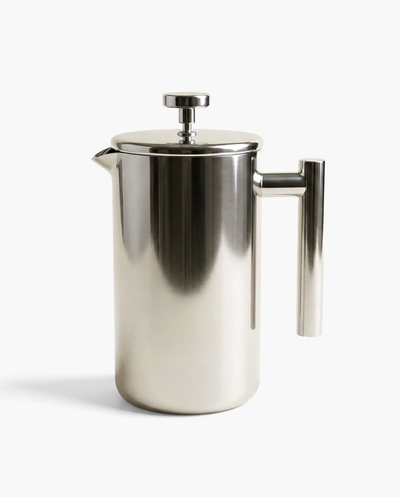
The short answer: an AeroPress is made of polypropylene that is free of BPA and phthalates and approved for food contact, and no published study shows it harming anyone. What nobody has measured is how many microplastic particles it sheds under 93 °C water. If you would rather not wait for that answer, the Signature Stainless Steel French Press brews in double-wall 304 steel, with no plastic in the pot.

Our pick
Double-wall 304 stainless steel body and a stainless mesh filter: steel wherever the hot coffee sits. Three sizes: 350 ml, 800 ml and 1 L.
See the Signature pressIs AeroPress Plastic Safe? What Is Known, and What Is Not
In the regulatory sense, yes. AeroPress states that every material it uses is free of BPA and phthalates, and FDA and EU approved for contact with food. That standard is real. It was also written before anyone counted microplastic particles, and that is where the honest uncertainty sits.
For the wider field of brewers, read our guide to the types of coffee makers.
What an AeroPress is actually made of
It depends on when you bought it: the plastic has changed three times since the 2005 launch.
So the AeroPress black plastic people ask about is polypropylene, the plastic of yogurt tubs.
Does BPA-free plastic still leach chemicals?
You will read that BPA-free brewers simply swap BPA for its cousins, BPS and BPF. That is a fair warning for some hard, clear plastics. It does not apply to polypropylene, which is made without bisphenols of any kind. Retire a pre-2009 AeroPress. For anything newer, bisphenols are the wrong worry.
The right worry is less settled. Like every plastic, polypropylene wears, which brings us to the particles.
AeroPress Microplastics: What Hot Water Does to Polypropylene
No peer-reviewed study has measured microplastics from an AeroPress. Anyone quoting you a number is guessing. What exists is careful work on the same plastic.
In 2020 a Trinity College Dublin team prepared infant formula in polypropylene baby bottles with hot water and counted what came out: 16.2 million particles per liter from the highest-shedding bottle under the standard 70°C preparation, published in Nature Food. Temperature drove the result: release climbed from about 0.6 million particles per liter at 25°C to 55 million at 95°C. The same paper reports that polypropylene kettles and lunchboxes shed at similar levels.
Two caveats. A baby bottle is sterilized and shaken hard, an AeroPress is stirred for ten seconds, so the figures do not transfer directly. And nobody yet knows what dose, if any, harms an adult: the World Health Organization calls the evidence too thin to conclude either way. That is not a verdict of safe. It is a verdict of unmeasured.
What you can act on today: heat and abrasion are the two levers. If you keep your AeroPress, brew at the 80 to 85°C its inventor recommends, wash it with a soft cloth, and replace a chamber gone cloudy or scratched.
Then look upstream: a plastic kettle holds boiling water far longer than any brew chamber does. A glass one such as the Sentinel Glass Kettle, where no plastic touches the water, removes that contact before coffee is involved.
For more on kettles, read our best gooseneck kettle guide.
Is the Black Plastic Itself the Problem?
The black plastic alarm has a specific origin. In late 2024, a study in the journal Chemosphere screened 203 black plastic products, spatulas and sushi trays among them, and found brominated flame retardants in most of the items it analyzed in depth. The likely source: old electronics casings recycled into new goods. The authors later corrected a calculation that had overstated the exposure risk tenfold. The contamination finding stood.
None of that work tested an AeroPress. Its chamber is a tinted, semi-translucent gray, not the opaque carbon black of a recycled spatula. We have no lab data of our own and will not pretend to. For now, color is the weakest part of the case against the AeroPress. Hot water on polypropylene is the stronger one.
Does Stainless Steel Leach Anything Into Coffee?
Stainless steel is an alloy of iron, chromium and nickel. The chromium forms a thin oxide skin that reseals itself when scratched, which is why the metal needs no coating and holds no odors. It carries no plasticizers, stabilizers or colorants, and it cannot shed microplastics for the plain reason that it is not plastic.
Honesty cuts both ways: steel is not perfectly inert. Tests that simmer tomato sauce in new stainless pans for hours find trace nickel and chromium. Coffee is far milder, and it sits in a press for four minutes. Unless you have a diagnosed nickel allergy, that is a footnote.
Grade matters: look for 304, also written 18/8, stated by the maker. Our stainless steel French press is double-wall 304 stainless steel, mirror-polished inside and out, and its filter is a fine stainless mesh over a perforated steel plate, so the coffee meets metal the whole way down. More such brewers sit in our plastic-free brewing options, and the long version of the argument is our guide to the best plastic free French press.
AeroPress plastic safety at a glance

French Press vs AeroPress: Brewing Performance Compared
Material is one axis. The cup is the other: a century-old immersion pot against a 2005 design that steeps briefly, then pushes the coffee through paper by hand.
Neither is better. If you love the AeroPress for its clean, paper-filtered cup, a steel press will taste heavier. An 8 cup French press, the 1 L size, also ends the routine of pressing three times in a row for guests. Compare formats in our French press collection.
The Steel and Glass We Reach For Instead
If the evidence leaves you wanting plastic out of the hot path, this is the bench we would build.
The Signature Stainless Steel French Press: steel wherever the coffee goes
The Signature Stainless Steel French Press is the flagship of our range and the direct answer to this article's question: everything the coffee touches is steel.
- No plastic, no BPA: the body is double-wall 304 stainless steel and the lid is knobbed steel. The spec sheet reads BPA-free and food-grade throughout.
- Hot inside, cool outside: the double wall holds brewing heat without warming the outer surface, and the tubular handle stays cool.
- A two-part filter that keeps the body of the cup: a fine stainless mesh screen backed by a perforated steel press plate. Grounds stay down, oils come through.
- A gauge etched inside: cup and ounce marks inside the body let you pour to the line, familiar ground after the numbers on an AeroPress chamber.
- Three sizes: 350 ml for one or two cups, the closest to the AeroPress habit, 800 ml for two to four, and 1 L for four to six, the classic 8 cup French press format. All pour through an anti-drip spout.
Sentinel Glass Kettle, for the water before it meets the coffee
Many electric kettles put boiling water against polypropylene, the very condition the Dublin study measured. The Sentinel Glass Kettle is high borosilicate glass on a stainless steel base plate, and no plastic touches the water. It boils 1.7 L on 1500 watts and shuts itself off at the boil.
Nomad Press Mug, for the bag your AeroPress used to travel in
The fair objection to a steel press is travel. The Nomad Press Mug is a 450 ml double-wall insulated travel mug with a French press plunger built in and a 304 stainless steel inner liner, so the coffee steeps against steel. With a silicone plunger seal and a flip-top lid, we describe it as steel where the coffee steeps, not as plastic-free.
AeroPress Premium, the AeroPress without the plastic chamber (about $150)
AeroPress answered its critics in 2024 with a version in glass, anodized aluminum and stainless steel. Same clean cup, no polypropylene chamber. It is still one cup per press, glass rules it out of a backpack, and the price sits in the bracket of an insulated steel press that serves the whole table.
Switching From AeroPress to Stainless Steel
Three habits change.
Step 1: Grind coarse and consistent
An AeroPress grind, medium-fine, clogs a press mesh and turns the cup bitter and silty. Go coarse, like sea salt, from a burr grinder, and dose at 1:16. For the three sizes of our Signature press, that gives:
Those are brim figures. If you fill lower, keep the ratio and scale the dose with the water.
Step 2: Preheat the steel
Rinse the press with hot water, empty it, then add the grounds. A warm double wall keeps the brew near temperature for the whole steep.
Step 3: Steep four minutes, then pour it all
Water at about 93°C, a gentle stir, lid on, four minutes. Not the one to two minutes an AeroPress taught you: coarse particles need the time. Press slowly and pour every cup at once, because coffee left on the grounds keeps extracting.
Cleanup: grounds into the compost, warm water, a drop of dish soap, and a rinse of the mesh until it runs clear.
Plastic-Free Claims That Do Not Survive a Closer Look
Read these labels twice before you pay.
- "BPA-free" as the whole answer: the label tells you what is absent, not what is present. Polypropylene was always BPA-free, and it still sheds particles in hot water.
- Glass presses with a plastic lid: the beaker is glass, but the steam and the pour both pass the lid. Turn it over before you buy.
- "Stainless" with no grade stated: unbranded presses rarely say which steel they use. Look for 304 or 18/8 in writing.
- Scouring pads on a plastic brewer: a roughened wall sheds more and holds more oil. Soft cloth only, cooler water, and a new chamber once it clouds.
A four-year-old counts down the steep
Twenty past eight, no school run today. Pajamas, cold tiles, a low January sun coming flat across the counter. She has dragged the step stool over to watch, and she counts the oven clock out loud while the lid stays on and the kitchen starts to smell of toast and dark chocolate. You rest a palm on the press, and the mirror-polished wall is cool under your hand though the coffee inside is not. At four minutes the plunger goes down with a low steel hush, and she announces that it is ready. Two mugs for the grown-ups, warm milk for her. Nowhere in that pot did hot water meet anything but metal, and this morning you did not think about it once.
If you take one thing from this article: the AeroPress is approved, BPA-free plastic and the evidence against it is thin, but hot water on polypropylene is a question science has not closed, and a steel press is the simplest way to stop asking it.
Frequently Asked Questions
Is the AeroPress plastic safe for daily coffee brewing?
By every current food-contact standard, yes. The chamber is polypropylene, made without BPA or phthalates, and no study has linked AeroPress use to a health problem. The unresolved part is microplastics, which those standards do not yet cover. If that matters to you, brew cooler or move to steel or glass.
Does the AeroPress release microplastics into my coffee?
Probably some, and nobody has published how much. Polypropylene sheds particles in hot water in lab tests, reaching 16.2 million per liter from baby bottles prepared at 70°C in a 2020 Nature Food study. An AeroPress holds less water for less time, so its figure is likely lower, but it has not been measured.
Is the AeroPress BPA free?
Yes. Every AeroPress made since August 2009 is BPA-free, and since July 2014 the Original has been polypropylene, a plastic made without bisphenols. Only the first generation, sold until mid 2009, was polycarbonate. If yours is that old, replace it.
Does AeroPress leach plastic in hot water?
Polypropylene is stable at brewing temperatures. What research on the same plastic shows is a release of microscopic particles that grows with heat. Brewing at 80 to 85°C, as the original instructions suggest, is the easy way to reduce it.
Is a stainless French press safer than an AeroPress?
On materials alone, it removes the open question. A press like our Signature stainless press has a double-wall 304 stainless steel body and a stainless mesh filter, so there is no plastic to shed particles. The AeroPress remains within every tested standard and makes a cleaner, lighter cup. Choose steel for peace of mind and volume, the AeroPress for speed and travel.
Related Guides
- The Search for the Best Plastic Free French Press: A Non-Toxic Brewing Guide
- Fellow Clara French Press Review: Is the Matte Black Aesthetic Worth the Price?
- How to Choose a French Press: A 5-Point Buying Guide
- Exploring the History and Evolution of the French Press
- How Long to Steep French Press? The Simple 4-Minute Rule