The standard 3 cup coffee press is the most misunderstood item in the coffee aisle. It sounds like a brewer for a small table, but it actually holds just twelve ounces, exactly enough for one modern mug. If you want a small french press that actually keeps that single serving hot, we reach for the Workshop Insulated Press.
The History of the 3 Cup Coffee Press and Its Confusing Math
The demitasse standard
To understand why a 3 cup coffee press seems so small, you have to look at the origins of European coffee culture. The french press was popularized in a time when coffee was consumed in small, potent doses. In mid century Europe, a standard cup was a demitasse. This small serving was roughly equivalent to four fluid ounces.
When traditional manufacturers label a product as a 3 cup coffee press, they are using this archaic measurement. Three cups multiplied by four ounces equals twelve ounces of total capacity. The math is accurate to the history, but it entirely ignores how people drink coffee today.
The modern mug reality
A standard ceramic coffee mug found in most kitchens holds between ten and twelve ounces. Therefore, a 3 cup coffee press does not hold three mugs of coffee. It holds exactly one standard modern mug. It is the perfect size for a solo drinker, but the labeling causes endless confusion for buyers expecting to serve a small group.
If you buy a small french press to share with a partner at breakfast, you will end up pouring two six ounce portions. The twelve ounce size is a personal brewer, designed to make one fresh mug at a time without wasting expensive beans.
| Marketing Label | Actual Capacity | Real Mugs Served |
|---|---|---|
| 3 Cup | 12 oz | One |
| 4 Cup | 17 oz | One large mug |
| 8 Cup | 34 oz | Three to Four |
The Thermal Failure of Small Glass Brewers
The surface area problem
If we accept that the 3 cup coffee press is actually a french press for one, it should at least brew that single cup well. Unfortunately, the standard glass design fails here due to basic thermodynamics. Brewing a small volume of coffee is much harder than brewing a large liter batch because you have less total heat energy in the water to begin with.
A small glass beaker has a very high surface area relative to the twelve ounces of water inside it. Glass is a poor insulator and a rapid radiator of heat. When you pour near boiling water into a room temperature glass 3 cup coffee press, the water temperature immediately plummets as it transfers heat to warm up the cold glass beaker.
Why temperature matters for extraction
Over the crucial four minute steep time needed for extraction, heat hemorrhages outwards into the room. Coffee needs water between 195 and 205 degrees Fahrenheit to properly dissolve the rich oils and sweet compounds in the grounds. If the water cools too much during the steep, the extraction slows down.
The result is a sour, under extracted cup of coffee. Worse still, by the time you press the plunger and pour the coffee into your mug, the liquid is already lukewarm. This is why a small french press requires insulation to do its job properly. A Workshop Insulated Press solves this by trapping the heat inside a vacuum layer.
The Gear That Makes a Small Press Work
1. Workshop Insulated Press
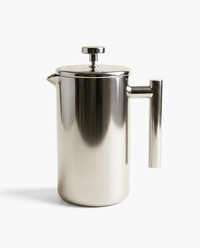
The Workshop Insulated Press treats a single serving with the same thermal respect as a large batch. It is built from double-walled stainless steel with a vacuum layer that slows heat loss.
- Vacuum insulation: Keeps the brew at drinking temperature for 60 to 90 minutes.
- Honest sizing: Available in a 12 oz size for one mug, or a 27 oz size for two.
- Clean pour: A two-stage fine stainless mesh filter keeps the silt out of your mug.
- Smooth action: The plunger comes down without resistance, and the spout pours clean.
- Daily durability: The brushed stainless finish forgives soap and does not crack if dropped.
2. The Signature Stainless Steel French Press
If you prefer a bright finish, The Signature Stainless Steel French Press offers double-wall 304 stainless steel with a mirror-polished exterior. It features an etched cup and ounce gauge inside the body so you can pour exactly twelve ounces without a scale. The two-part plunger pairs a fine stainless mesh screen with a perforated press plate to hold the grounds down while letting the coffee oils through.
3. Walnut Glass Press
For those who want to watch the brew color develop, the Walnut Glass Press offers a double-wall heat-resistant glass carafe. The air gap between the walls keeps the coffee warm 15 to 20 minutes longer than single-wall glass, while the exterior stays cool to the touch. It features a rosewood lid and comes in a 12 oz size that is perfect for a slow morning.
4. Bodum Chambord 3-Cup
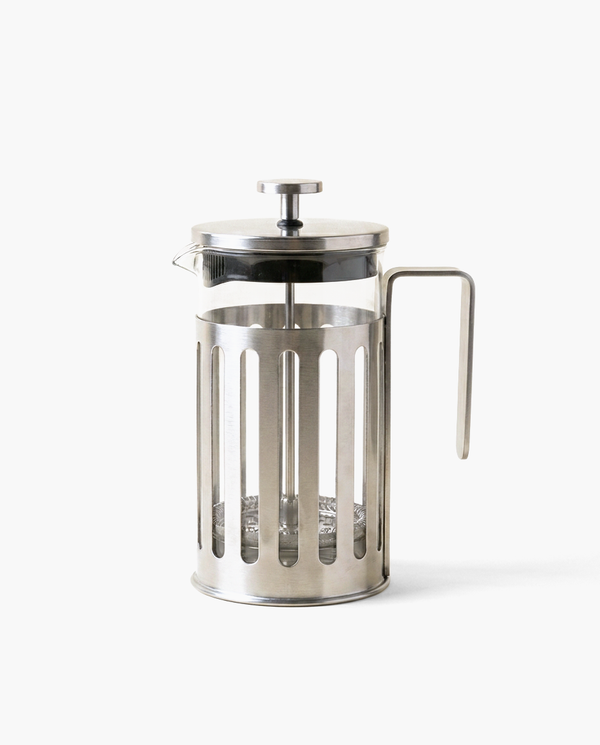
A classic design that usually costs around $40, the Bodum Chambord uses a single-wall borosilicate glass beaker set in a steel frame. It has a traditional look, but the thin glass loses heat rapidly during the steep. For a small twelve ounce serving, an insulated steel press does a better job of keeping the water at extraction temperature for the full four minutes.
How to Brew the Perfect Twelve Ounce Batch
The golden ratio for a single mug
Brewing small volumes requires precision. A little too much coffee or too little water drastically changes the flavor profile in a 3 cup coffee press. A safe place to start is a 1:16 ratio by weight, meaning one part coffee to sixteen parts water.
For a twelve ounce press, measure out 21 grams of whole bean coffee (about 0.75 ounces). You will need 12 fluid ounces of water (roughly 350 grams). This ratio provides a strong, full bodied cup without crossing into overwhelming bitterness.
The critical coarse grind
Because the brewing vessel is narrow, the plunge can be difficult if the grind is wrong. You must use a coarse grind, similar in texture to sea salt. Fine powder from a cheap blade coffee grinder will clog the mesh filter and create dangerous resistance when you push down. A coarse grind keeps the cup clean and allows the extraction to happen evenly over four minutes.
Water temperature and the bloom
Bring your kettle to a boil, then let it sit for ten seconds so the water settles to around 200 degrees Fahrenheit. Add your 21 grams of coarse grounds to the empty Workshop Insulated Press. Pour just enough hot water to wet the grounds and wait thirty seconds. This lets the coffee degas, blooming up as the trapped carbon dioxide escapes.
The four minute steep and the plunge
Pour the remaining water slowly in a circular motion until you reach the twelve ounce mark. Place the lid on to retain heat, but do not press the plunger yet. Set a timer for exactly four minutes. When the time is up, press down gently with steady, even pressure. Pour immediately into your favorite mug.
Mistakes That Ruin a Single Serving
A twelve ounce batch leaves no room for error. Avoid these common habits to keep your morning cup tasting right.
- Using fine grinds: Pre-ground grocery store coffee is sized for drip machines. It will clog the fine mesh of a small press, push silt into your cup, and make the plunger dangerously hard to press.
- Pouring boiling water: Water straight off a rolling boil extracts harsh, bitter compounds from the roast. Let the kettle sit for a few seconds before pouring.
- Leaving coffee on the grounds: The extraction does not stop when you push the plunger down. If you leave brewed coffee sitting on the compressed grounds, it will turn bitter. Pour the entire mug as soon as the four minutes are up.
- Stovetop heating: A french press is a brewer, not a cooker. Do not put a glass or vacuum insulated press on a stove. The direct heat will shatter the glass or ruin the vacuum seal of a steel model.
Maintenance and Longevity for a Small Press
Daily rinsing
Small glass beakers are notoriously difficult to wash by hand because a sponge barely fits inside, and they become slippery with soap. The Workshop Insulated Press makes this easier. The stainless steel forgives soap, and a daily rinse with warm water and a soft sponge is all it takes. The grounds rinse off the mesh easily when they are fresh.
Weekly deep clean
Trapped grounds dull the brew over time. Once a week, disassemble the filter screen, brush the mesh, rinse, and dry. The parts are dishwasher safe on the top rack after disassembly, though hand washing preserves the brushed finish longer. When you put the press away, store it with the plunger up, away from the bottom of the carafe.
Tuesday morning, frost on the windowpane, and a quiet kitchen before the news comes on
You measure out the beans, pour the water, and let the small steel press sit on the counter while the rest of the house sleeps. Four minutes later, the plunger glides down with zero resistance. You pour a single twelve ounce mug. The steam rises against the cold glass of the window, and because the double steel walls held the heat through the whole steep, the second half of the cup is just as hot as the first sip.
If you take one thing from this article: a 3 cup coffee press is really just a brewer for one, and a single serving needs double-wall insulation to survive the steep.
Frequently Asked Questions (FAQ)
How many ounces are actually in a 3 cup coffee press?
A standard 3 cup coffee press holds twelve fluid ounces, which is roughly 350 milliliters. This naming convention is based on small four ounce European demitasse cups, not modern coffee mugs.
Is a 3 cup french press enough for two people?
Generally, no. Because a 3 cup french press only holds twelve ounces total, splitting it between two people results in two small six ounce servings. Most modern coffee drinkers prefer a mug size of ten ounces or more.
Why does coffee get cold so quickly in my small glass press?
Small volumes of liquid lose heat faster than large volumes. Furthermore, glass is a poor insulator. A glass 3 cup coffee press radiates heat rapidly, meaning your brew temperature drops quickly during the steep and cools fast once poured.
How much coffee grounds should I use for a 3 cup press?
For a standard twelve ounce capacity press, we recommend using a 1:16 ratio, which is 21 grams of coarse ground coffee to 350 grams of water.
What is the best alternative to a glass 3 cup coffee press?
The best alternative is a double-walled stainless steel press in the same twelve ounce size. It provides the perfect single serving volume but adds vacuum insulation to keep the coffee hot during the steep, and it does not crack if dropped.