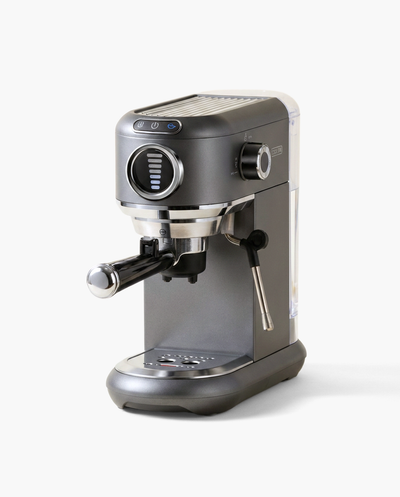
Building an espresso setup for beginners usually means choosing between an appliance that makes weak coffee and a commercial machine that requires a second mortgage. The middle ground is a machine that controls the temperature and pressure for you while you learn the grind. We keep the Capri Espresso Station on our counter because it pulls a café-strength shot in thirty seconds without asking you to be a technician.
How to Choose an Espresso Machine for Beginners
The truth is that building a beginner espresso setup is not about buying the most expensive machine with the most chrome plating. It is about precision, consistency, and understanding the variables of extraction. Many beginners blow their budget on a massive dual-boiler machine and neglect the fundamental components of temperature stability and workflow. If you want to transform your morning ritual immediately, you need tools that forgive your early mistakes while teaching you the right technique.
The gear that makes a beginner setup work
1. The Capri Espresso Station
The Capri Espresso Station is the espresso machine that earns its counter space. It pairs a compact body with the internal hardware needed to extract a proper shot, taking the guesswork out of temperature management.
- 19-bar pump: Generates more than enough pressure at the source to ensure a standard 9-bar extraction at the puck.
- PID temperature control: Holds a constant 197 degrees Fahrenheit extraction temperature, so your coffee does not taste burnt or sour from heat fluctuations.
- Dual extraction modes: Seven levels of automatic volume adjustment for quick mornings, plus a manual mode for dialing in new beans.
- Capsule compatibility: Includes inserts for ground coffee, ESE pods, Nespresso-compatible capsules, and Dolce Gusto-compatible capsules.
- Professional steam wand: A 360-degree swivel wand with a separate dial to texture microfoam for latte art.
2. The Verona Bottomless Portafilter
A spouted portafilter hides your mistakes until you taste them. The Verona Bottomless Portafilter removes the spout so you can watch the extraction happen in real time. It is a 58mm E61-compatible tool with a solid wood handle and a 304 stainless steel naked basket.
It comes in a magnetic gift box with a dosing funnel to keep your counter clean, a spare double-wall basket, and a retaining spring. If your puck is uneven or your grind is wrong, this portafilter shows you the channeling immediately.
3. The Workshop Brew Scale
You cannot replicate a good shot if you do not know how much coffee went in and how much liquid came out. The Workshop Brew Scale offers 0.1g precision and a built-in timer on an LED backlit display. It holds up to 3000g and features a removable silicone pad that is waterproof and non-slip. Press start to begin the timer while weighing, and track your total brew duration without reaching for your phone.
4. Breville Bambino Plus
Priced around $500, this is a popular entry-level appliance. It features an automatic milk frother and a very fast heat-up time. It is capable for hands-off milk drinks, but it relies on a proprietary 54mm portafilter size. This limits your ability to upgrade baskets or use standard commercial accessories. The Capri gives you manual steam control to learn real texture, and it works with ground coffee, ESE pods and NS or DG capsules.
5. Gaggia Classic Pro
Priced around $450, this machine is a traditional single-boiler unit with a commercial 58mm group head. It is a traditional machine, but it relies on a mechanical thermostat. To get the temperature right, you have to learn a tedious process called temperature surfing, flushing water and timing the boiler light. The Capri solves this entirely with a built-in PID thermostat that holds the water exactly at 197 degrees.
History: The Evolution of the Home Espresso Setup
To understand what makes a beginner espresso setup effective today, we have to look at where we started. The quest for espresso, literally pressed out coffee, began in the late nineteenth century in Italy. Inventors like Angelo Moriondo and Luigi Bezzera sought to reduce brewing time to accommodate busy workers. However, these early machines relied on steam pressure, which often scorched the beans and resulted in a bitter, burnt flavor profile.
It was not until the mid-twentieth century that the lever-driven machine introduced the high-pressure extraction that defines modern espresso. This pressure emulsified the coffee oils, creating the crema that is now the hallmark of a good shot. For decades, this technology was massive, expensive, and exclusively commercial.
In the 1970s and 1980s, the market saw the introduction of the home espresso setup. Suddenly, the ability to create pressure was miniaturized. Early home machines were often underpowered or relied on steam toys that mimicked the bitter failures of the nineteenth century. Today, the landscape has shifted.
We now have access to affordable pumps and precise thermostats that can replicate commercial extraction. Understanding this history helps us appreciate that the gear we choose for the best home espresso setup must prioritize pressure stability and thermal consistency.
The Golden Ratio Table
| Portafilter Basket Size | Coffee (Grams) | Water (ml) | Brew Time | Output (approx) |
|---|---|---|---|---|
| Single Basket | 7g, 9g | 25ml, 30ml | 20-25 secs | 14ml, 18ml |
| Double Basket | 18g, 20g | 60ml | 25-30 secs | 36ml, 40ml |
| Triple Basket | 21g, 22g | 75ml | 30-35 secs | 45ml, 50ml |
| Moka Pot (3 Cup) | 15g, 17g | 150ml | 3-4 mins | 120ml |
The Science: Why Grind Consistency Matters
If you are struggling with your current brewing method, the culprit is almost certainly channeling. This is a phenomenon where water, under pressure, finds the path of least resistance through your coffee puck. Instead of flowing evenly through all the coffee, the water drills a hole through one weak spot. This results in a cup that is simultaneously sour from under-extraction and bitter from over-extraction.
Why does this happen? Usually, it is because of inconsistent grind size. Most entry-level blade grinders produce boulders and fine dust in the same batch. The dust clogs the filter, while the large chunks let water rush past without extracting flavor. Particle uniformity is the single biggest factor in flavor clarity. You can browse our coffee grinders to find burr sets that shave beans to a uniform size without generating flavor-destroying heat.
Step-by-Step Guide: The Perfect Brew
Creating the perfect shot is a ritual. It requires patience and the right process. Follow these steps to maximize your beginner espresso setup.
Step 1: The Precision Grind
Your brew starts here. Set your grinder to a fine setting, similar to table salt. Turn on your Workshop Brew Scale and weigh your beans. Eighteen grams is the standard for a double shot. Grind steadily. If you use a manual grinder, the slow action prevents heat buildup, preserving the volatile oils in the coffee.
Step 2: Prep and Tamp
Place the dosing funnel over your Verona Bottomless Portafilter basket and pour in the grounds. Remove the funnel and use your finger to level the bed of coffee so it is flat. Use a tamper to apply even pressure. The goal is to create a compact, level puck that resists the water pressure evenly. If the bed is slanted, the water will channel to one side.
Step 3: The Extraction
Lock the portafilter into the Capri Espresso Station. Place your cup and scale on the removable drip tray. Press the manual extraction button. You are looking for a flow that resembles warm honey. If it gushes out like a faucet, your grind was too coarse. If it drips slowly or not at all, your grind was too fine. Aim for 25 to 30 seconds of brew time.
Step 4: Texturing the Milk
If you are making a latte or cappuccino, the milk texture is as important as the coffee. The Capri features a professional 360-degree swivel wand. Use cold whole milk, submerge the tip just below the surface, and turn the dial. Swirl the pitcher until it is too hot to hold, around 150 degrees. You can read our guide on the best milk for latte to refine your pouring technique.
Mistakes that ruin the beginner cup
- Pre-ground coffee: Espresso requires micro-adjustments to the grind size based on the specific bean and humidity. Pre-ground coffee is typically stale and usually too coarse, resulting in a watery shot.
- Tap water without a filter: High mineral content accelerates scale buildup and clogs the internals. Filtered water extends the life of your equipment and tastes cleaner.
- Ignoring the scale: Guessing your dose leads to unpredictable extraction. If you put 17 grams in today and 19 grams in tomorrow, the water resistance changes entirely.
- Tamping too hard: Thirty pounds of pressure is the standard, but consistency matters more than force. Tamping with all your body weight crushes the puck and chokes the machine.
Troubleshooting Table
| Problem | Cause | Fix |
|---|---|---|
| Sour / Acidic Taste | Under-extraction (water moved too fast) | Grind finer. |
| Bitter / Dry Taste | Over-extraction (water moved too slow) | Grind coarser. |
| Watery Shot | Dose too low or beans too old | Increase coffee dose (up to 20g) or buy fresh beans. |
| No Crema | Stale beans | Use beans roasted within the last 30 days. |
Maintenance
A great home espresso setup is only as good as its cleanliness. Coffee oils are rancid. If you leave old residue in your portafilter or basket, it will taint every subsequent cup with a funky, stale flavor. The Capri Espresso Station requires two things to live a long life: clean water going in, and no scale building up inside.
After every session, run a blank shot through the portafilter and purge the steam wand for three seconds. Wipe the wand tip with a damp cloth immediately, because dried milk acts like cement. Once a week, remove the portafilter basket, insert a blind filter, add a pinch of espresso machine cleaner, and run the brew cycle three times.
This backflush pushes old oils out of the group head. Every month, use a commercial descaling solution or a mix of water and white vinegar. Run it through the brew and steam system, then flush with two full tanks of fresh water from the 37 oz reservoir.
Saturday morning, just past eight, and the first shot pulls clean
It is Saturday morning, the kitchen still dark, heavy rain against the window. You weigh the beans on the Workshop scale, lock the Verona bottomless portafilter in, and press the Capri's single button. The 19-bar pump engages, and you watch the naked extraction form a dark, thick stream, turning blonde right at the thirty-second mark.
The PID thermostat ensures the crema is thick enough to hold a spoon. You use the 360-degree swivel wand to steam the milk to a wet paint microfoam, pour a simple heart, and carry the cup to the table. The coffee tastes like chocolate and hazelnut, not ash. There is no line, no paper cup, and no rush.
If you take one thing from this article: an espresso machine should manage the temperature and pressure for you, so you can spend your morning enjoying the coffee instead of fighting the equipment.
Frequently Asked Questions
What is the most important part of a beginner espresso setup?
The grinder is the most critical component. Without a consistent grind size, you cannot achieve even extraction, regardless of how expensive your espresso machine is. A high-quality burr grinder that shaves the beans uniformly is essential.
How much does a good beginner espresso setup cost?
You can build a high-quality manual setup for under $150 if you utilize a manual grinder and a manual brewing method like a Moka Pot. Semi-automatic electric setups that offer genuine pump pressure and temperature control typically start around $500 to $700.
Can I use regular coffee beans for espresso?
Yes. Espresso beans are coffee beans roasted slightly darker to reduce acidity and increase solubility. However, you can use any roast for espresso. Medium roasts are often preferred for a more complex, balanced flavor profile.
Why is my espresso shot sour?
Sourness usually indicates under-extraction. This means the water passed through the coffee too quickly or the water was not hot enough. Try grinding your beans finer to slow down the flow and increase contact time.
Is a manual grinder better than an electric one?
For the price, yes. A basic manual grinder often produces a grind quality comparable to a mid-range electric grinder because you are paying entirely for the burrs, not the motor or the electronics.