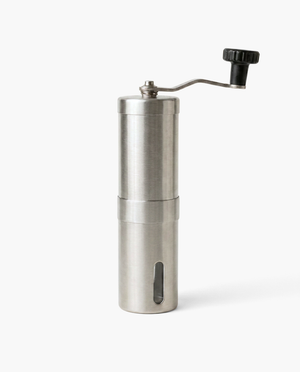
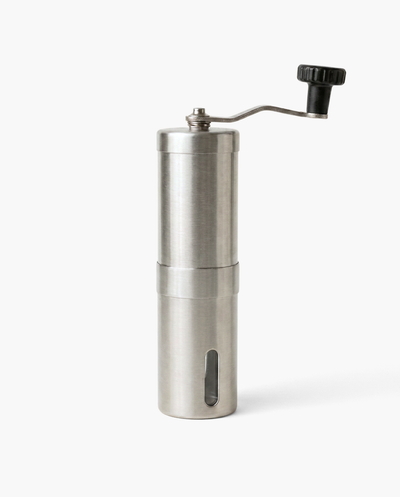
The best coarse ground coffee for French press is not something you buy pre-ground. It is whole beans crushed fresh to the size of kosher salt, right before you brew, on a grinder that holds a true coarse setting. We reach for the Precision Manual Grinder because a conical burr crushes every bean to an even size instead of chopping it.
Why a French Press Needs a Coarse, Even Grind
Steeping coarse grounds in hot water is not a new idea. The metal mesh screens used in mid-19th-century France could not hold back anything but the largest particles, so a fine grind simply passed straight through and ruined the cup. The design changed over the decades, the version most kitchens use today traces to a 1929 patent, but the reason for a coarse grind never did.
A French press steeps for about four minutes, far longer than a drip machine or an espresso shot gets. That long contact time is exactly why the grind has to be coarse: fine particles release their compounds fast, and by the four-minute mark they have gone past sweet and into bitter. Coarse particles extract slowly and evenly, so the cup stays balanced for the whole steep instead of turning on you halfway through.
What Coarse Actually Looks Like
Coarse means kosher salt or coarse breadcrumbs, not sand and not gravel. Espresso grind is closer to table salt. A drip or pour-over grind sits between the two, fine enough to slip through a French press mesh screen and leave sediment in the bottom of the cup. If you can still see individual, chunky particles when you tip the grounds into your palm, you are in the right range.
The French Press Ratio and Grind Size Table
Grind size sets the texture. Ratio sets the strength. Use roughly 1 part coffee to 15 parts water by weight and scale it to the size of your press. For the fuller math behind that number, see our 32-ounce ratio guide.
| French Press Size | Coffee | Water | Steep Time | Yield (approx) |
|---|---|---|---|---|
| 3 Cup (Small) | 23 to 25 g | 350 ml | 4 min | 300 ml |
| 4 Cup (Standard) | 33 to 35 g | 500 ml | 4 min | 420 ml |
| 8 Cup (Large) | 53 to 55 g | 800 ml | 4 min | 710 ml |
| 12 Cup (Party) | 67 to 70 g | 1000 ml | 4 min | 890 ml |
Brewing for a table rather than a mug changes the math further out than this. If you regularly brew for a group, our guide to the 64 oz French press covers the larger sizes.
Why Pre-Ground and Blade-Chopped Coffee Fail
Grinding a bean multiplies its surface area. The moment that happens, CO2 starts escaping and oxygen starts moving in, and the flavor compounds that make coffee worth drinking begin to fade within minutes, not days. A bag of pre-ground coffee has already lost most of its aroma before it reaches your cupboard.
The bigger problem for a French press is particle consistency. A blade grinder chops beans unevenly, a spinning blade against falling beans, so one pulse produces a mix of fine dust and half-cracked boulders. Coffee consultant Scott Rao makes the same point: the dust extracts almost instantly and turns bitter, while the boulders barely extract at all and taste sour, and a French press ends up with both problems in the same cup.
The mesh screen in a French press only stops particles above roughly 300 microns. Most pre-ground and supermarket coffee is milled for drip machines, well below that line, which is why it slips through and leaves grit in your last sip. The Precision Manual Grinder uses a conical burr instead of a blade, crushing every bean to close to the same size, so the grounds stay above the mesh line and the cup stays clean.
If you brew pour-over on other mornings, the grind rules change again, our guide to the best chemex coffee grinder covers that setting.
How to Brew Coarse-Ground Coffee in a French Press, Step by Step
The ratio table above sets your dose. Here is the rest of the brew, five steps, about six minutes start to finish.
Step 1: The Grind
Set your grinder to its coarsest setting, kosher salt or coarse breadcrumbs. Grind just before you brew, pre-ground coffee starts losing aroma the moment it is cut. A manual burr grinder makes this repeatable, because a conical burr crushes every bean to close to the same size instead of chopping it at random.
Step 2: Water and Temperature
Bring water to a boil, then let it rest about 45 seconds. You want roughly 200°F (93°C). Water straight off a rolling boil, 212°F, will scorch the grounds and push the cup toward an ashy, flat taste.
Step 3: The Bloom
Pour just enough water to wet the grounds, about twice the weight of the coffee, and stir gently. You will see bubbles rise as CO2 escapes, this is the bloom. Give it 30 seconds before adding the rest of the water. Skipping it is the fastest way to an uneven extraction.
For a deep dive, read our complete pour over guide.
Step 4: The Steep
Pour the rest of the water in a slow circle, set the lid on top without pressing the plunger down, and start a timer for four minutes. The lid holds heat in while the grounds do their work.
Step 5: The Plunge and Pour
Press the plunger down slowly and evenly. Heavy resistance means your grind is too fine, the plunger dropping with almost no resistance means it is too coarse. Pour right away and decant the whole pot, grounds left under liquid keep giving up bitterness for as long as they sit.
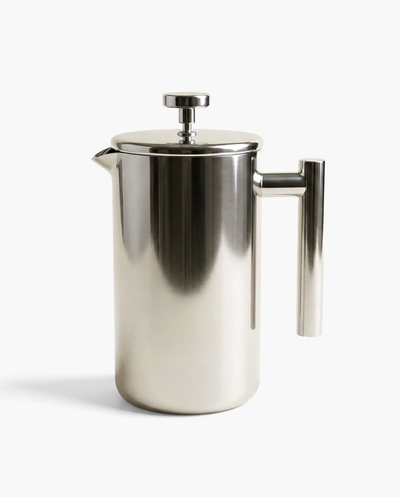
Our own Signature Stainless Steel French Press keeps that first pour hot without forcing you to rush, thanks to the double-wall steel and a fine mesh screen that holds back a properly coarse grind without letting sediment through.
Fixing a Sour, Bitter, or Gritty Cup
| Problem | Cause | Fix |
|---|---|---|
| Sour, acidic taste | Under-extraction, grind too coarse | Adjust the grinder one notch finer, or steep 30 seconds longer |
| Bitter, dry taste | Over-extraction, grind too fine | Adjust the grinder coarser, or lower the water temperature |
| Hard to plunge | Too many fines clogging the mesh | Your grinder is producing dust, switch to a burr grinder |
| Watery, weak | Incorrect ratio | Use the 1 to 15 ratio and add more coffee next time |
| Sediment in the cup | Grind too fine or inconsistent | Use a coarser setting and pour slowly, leaving the last half inch in the pot |
What It Takes to Land on 800 Microns Every Morning
Two things decide whether you land in that 800 to 1,000 micron window every time: a grinder that holds a coarse setting, and a press with a mesh tight enough to catch what a coarse grind still lets through. Here is what we reach for, and what else is worth knowing about, drawn in part from our French press collection.
Precision Manual Grinder
A conical burr in a brushed stainless body, dialed by hand at the base.
- Burr-ground, not blade-chopped: a conical burr crushes every bean to close to the same size, so the cup does not carry both bitterness and sourness at once.
- One grinder, every setting: the dial at the base moves from espresso-fine to French press coarse, so you are not keeping a second grinder for pour-over mornings.
- Goes wherever you brew: the crank folds flat and lifts off, and the slim steel body slips into a bag for a cabin or a campsite.
- No motor, no whine: it is a hand crank, so you can grind a cup at 6 a.m. without waking anyone else in the house.
- Built to outlast a plastic hopper: the stainless body will not rust or hold odors.
Signature Stainless Steel French Press
The grinder gets you the right particle size, the press decides whether that size stays in the pot or ends up in your cup. This one pairs a fine stainless mesh screen with a perforated steel plate, so even a properly coarse grind stays down while the oils that give French press its body come through.
Double-wall 304 stainless steel keeps the coffee hot and the outside cool to the touch, and it comes in three sizes, 12, 27, and 34 ounces, so the ratio table above maps directly onto what is on your counter.
Hario Skerton Pro (around $60)
A fair comparison: a manual conical burr grinder for around $60, and it does grind coarse enough for a French press. What it does not have is a steel body, the housing around the burr is plastic rather than steel. A steel body is what won't rust or hold odors after years of daily use.
Grinds That Ruin a French Press Before You Pour
- Pre-ground bags for drip machines: most are milled fine, well under the 300 micron line a French press mesh needs, so they slip through and leave sediment.
- A blade grinder set to coarse: pulsing longer does not fix the problem, it just gives you bigger boulders next to the same fine dust.
- Coffee ground days in advance: the surface area is already exposed to air, so even a perfect coarse grind starts losing aroma within minutes of being cut.
- A metal spoon in a glass beaker: it can chip the glass over time and cause a crack you will not notice until hot water is already inside, stick to wood, plastic, or a steel press body.
- Guessing the ratio: too little coffee for the water gives a thin, watery cup no matter how good the grind is.
At the Cabin, and the Only Sound Is the Burrs
The cabin is quiet except for the wind in the trees outside, and nobody else is up yet. You measure the beans by feel now, tip them into the hopper, and turn the crank in slow, even pulls. There is no motor to announce what you are doing, just the dry, steady crunch of the burrs working through the beans and the smell that rises a few seconds later, toasted, a little sweet.
By the time the kettle clicks off, the grounds behind the viewing window look exactly like kosher salt. You pour, wait four minutes, plunge, and the first cup of the morning is ready before anyone else is out of bed.
If you take one thing from this article: coarse means kosher salt, not sand, and a burr grinder is the only reliable way to land there, morning after morning.
Frequently Asked Questions
What is the best grind size for French press coffee?
Aim for roughly 800 to 1,000 microns, about the size of kosher salt or coarse breadcrumbs. That range is coarse enough to stay above the mesh screen and slow enough to extract evenly over a four-minute steep.
Can I use regular ground coffee in a French press?
You can, but most bagged coffee is ground for drip machines, which is too fine for a French press mesh. It will slip through the screen and leave sediment, and it tends to taste bitter because the fine particles over-extract during the long steep.
Why does my French press coffee taste muddy?
Muddy usually means fines, the dust a blade grinder or a stale pre-ground bag leaves behind. A burr grinder crushes beans to a uniform size instead of chopping them at random, which is the fastest fix.
How long should I grind beans for a French press?
With a burr grinder you set a coarseness, not a time, turn the dial to its coarsest mark and grind until the hopper is empty. If you are stuck with a blade grinder, pulse in short bursts and shake between pulses, though the result will still be less even than a burr grind.
What roast works best for French press?
Medium to dark roasts tend to suit French press well, they carry more surface oil and dissolve a little more readily, which pairs naturally with the immersion method's heavier body. Lighter roasts can work too, just watch for sourness and dial the grind slightly finer if that happens.
How do I store coffee beans so they stay fresh for grinding?
Keep whole beans in an airtight container, away from light and heat, and grind only what you need right before brewing. A cool, dark cupboard works better than the fridge, which introduces moisture every time you open the lid.
Related Guides
- The Perfect French Press Coffee Ratio : A Simple Home Guide
- 32 Ounce French Press How Much Coffee: The Ultimate Ratio Guide
- The Ultimate Guide to the 64 oz French Press (Coffee Pot) for Group Brewing
- How to Choose a French Press: A 5-Point Buying Guide
- Bodum French Press Instructions: A Step-by-Step Brew Guide